










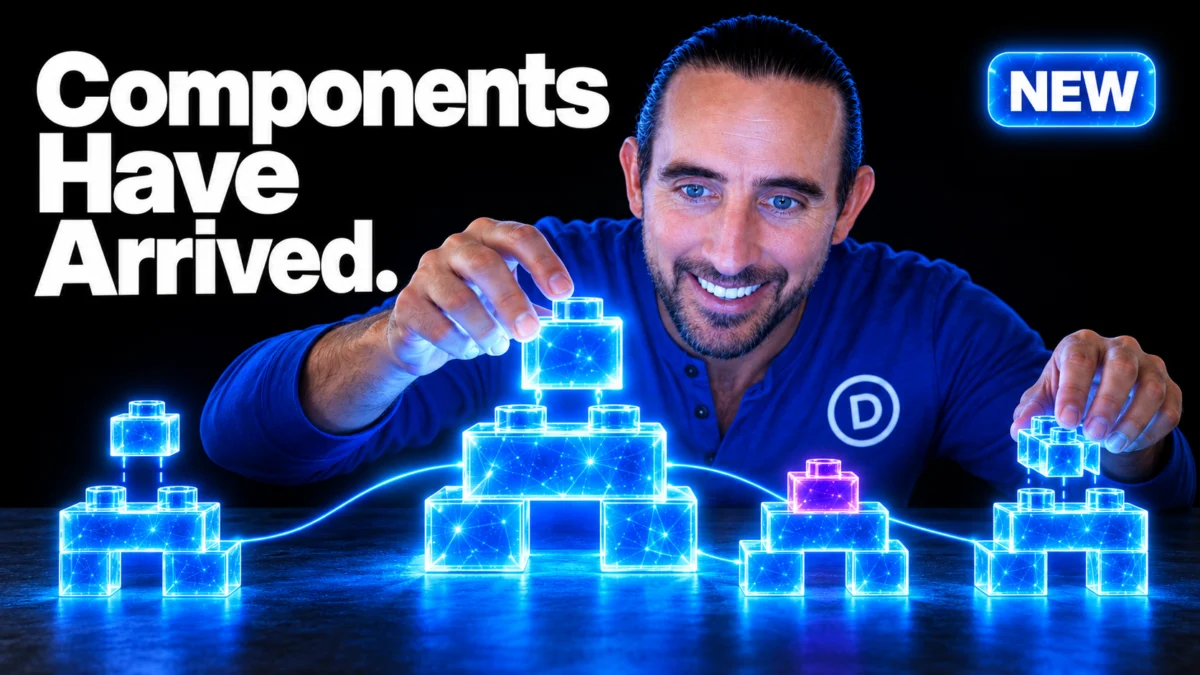
The landscape of professional web development is witnessing a seismic shift with the latest update to Divi 5. Elegant Themes has officially rolled out "Components and Slots," a sophisticated architectural framework that redefines how designers and developers approach reusable design systems. This update, heralded by the development team as the most significant leap forward since the introduction of Variables and Presets, provides a granular level of control that bridges the gap between global design consistency and the need for localized, page-specific customization.
The Main Facts: What Are Components and Slots?
At its core, the Components and Slots system is the next evolutionary step for Divi’s Global Elements. For nearly a decade, Global Elements allowed users to sync design changes across multiple pages. However, the new Components system elevates this capability by introducing "Selective Sync" and "Slots."
Components function as master design units. When a user updates a master Component, all connected instances across the website update automatically. The innovation lies in the user’s ability to "detach" specific attributes—such as typography, spacing, or content—at the instance level. This means a developer can maintain a globally synchronized layout structure while allowing individual pages to feature unique content or specific styling tweaks.
Slots, on the other hand, represent a breakthrough in layout flexibility. A Slot acts as a dedicated, free-form placeholder within a Component. While the surrounding design remains locked to the global master, the content within the Slot can be entirely unique to that instance. This allows for complex, modular page builds where consistency and creativity coexist.
A Chronology of Innovation: From Global Elements to Components
To understand the magnitude of this update, one must look at the trajectory of the Divi ecosystem:
- The Early Years (Pre-2015): The era of static building where every element was independent, leading to massive maintenance overhead for large-scale websites.
- The Era of Global Elements (2015–2023): Divi introduced basic synchronization, allowing users to save elements to a library and sync them. While revolutionary, this system often suffered from "all-or-nothing" limitations—if you wanted to change one word in a global footer, you often had to detach the entire element, losing the connection to the source.
- The Rise of Systematization (2024): The introduction of Variables and Presets allowed for standardized design tokens (colors, fonts) and element styles.
- The Present (2026): The launch of Components and Slots. This completes the "Design System" triad by providing the structural container that holds variables and presets together, offering a professional-grade workflow for enterprise-level web development.
Supporting Data and Technical Architecture
The architecture behind Components is designed for performance and scalability. Unlike previous iterations that required significant browser processing to render synced elements, Divi 5 utilizes an intelligent pre-loading mechanism.
Performance Benchmarks
- Optimized Rendering: Components are fetched by the Visual Builder before the page renders, eliminating the "flicker" associated with loading synchronized global content.
- Intelligent Pre-caching: The builder automatically caches up to 50 recently modified components. This ensures that as a developer drags and drops items from the library, the interaction is nearly instantaneous.
- Nested Hierarchy: Components can now contain other Components. This recursive capability allows for the creation of complex UI libraries, where a "Global Header" component might house a "Logo" component, a "Navigation" component, and an "Announcement" component.
Implications for the Industry: Scalability and Workflow
The implications of this update for agencies and freelance web professionals are profound. In a standard agency environment, managing a site with 50+ pages requires extreme discipline. If a client requests a change to the typography of a specific call-to-action (CTA) module, doing so manually across dozens of pages is a high-risk task prone to human error.
With the new system, a developer can update the master Component once, and the change propagates across the entire site in seconds. Simultaneously, if one specific page requires a different CTA text, the "Selective Sync" feature ensures that only the text attribute is overridden, while the design, padding, and layout structure remain tied to the global master.
Furthermore, the integration with the Divi AI Agent creates a symbiotic relationship between machine learning and design. The AI can now perform complex tasks like:
- Identifying repetitive modules on a page and suggesting they be converted into a single Component.
- Executing bulk updates to Component attributes.
- Managing the "detachment" of specific parameters based on natural language prompts (e.g., "Make this testimonial’s photo local to this page but keep the font global").
Official Perspectives and User Experience
In their official release, the Elegant Themes engineering team emphasized that this update was not just about adding features, but about creating a "first-class citizen" experience for the builder. By providing a dedicated "Components Manager"—a central dashboard to track, edit, and export components—the developers have signaled a transition from a page-building tool to a comprehensive design system platform.
"The goal," says the product team, "is to remove the friction between the designer’s intent and the site’s structure. By clearly separating Local and Global modes, we are eliminating the fear of accidental global changes that has plagued site builders for years."
Future-Proofing: The Role of Slots in Modern Design
The introduction of Slots is perhaps the most forward-thinking aspect of this update. In modern web design, "component-based architecture" (similar to React or Vue.js) is the industry standard. By bringing Slots into the Visual Builder, Divi is effectively bringing professional software engineering concepts to a visual interface.
A developer can now create a "Hero Section" Component that acts as a blueprint. By placing a Slot in the center, they provide a "drop zone" for content. This means a designer can hand off a site to a client, and the client can add completely unique, non-standard content into the "Slot" without being able to break the structural integrity of the surrounding design. This is a massive win for client-site maintenance.
Final Thoughts: A New Standard for Divi
The rollout of Components and Slots is a watershed moment for the Divi community. It transforms the platform into a tool that is as capable of building massive, complex enterprise sites as it is for simple landing pages.
For the professional user, this means:
- Reduced Maintenance: Updating global designs takes seconds, not hours.
- Increased Creativity: The "Slot" system encourages experimentation within a safe, structured environment.
- Portability: With improved Import/Export functionality, entire design systems can be moved between projects, making agency work significantly more efficient.
As Divi 5 continues to evolve, it is clear that the focus has shifted toward building a robust, predictable, and highly efficient design ecosystem. For those who have been waiting for a more professional, system-oriented way to build, the arrival of Components and Slots is the answer they have been looking for.
Getting Started
To get the most out of these new features, users are encouraged to:
- Audit current sites: Identify repetitive elements that should be converted into Components.
- Use the Manager: Spend time in the new Components Manager to organize existing global elements.
- Experiment with Slots: Begin building layouts that prioritize structural consistency with flexible, local content injection.
The future of Divi is modular, and with this update, the path to building faster, more reliable, and highly scalable websites has never been clearer.



