










By the Digital Media Desk
Published: November 2026
Main Facts
The fundamental architecture of digital discovery has fundamentally fractured. For decades, the digital marketing playbook rested on a predictable premise: a user types a query into a search engine, reviews a page of blue links, and clicks through multiple results until they find a satisfactory destination. Today, that user journey has been systematically bypassed.
With the widespread deployment and evolution of AI Overviews, search engines now synthesize answers directly at the top of the results page. For brands, this technological shift has introduced a stark binary reality: a company is either cited as a primary source within the generated text or completely ignored—all without the user ever visiting an external website.
Traditional rank-tracking tools, once the gold standard for measuring search engine optimization (SEO) success, are now functionally obsolete when it comes to capturing this new layer of visibility. Because AI Overviews sit above traditional featured snippets as the ultimate high-visibility real estate, their fluctuating citation patterns leave many marketers staring at stable traditional rankings while experiencing a mysterious, compounding drop in traffic.
Navigating this new era requires modern organizations to abandon legacy metrics and adopt specialized tracking frameworks. These new methodologies must account for volatile citation algorithms, distinct query category variations, competitive intelligence gaps, and the complex reality of user-generated content (UGC) integration.
.png)
Chronology
The transition from a link-based search ecosystem to an answer-driven paradigm did not happen overnight; it represents the culmination of a multi-year technological transformation across the search landscape.
- Early Generative Search Experiments (2023–2024): Search giants began rolling out experimental generative search experiences. Initially treated as a novelty or a fringe feature by mainstream marketers, these early rollouts signaled a clear intent to move users away from traditional click-through journeys toward integrated, conversational answers.
- The Mainstream Rollout and the "Ranking-Fine, Traffic-Dropping" Paradox (2024–2025): AI-generated answers became standard fixtures on core search results pages. During this phase, digital marketing teams experienced widespread panic as organic traffic dipped despite core ranking positions remaining secure. The industry realized that traditional rank-tracking dashboards were blind to above-the-fold AI summaries.
- The Rise of Answer Engine Optimization (AEO) and UGC Dominance (2025–Early 2026): Marketers began shifting focus from traditional keyword optimization to Answer Engine Optimization (AEO). Concurrently, search engines increasingly favored user-generated content—such as Reddit threads, forum discussions, and YouTube videos—over corporate landing pages, forcing brands to rethink how they participate in digital communities without crossing into blatant self-promotion.
- The Modern Data Maturity Era (Late 2026): Today, tracking AI Overviews has evolved from a reactive guessing game into a structured discipline. Organizations now utilize dedicated AEO platforms, multi-step baseline audits, and proxy-based attribution models to systematically monitor, analyze, and optimize their presence in AI-generated search environments.
Supporting Data and Analytical Frameworks
Because legacy analytics platforms like Google Search Console (GSC) do not categorize AI Overview impressions or clicks as distinct, isolated traffic sources, marketers must rely on structured proxy measurements and disciplined auditing frameworks.
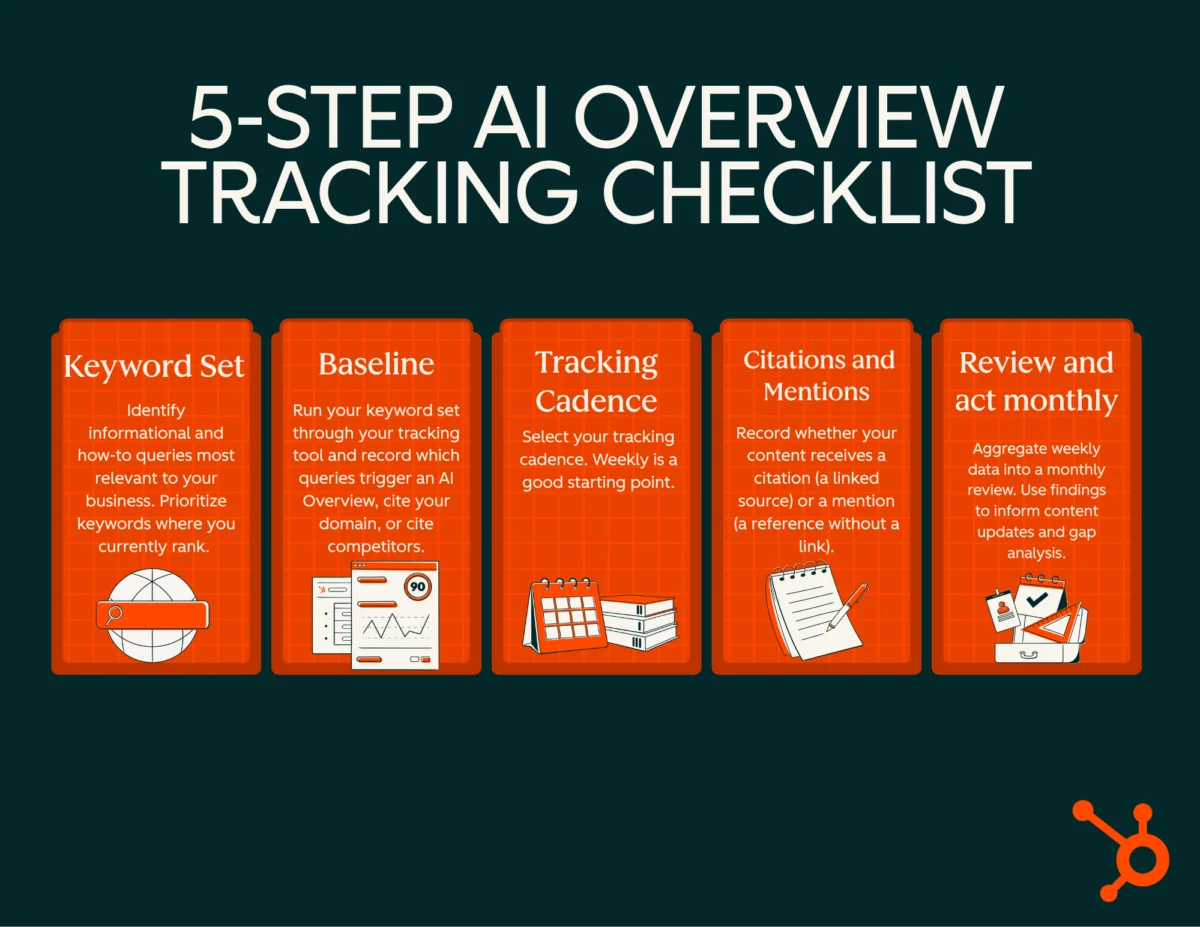
The 5-Step AI Overview Tracking Checklist
Industry practitioners recommend a rigorous, repeatable methodology to establish true visibility:
- Define Your Keyword Set: Filter your targets to prioritize informational and how-to queries where you already hold strong organic positions, temporarily deprioritizing purely transactional keywords.
- Establish a Baseline: Run initial diagnostic audits (utilizing tools like free AI search graders) to record which queries trigger AI Overviews and which currently cite your domain versus competitors.
- Select Your Tracking Cadence: Monitor weekly for standard operations, scaling to daily checks during active search engine algorithm updates or for high-priority brand assets.
- Log Citations vs. Mentions Separately: Distinguish between a linked source (citation) and a text-only reference (mention) to maintain data integrity over time.
- Review and Act Monthly: Aggregate weekly logs to spot macro-trends, identify content gaps, and inform strategic updates.
Core Key Performance Indicators (KPIs)
To measure success in an AI-driven landscape, digital teams are tracking five critical metrics:
- Coverage: The percentage of a tracked keyword set that actually triggers an AI Overview.
- Mention Frequency: How often a brand or product is referenced in the text, regardless of a hyperlink.
- Citation Coverage: The percentage of tracked keywords where a domain earns an active, clickable citation link.
- Cited-Page Distribution: Identifying which specific internal pages earn citations to isolate high-performing content structures.
- Business-Impact Proxies: Observing organic click-through rate trends on cited pages, fluctuations in branded search volume, and referral traffic correlations.
Official Responses and Industry Insights
As the digital marketing ecosystem grapples with these sweeping changes, industry leaders, technology providers, and search experts have weighed in on how brands must adapt their long-term strategies.

Data analysts emphasize that the core principle of earning an AI Overview citation is ruthlessly simple: answer one question completely rather than many questions partially. Experts note that structured formatting—such as clear headers, bulleted lists, and step-by-step instructions—plays a vital role in helping automated parsing systems extract and attribute specific passages.
Furthermore, platform developers have increasingly integrated diagnostic solutions to help brands audit their standing. Major marketing software providers, including HubSpot, have rolled out dedicated AEO products and AI search graders designed to give enterprises a clear diagnostic snapshot of how their brand appears in generative search experiences.
However, software vendors and search experts alike issue a firm caveat: no tool or diagnostic framework can guarantee inclusion. Because AI Overview compositions and algorithms shift dynamically, optimization efforts must be framed as investments in content quality and topical authority rather than transactional tactics designed to game the system.
Implications
The structural shift toward AI Overviews carries profound long-term implications for brand strategy, content creation, and digital ROI.
1. The Death of Superficial Content
Thin, derivative content that merely restates common knowledge or prioritizes conversion messaging over substantive answers is rapidly losing viability. Because AI engines reward deep, highly specific, and authoritative explanations, content creators must pivot toward producing original research, precise technical definitions, and practitioner-level insights that automated systems cannot easily replicate.
.png?width=650&height=502&name=Pastel%20Playful%20Illustrated%20Project%20Stages%20Graphic%20Organizer%20(4).png)
2. The Rise of Decentralized Brand Discovery
Brands can no longer rely solely on their owned-and-operated web properties to capture search visibility. Because search engines increasingly favor user-generated content—such as forum discussions, peer reviews, and community threads—for queries requiring firsthand experience, marketing strategies must incorporate authentic community engagement. Brands must learn to contribute value to third-party platforms without crossing into prohibited, promotional behavior.
3. Redefining Success Without Closed-Loop Attribution
Perhaps the most challenging implication for corporate leadership is the acceptance of attribution limits. Without native analytics parameters identifying AI Overviews as direct traffic drivers, executive teams must transition away from old-school, single-touch attribution models. Instead, leadership must embrace proxy-based measurement, viewing AI visibility as an essential top-of-funnel brand awareness mechanism that influences downstream customer acquisition through indirect, multifaceted channels.
Ultimately, organizations that master the disciplines of Answer Engine Optimization, maintain rigorous tracking cadences, and focus on genuine information utility will thrive in the new search economy. Those clinging to outdated, link-only paradigms risk becoming invisible ghosts in a machine-generated world.



