










SANTA CLARA, Calif. — Transforming a conceptual simulation into a fully functional, real-time application has historically been one of the most arduous bottlenecks in software engineering and robotics. Traditionally, developers have had to spend weeks—if not months—manually assembling disparate assets, writing complex glue code to bridge physics engines with rendering pipelines, and painstakingly debugging scene behaviors to ensure physical accuracy.
Today, that paradigm is undergoing a seismic shift. By coupling frontier artificial intelligence models with NVIDIA Omniverse libraries, developers are bypassing traditional coding constraints. Using natural-language prompts, engineers can direct AI agents to build, test, and refine intricate virtual environments, opening unprecedented pathways for exploring complex scenarios, diagnosing robotic failures, and optimizing industrial designs at scale.
Main Facts: The Intersection of Generative AI and GPU-Accelerated Physics
The core innovation centers on a synergistic workflow: human developers issue natural-language instructions, guide changes, and review outcomes, while autonomous AI agents—such as advanced iterations of GPT and Claude variants—do the heavy lifting of writing application code, generating animations, and orchestrating pipelines.
Meanwhile, NVIDIA Omniverse libraries supply the heavy-duty infrastructure required for modern simulation:
- GPU-Accelerated Physics: Engines like
ovphysxand the Newton Physics Engine calculate real-world collisions, gravity, and material constraints in real time. - Advanced Rendering: Tools like
ovrtxdeliver photorealistic, ray-traced visuals and precise sensor data simulation. - Scene Management: OpenUSD (Universal Scene Description) and components like
ovstageallow seamless asset integration and real-time updates. - High-Performance Computation: Frameworks such as NVIDIA Warp accelerate complex spatial calculations, making large-scale iterative trials viable.
Rather than manually programming every coordinate and constraint, engineers act as directors, steering AI agents to construct end-to-end applications across autonomous driving, humanoid robotics, computer-aided design (CAD), and digital twins.
Chronology: From Static 3D Assets to Dynamic, AI-Driven Ecosystems
The evolution toward agent-driven simulation represents a natural culmination of NVIDIA’s long-term investments in Omniverse, OpenUSD, and generative AI.
- Phase 1: Foundation Building (Pre-2024): NVIDIA established OpenUSD as the universal language for 3D simulation and launched foundational Omniverse developer tools, focusing on GPU-accelerated ray tracing and physics.
- Phase 2: The Integration of AI and Robotics (2024–2025): Tools like NVIDIA Isaac Sim and modular libraries (
ovstage,ovui) matured, allowing developers to test robots in virtual warehouses and smart factories. However, setting up these environments still demanded significant manual engineering overhead. - Phase 3: The Frontier AI Agent Era (Current Landscape): The introduction of AI models capable of complex, multi-step coding and spatial reasoning changed the equation. Developers began tasking AI agents with assembling entire simulation pipelines. Across recent proofs-of-concept led by NVIDIA engineering teams, agents have successfully built humanoid simulators, mapped autonomous vehicle testing grounds from scratch, and synchronized real-world sensor streams with virtual counterparts in days rather than months.
Supporting Data and Real-World Applications
To demonstrate the versatility of this methodology, NVIDIA teams have deployed AI agents across six distinct engineering domains, yielding remarkable quantitative and qualitative results:
1. Humanoid Robotics in Warehouse Environments
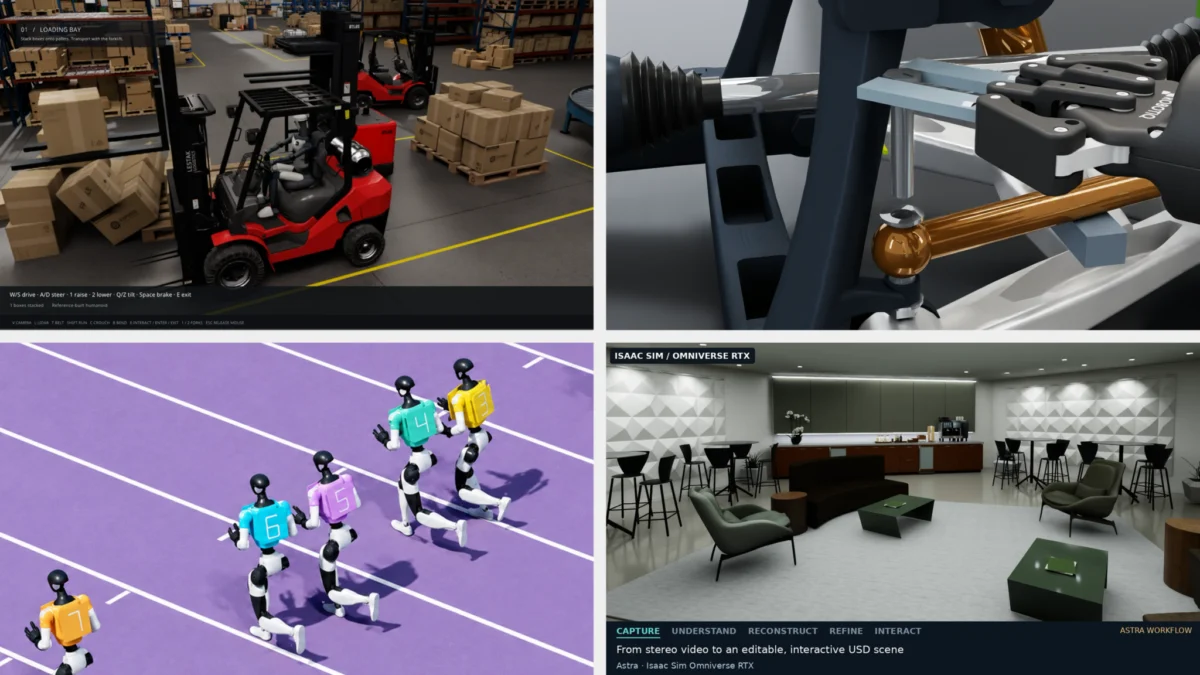
Frank DeLise, Omniverse product manager at NVIDIA, utilized an advanced AI agent to transform a SimReady warehouse asset and a humanoid robot model into an interactive simulator featuring first- and third-person perspectives. By directing the agent to connect ovphysx, ovstage, ovrtx, and ovui libraries, DeLise successfully gamified physics-based control, proving that complex behavioral exploration can be initiated via conversational prompts.
2. Autonomous-Driving Validation Workflows
Autonomous-vehicle simulations are notoriously sensitive to minor changes in road geometry, lighting, or sensor placement. Doyub Kim, a simulation technology manager at NVIDIA, tasked an AI agent with building "Zero to Alpamayo"—a reusable simulation environment modeled after San Francisco’s Market Street. The agent mapped out the workflow in stages, integrating asset creation, traffic management, Omniverse RTX sensor simulation, and Alpamayo driving models. In a parallel Cosmos3-Nano experiment, environmental variables like weather and lighting were dynamically altered in recorded simulation videos to rigorously test the driving model’s resilience.
3. Sensor-Driven Digital Twin Refinement
Ensuring that simulated sensors match real-world physical outputs is critical for autonomous machine deployment. Ashley Reid, specializing in RTX sensor validation, directed AI agents to compare ovrtx camera and raw LiDAR outputs against recorded physical data. Over a compressed three-day iterative workflow, the agents successfully created two digital twins from scratch and enhanced two existing ones. Discrepancies in missing objects, geometry, and materials were systematically resolved based on strict camera and LiDAR performance metrics.
4. The "Robo Olympics": Stress-Testing Physical Constraints
Teaching robots dynamic movements requires rigorous stress-testing against physical constraints. Tae Kim, NVIDIA Omniverse engineering and product lead, leveraged sports videos and natural-language commands to guide an AI agent in building the "Robo Olympics"—an experimental benchmark testing simulated Unitree G1 humanoids performing complex athletic maneuvers. Powered by the Newton Physics Engine and NVIDIA Warp, one trial sequence revealed that a humanoid robot successfully cleared a single hurdle in 64 out of 100 simulation trials, providing actionable telemetry to refine robot timing and actuation controllers.
5. Robotic Disassembly via CAD Integration
Before a robot can effectively dismantle manufactured goods, engineers must verify that its tools can physically reach and remove internal components. Jens Jebens, senior product manager for OpenUSD, directed an AI agent to model a car suspension using PTC Onshape and configure it within NVIDIA Isaac Sim. The agent autonomously measured spatial constraints and designed a specialized robotic wrench capable of reaching and unbolting the suspension components, directly connecting CAD tooling decisions to robotic policy training.
6. Browser-Based Space Exploration and Room Reconstruction
Nic Johns, engineering director, prompted an AI agent to assemble NASA assets into an OpenUSD-based model of the International Space Station complete with live telemetry, streaming it directly into a web browser using Blender and ovstream. Similarly, Chirag Majithia from the Isaac engineering team directed an agent to convert stereo camera captures into an editable OpenUSD studio environment, leveraging USD Content Agents to govern how doors, drawers, and physical objects interact under simulation.
Official Responses and Industry Perspectives
NVIDIA leadership views this convergence of frontier AI and simulation as a monumental leap forward for software development. By abstracting away the boilerplate code required to connect rendering engines, physics libraries, and UI frameworks, developers can shift their focus entirely to logic, experimentation, and problem-solving.
"When you empower frontier AI agents with deep access to GPU-accelerated foundational libraries like Omniverse, you change the velocity of engineering," industry analysts note. What once required multidisciplinary teams months to prototype can now be iterated upon conversationally in real time. This democratization of simulation design bridges the gap between mechanical engineering, computer vision, and generative artificial intelligence.
Implications: The Future of Simulation and Autonomous Systems
The implications of combining frontier AI agents with NVIDIA Omniverse libraries extend far beyond gaming and visualization.
- Accelerated Robotics Deployment: By drastically reducing the time required to spin up physics-accurate training environments, companies can train autonomous delivery drones, warehouse humanoids, and self-driving fleets safely in simulation before deploying them into unpredictable physical worlds.
- Democratization of Engineering: As natural-language interfaces replace complex API wiring, domain experts—such as logistics managers, urban planners, and mechanical engineers—will be able to build sophisticated simulations without needing deep expertise in graphics programming or low-level shader writing.
- Closing the Reality Gap: The ability to continuously ingest real-world sensor data, compare it against synthetic environments via automated AI loops, and instantly patch digital twins ensures that simulated testing grounds will mirror reality with unprecedented fidelity.
As developers continue to push the boundaries of what AI agents can architect, the line between imagination and executable simulation is rapidly dissolving. For engineers looking to bring their virtual concepts to life, the tools are no longer bound by lines of manual code—they are limited only by the scope of their vision.



