









LONDON — Across the United Kingdom, the digital economy is undergoing a profound structural evolution. No longer content with merely experimenting with artificial intelligence, British enterprises, startups, healthcare providers, and public sector institutions are putting the full technology stack to work. The scale and velocity of deployment are accelerating at an unprecedented pace, transforming traditional business models while tackling some of the planet’s most stubborn challenges.
At the center of this national wave of technological adoption is NVIDIA. The Silicon Valley computing giant is actively embedding itself into the British innovation ecosystem, highlighted by a substantial five-year, $250 million compute commitment dedicated to strengthening the U.K.’s agentic safety and security research. Furthermore, NVIDIA has stepped onto the global stage as a Global Alliance Founding Partner of the prestigious Earthshot Prize, channeling advanced compute resources and technical expertise toward innovators designing scalable solutions for the world’s most critical climate and sustainability crises.
This convergence of foundational computing power, sovereign datasets, and sector-specific applications is redefining what is possible across multiple pillars of British society, signaling that the U.K. has successfully transitioned from AI ambition to widespread, high-impact application.
Main Facts: The Anatomy of the U.K.’s AI Acceleration
The acceleration of the U.K.’s AI landscape is characterized by deep institutional commitments, localized infrastructure investments, and specialized vertical integration. Rather than relying on generic, off-the-shelf models, British pioneers are building sovereign infrastructure tailored to local regulatory environments, cultural nuances, and operational demands.
Key facets of this technological rollout include:
- Massive Infrastructure Investments: A multi-million-pound commitment by NVIDIA to bolster U.K. safety and security research, paired with enterprise-level deployment of next-generation hardware such as the NVIDIA B300 Blackwell Ultra.
- Sovereign Data and Models: Initiatives like Locai Labs’ Nemotron-Personas-UK—an open-source dataset featuring one million synthetic personas mapped to the U.K.’s unique demographic, regional, and cultural diversity—ensuring AI systems are inherently fair and representative.
- Critical Sector Overhauls: Deep integrations within the National Health Service (NHS), regional smart city "City Brain" projects, foundational banking models, and pioneering quantum computing calibration experiments.
- Startup Ecosystem Integration: More than 3,100 U.K. startups are now actively participating in the NVIDIA Inception program, utilizing cutting-edge tools to scale globally from British soil.
Chronology of Deployment: From Research Labs to Real-World Scale
The rapid maturation of the U.K.’s AI ecosystem did not happen overnight; it follows a deliberate trajectory of strategic investments, model training, and eventual real-time deployment that has culminated in widespread adoption throughout 2026.
Early Foundations and Strategic Commitments
The groundwork for the current wave was laid through targeted investments in sovereign compute infrastructure and open-source frameworks. Financial institutions and tech pioneers began moving away from experimental sandboxes toward heavy production environments.
- Earlier in the year, financial titan Revolut introduced PRAGMA, a foundation model for banking event sequences pre-trained on 26 million anonymized user histories.
- Simultaneously, regional authorities began recognizing the need for localized digital infrastructure, planting the seeds for smart city frameworks like the Liverpool City Region’s "City Brain."
Scaling Infrastructure and Healthcare Integration
As compute capacity expanded through advanced hardware deployments, high-stakes sectors like healthcare and energy began transitioning internal systems to dedicated infrastructure.
- Energy innovator Fuse Energy migrated its customer AI operations onto in-house infrastructure powered by NVIDIA B300 Blackwell Ultra chips, drastically improving response times for more than 450,000 households across the U.K.
- Concurrently, OneAdvanced rolled out the U.K.’s first fine-tuned Large Language Model (LLM) designed specifically for primary care AI-triage, utilizing the NVIDIA Agent Toolkit to safely support millions of NHS patients.
Real-Time Execution and Quantum Frontiers
Today, the ecosystem has shifted entirely into real-time operational execution and cross-disciplinary innovation.
- Financial institutions such as Lloyds Banking Group have brought transactions foundation models like ATUM into production, converting billions of transaction data points into reusable intelligence.
- At the cutting edge of physics, quantum computing firms like Riverlane have successfully demonstrated that GPUs can accelerate decoder recalibration workflows for quantum error correction, bridging the gap between classical AI and theoretical quantum hardware.
Supporting Data: Sector-by-Sector Impact
To fully appreciate the scope of the U.K.’s AI transition, one must examine how discrete industries are leveraging accelerated computing to solve complex operational hurdles.
1. Energy and Utilities
In the energy sector, responsiveness is paramount. Fuse Energy’s transition to NVIDIA B300 Blackwell Ultra infrastructure allows the company to manage complex grid demands and customer service inquiries for nearly half a million households with unprecedented speed. By keeping infrastructure in-house, Fuse ensures data privacy while drastically cutting down inference latency.
2. Healthcare and Life Sciences
Healthcare remains one of the most transformative arenas for AI deployment in the U.K.:
- Primary Care Triage: OneAdvanced has operationalized the nation’s most advanced fine-tuned LLM for primary care, easing the administrative and diagnostic burdens on National Health Service personnel.
- Clinical Knowledge Retrieval: Clinical assistant platform Heidi has integrated NVIDIA Nemotron open models, granting medical professionals instantaneous, secure access to trusted medical evidence.
- Secure Speech Recognition: Speechmatics deployed its multilingual medical speech model, Oak, via NVIDIA Triton Inference, giving healthcare providers absolute control over where sensitive patient audio is processed and stored.
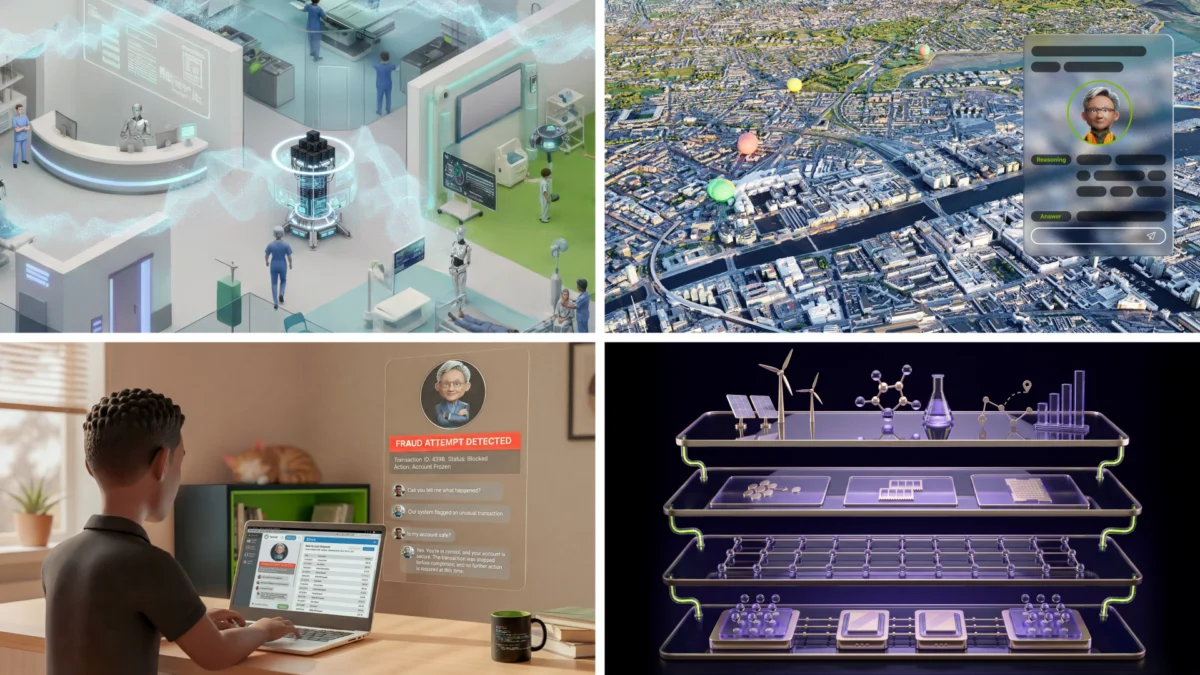
- Hospital Logistics: Apian, Synnovis, and NVIDIA are utilizing digital simulations via NVIDIA Cosmos to coordinate autonomous hospital robots, taking over the heavy lifting of transporting lab samples so medical staff can focus entirely on patient care.
- Autonomous Science: Danaher is collaborating with NVIDIA to accelerate scientific discovery. By implementing NVIDIA BioNeMo open models into its AI-driven protein design workflows, Danaher’s autonomous labs are achieving up to an 8x faster discovery rate for affinity reagents.
3. Smart Cities and Public Services
Civic infrastructure is undergoing a digital renaissance. The Liverpool City Region is spearheading an NVIDIA-powered "City Brain," creating a sovereign AI strategy meant to serve as a blueprint for dozens of Unitary Authorities across the U.K. Similar exploratory initiatives are underway at Digital Jersey, Innovation City Belfast, and the Tees Valley Combined Authority, proving that trusted AI compute can effectively modernize public services at a local level.
4. Financial Services
The U.K.’s storied financial sector is rapidly modernizing its core architectures through foundational AI:
- LSEG (London Stock Exchange Group): Collaborating with NVIDIA to bring GPU-accelerated market analytics to global financial institutions.
- Revolut: Successfully transitioning its PRAGMA foundation model from research to real-time scaling for banking event sequences.
- Lloyds Banking Group: Developing ATUM, a transaction foundation model that turns billions of banking transactions into reusable AI assets.
- Starling Bank: Building a specialized banking foundation model trained natively on Civo’s U.K. sovereign cloud infrastructure.
- NatWest and Modulr: NatWest is leveraging NVIDIA Nemotron Voice to better understand regional speech patterns among British banking customers, while Modulr is deploying specialized multi-agent networks powered by Nemotron to automate complex payment operations.
5. Quantum Computing
The boundary between classical computing and quantum mechanics is beginning to blur. Riverlane’s recent work with NVIDIA demonstrates that graphics processing units can effectively accelerate decoder recalibration workflows. This technological synergy addresses one of the primary roadblocks in quantum error correction: ensuring that error-correction software can keep pace with real-time, unpredictable changes in quantum hardware behavior.
Official Responses and Industry Perspectives
The mobilization of the U.K.’s tech ecosystem has drawn praise from international technology leaders and domestic innovators alike, highlighting the collaborative spirit driving the nation forward.
Industry analysts note that the U.K.’s unique combination of regulatory clarity, academic excellence, and entrepreneurial drive makes it an ideal testing ground for sovereign AI initiatives. By focusing heavily on safety, security, and ethical deployment—underwritten by investments such as NVIDIA’s $250 million research commitment—the country is establishing global benchmarks for responsible AI governance.
Furthermore, the integration of over 3,100 British startups into the NVIDIA Inception program underscores a vibrant bottom-up economic engine. These agile companies are leveraging enterprise-grade infrastructure to scale solutions that were once exclusive to trillion-dollar technology conglomerates.
Implications for the Future of the U.K. Economy
The large-scale deployment of the full AI stack across the United Kingdom carries profound implications for the nation’s economic competitiveness, workforce development, and geopolitical standing in the tech sphere.
- Economic Resilience and Sovereign Capabilities: By building native infrastructure—such as Civo’s sovereign cloud and localized datasets like Locai Labs’ Nemotron-Personas-UK—the U.K. is safeguarding its digital sovereignty. Ensuring that British data is processed through models that understand regional cultural and demographic nuances prevents technological dependency on foreign entities.
- Productivity Gains in Public Services: The integration of AI into the NHS through OneAdvanced and hospital robotics via Apian offers a viable roadmap for alleviating systemic strain on public infrastructure. Automated triage and optimized logistics free up valuable human capital, directly improving citizen welfare.
- Positioning as a Global Innovation Hub: Through strategic alignments like the Earthshot Prize partnership and cutting-edge quantum research with Riverlane, the U.K. is positioning itself not merely as a consumer of technology, but as a primary exporter of intellectual property and sustainable solutions to global crises.
As the ecosystem continues to mature, all eyes turn toward upcoming industry milestones. Stakeholders are eagerly anticipating NVIDIA founder and CEO Jensen Huang’s keynote address at GTC Berlin, where further details regarding European and U.K. technological integrations are expected to be unveiled. For British enterprises, startups, and public servants alike, the message is clear: the era of AI ambition has officially given way to an era of permanent, scaled application.



