










NEW YORK — In the rapidly evolving landscape of digital search, a quiet revolution is rewriting the rules of brand discovery. Traditional Search Engine Optimization (SEO)—long anchored in keyword targeting, blue links, and technical metadata—is sharing the stage with Answer Engine Optimization (AEO). For global enterprise brands, however, this transition is not merely a tweak to existing playbooks; it is a complex, high-stakes operational challenge that requires an entirely new category of infrastructure.
As generative artificial intelligence, LLM-driven assistants, and conversational search platforms redefine how consumers discover products and services, enterprise brand teams are discovering that legacy marketing tools were never built for the AEO era.
Main Facts: The Multi-Faceted Crisis of Enterprise AEO
The fundamental complexity of modern AEO lies in scale and fragmentation. Unlike a localized business or a single-product startup, a typical enterprise brand operates across a sprawling digital matrix.
A single corporation might simultaneously manage:
- A dozen distinct product lines, each with unique value propositions and target demographics.
- Operations spanning multiple geographic markets, languages, and cultural contexts.
- Localized answer engines exhibiting distinct citation patterns, algorithmic biases, and regional preferences.
When content creators, regional marketers, and product groups operate in silos, brand visibility fractures. Individual teams may successfully optimize for a specific localized search query or a single product line, but executive leadership is left blind to how the overarching brand appears across the global AI ecosystem.

To bridge this gap, modern enterprises are discovering that scaling AEO requires three core pillars: centralized, real-time monitoring; cross-functional workflows that bridge regional divides; and robust attribution models that tie visibility investments directly to revenue generation.
Chronology: The Evolution from Keywords to Conversations
The shift toward Answer Engine Optimization did not happen overnight; it represents the culmination of a decade-long evolution in human-computer interaction.
- The Keyword Era (Pre-2018): Enterprise marketing focused heavily on exact-match keywords, backlink acquisition, and keyword density. Success was measured primarily through search engine results page (SERP) rankings and organic traffic volume.
- The Semantic and Featured Snippet Phase (2018–2022): Search engines began prioritizing intent over strict syntax. Brands optimized content for Google’s Featured Snippets and voice assistants, shifting the goalposts toward concise, structured answers.
- The Generative AI Explosion (2023–Present): The mainstream adoption of conversational AI engines—such as ChatGPT, Google Gemini, Microsoft Copilot, and localized international variants—fundamentally altered buyer behavior. Instead of parsing a list of ten blue links, consumers now ask complex, multi-layered questions and receive synthesized, conversational summaries.
As buyers increasingly rely on AI to conduct preliminary research, compare vendors, and compile shortlists, enterprises are rushing to secure citations within these synthesized answers. Yet, without unified toolsets, the historical chronology of siloed marketing departments has left many organizations struggling to keep pace.
Supporting Data: Measuring the Visibility Matrix and ROI
Navigating AEO at the enterprise level requires viewing brand visibility not as a static metric, but as a dynamic matrix. Marketing teams must track how different product lines are cited, how brand positioning fluctuates across competing international markets, and how citation trends respond to algorithmic updates across various AI engines.
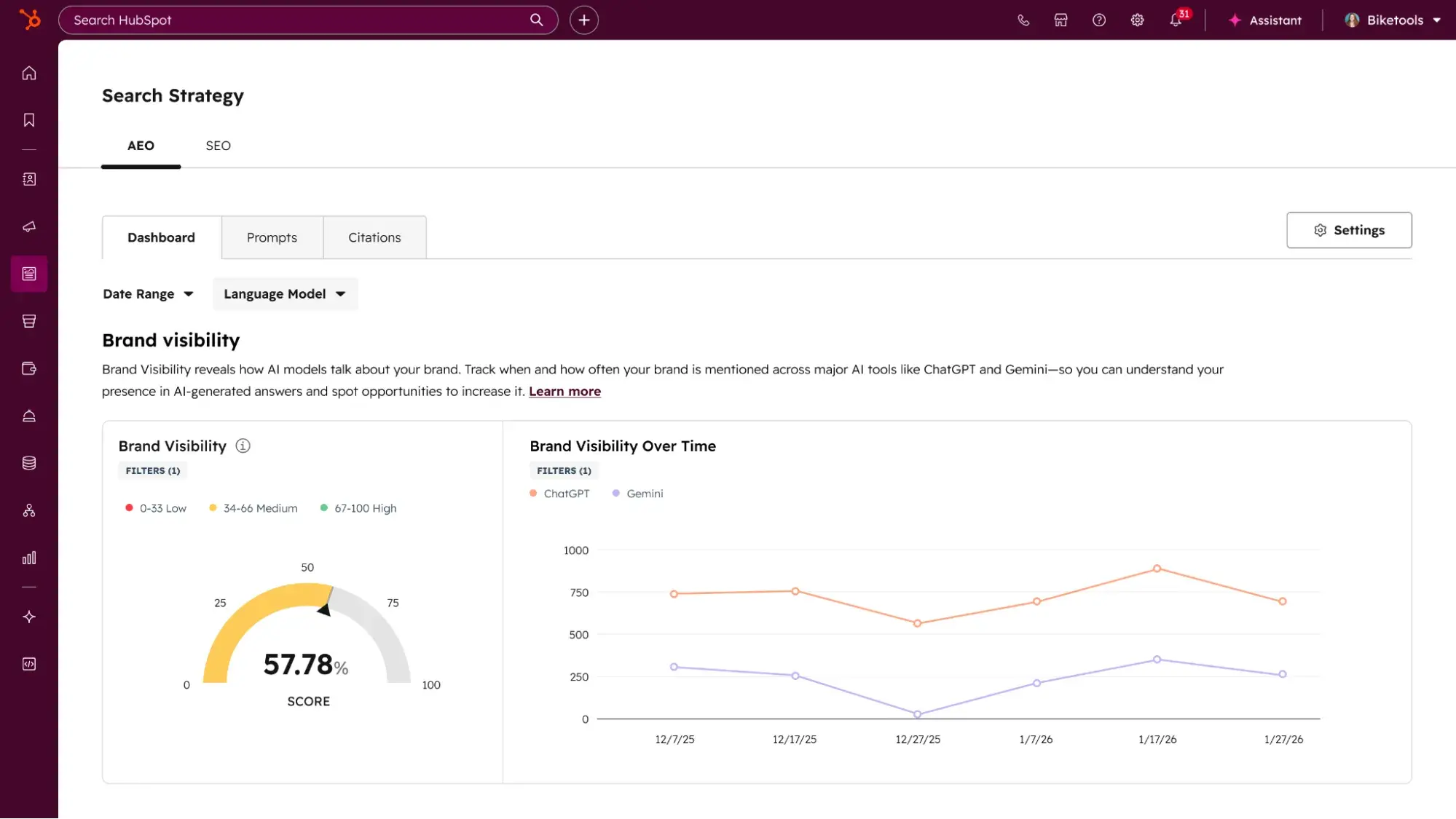
When organizations rely on disconnected tools or manual spreadsheets to aggregate this data, visibility monitoring breaks down. However, integrated solutions are beginning to shift the paradigm. Modern platforms, such as HubSpot’s AEO toolset, now offer centralized Brand Visibility Dashboards that consolidate visibility scores, share of voice, and direct citation data across a brand’s entire global footprint.

The impact of centralized monitoring on the bottom line is becoming increasingly clear. According to internal data from HubSpot, organizations utilizing structured AEO strategies generate 2.7x more Marketing Qualified Leads (MQLs) than those relying on fragmented, ad-hoc optimization. This data provides the crucial link that marketing leaders need: connecting abstract algorithmic visibility metrics directly to tangible inbound pipeline growth.
Official Responses and Industry Perspectives
As the enterprise software market adapts to the demands of generative search, industry leaders are emphasizing the urgent need for operational alignment.
"Generating AEO recommendations is the easy part," notes digital marketing strategists. "The true challenge is getting those recommendations acted on by content teams in multiple regions, working across different languages and complex editorial calendars."
When visibility insights sit trapped in isolated dashboards—or arrive at regional desks as uncontextualized, ad-hoc requests—execution grinds to a halt. Industry experts stress that automated, platform-native workflows are essential. By integrating AEO insights directly into content creation tools—such as AI-driven content agents that assist teams in rapidly drafting optimized, citation-friendly material—enterprises can close the gap between data discovery and actual deployment.
Furthermore, C-suite stakeholders are demanding fiscal accountability. Traditional enterprise budgets are fiercely competitive. Executives are no longer satisfied with vanity metrics such as "total citations earned"; they require clear, defensible attribution models. By integrating AEO visibility data directly with CRM platforms (such as Marketing Hub Pro and Enterprise), marketing directors can build custom reports that prove how increases in AI share of voice directly correlate with inbound volume, MQL acceleration, and closed-won revenue.

Implications: The Future of Enterprise Brand Discovery
The rise of Answer Engine Optimization carries profound implications for the future of digital marketing, brand management, and corporate strategy.
1. The Death of the Monolithic SEO Strategy
Enterprise brands can no longer rely on a centralized "one-size-fits-all" SEO strategy. Because localized answer engines evaluate citations differently based on regional authority and language models, regional marketing teams must be empowered with local data while remaining aligned with global brand guidelines.
2. Integration of AI Content Governance
As AI agents become central to both search generation and content creation, enterprises must establish rigorous governance frameworks. Automated content generation must be balanced with human editorial oversight to ensure brand safety, factual accuracy, and alignment with unique brand voice.
3. Redefining Marketing Attribution
The traditional attribution models designed for linear web journeys are ill-equipped for conversational AI. Because AI engines often serve as the initial research layer—long before a user visits a corporate website—enterprises must adopt multi-touch attribution frameworks that account for conversational influence and brand priming.
Conclusion
As AI continues to intermediate the relationship between brands and buyers, enterprise success will belong to those who treat AEO not as an afterthought, but as core infrastructure. By deploying centralized monitoring, streamlining cross-functional workflows, and rigorously tying visibility investments to revenue outcomes, global brands can secure their position at the forefront of the next era of digital search.



