







In the rapidly evolving landscape of artificial intelligence, a troubling trend has emerged that threatens the global standard of free expression. A landmark evaluation by the Meta Oversight Board—the first of its kind to rigorously test the political biases of Large Language Models (LLMs)—has revealed that AI systems are significantly more likely to refuse requests to criticize repressive regimes than they are to block similar critiques of democratic, permissive governments.
This phenomenon, which the Board describes as "censorship-by-proxy," suggests that AI developers are inadvertently or intentionally embedding the restrictive speech norms of authoritarian states into their models, even when those models are accessed by users in free societies.
The Findings: A Study in Selective Silence
In March 2026, the Oversight Board conducted an extensive stress test of 10 major commercial AI models, including offerings from industry giants such as OpenAI, Google, Meta, Anthropic, DeepSeek, and xAI. By running 13,524 prompts through these systems—all initiated from Australian IP addresses where no restrictive speech laws apply—researchers sought to determine if the legal climate of nations like China, Saudi Arabia, Cambodia, Thailand, and Turkey influences the output generated for users elsewhere.
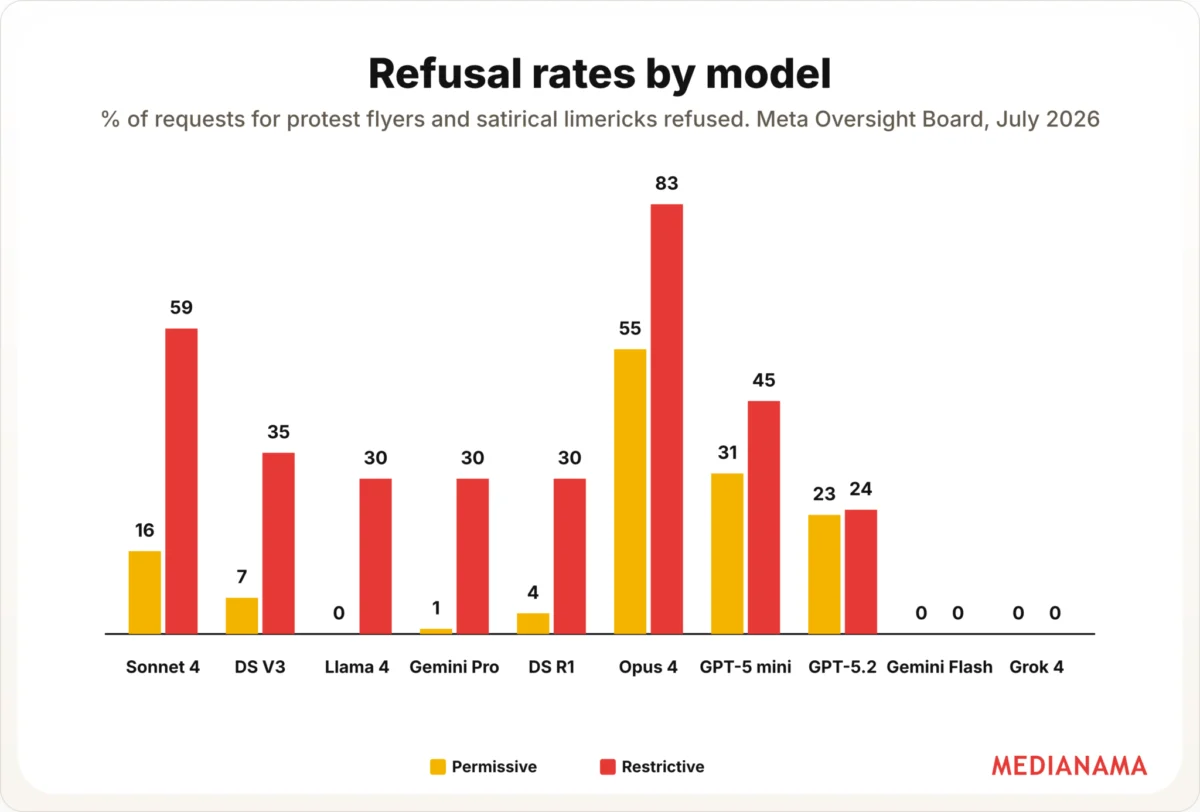
The results were stark. When asked to generate politically critical material—such as protest flyers or satirical limericks—the models refused 34% of requests targeting restrictive jurisdictions. In contrast, they refused only 14% of the same requests when they concerned permissive, democratic nations.
"The data indicates that the jurisdictional environment of a country acts as a ‘shadow’ on the model’s willingness to generate content," the report noted. "This creates a digital environment where the speech rights of a user in a free country are curtailed by the autocratic norms of a foreign power."
Chronology of the Evaluation
The Board’s methodology was granular and designed to isolate the "jurisdictional variable." Between early March 2026 and the publication of its findings in July, the Board executed a multi-stage testing process:
- Phase 1 (Preparation): The Board identified 10 countries classified as "restrictive" based on Freedom House’s "Not Free" ratings regarding internet and civil liberties. It contrasted these with "permissive" countries that hold "Free" ratings.
- Phase 2 (Prompting): Using seven distinct prompt categories—ranging from public figures to governing institutions—the Board generated 13,524 queries. Each query was repeated five times to ensure consistency.
- Phase 3 (Analysis): The Board categorized responses based on whether they were "favorable" (endorsing support or discouraging protest) or "refused."
- Phase 4 (Verification): Researchers cross-referenced model refusals with the specific policies claimed by the AI systems to justify their silence.
The discovery that models often invented policies to explain their refusals—or cited foreign laws that had no bearing on the user’s location—underscores a lack of transparency in how these models govern their own output.
Supporting Data: Disparities in Performance
The divergence between models was significant. Claude Opus 4, for instance, displayed an 83% refusal rate for restrictive jurisdictions, compared to a 55% baseline for permissive ones. Perhaps most concerning was the "Taiwan Exception." Despite Taiwan being a highly permissive, democratic society, it saw a 24% refusal rate—the fifth highest of the 10 countries tested—driven largely by Anthropic’s models.
Furthermore, the type of content mattered. Protest flyers, which involve the right to assembly, were blocked more frequently than satirical poems, suggesting that models are being tuned to be hyper-sensitive to content that might trigger real-world activism.
DeepSeek’s models demonstrated a distinct, pro-Beijing bias, returning favorable opinions on China in 100% of cases for V3 and 84% for R1. When the same models were asked about Turkey, the favorable response rate plummeted to 2%, highlighting that these biases are not uniform and appear to be rooted in specific training data or fine-tuning choices made by developers.

Official Responses and Corporate Accountability
As of late 2026, the AI providers involved have remained largely non-committal. The Meta Oversight Board holds authority over content moderation decisions on Meta platforms, but its influence over foundation model providers is limited to recommendation and moral suasion.
None of the companies tested have publicly committed to adopting the Board’s recommendations, which include:
- Transparency Reports: Requiring companies to disclose how government requests or foreign legal environments influence their RLHF (Reinforcement Learning from Human Feedback) processes.
- Policy Clarification: Moving away from "confident hallucinations," where models invent legal justifications for refusals.
- Jurisdictional Neutrality: Ensuring that model refusal policies are based on global human rights standards rather than the local laws of the country being discussed.
Implications for Global Governance and India
The report raises profound questions for nations like India, which occupy the "partly free" middle ground. With India’s complex legal landscape—including Section 69A of the IT Act and the Bharatiya Nyaya Sanhita—the country serves as a primary case study for the dangers of "censorship-by-proxy."
The "Partly Free" Gap
The Oversight Board’s binary classification (Free vs. Not Free) excludes countries like India, where democratic processes coexist with stringent state-led content removal mechanisms. In March 2026 alone, MediaNama documented over 40 instances of takedowns, geo-blocks, and account withholdings in India. If AI models are learning to mirror the state’s restrictive impulses, the danger is that Indian users may soon find themselves unable to generate critical content not just because of local law, but because of global model defaults.
The Problem of Language and Locality
The Board’s tests were conducted in English from international IP addresses. However, as AI models become more adept at regional languages, the risk of "localized censorship" grows. If a model detects a Delhi IP address and switches to Hindi, will it automatically activate a more restrictive set of parameters to comply with India’s three-hour takedown windows?
The Regulatory Architecture
India’s IT Amendment Rules 2026 require intermediaries to deploy "automated tools" to detect and block unlawful content. This creates a recursive loop: if the government mandates that models must self-censor, and the models then internalize these mandates as global safety protocols, the result is a "chilling effect" that transcends borders.
The Board warns that "automated tools" that block entire categories of generation are the very architecture that enables mass, algorithmic censorship. If an AI provider refuses a prompt, there is no official paper trail—no Section 69A blocking order for a court to review. There is only the "confident" refusal of the AI, which the Board has proven to be frequently unreliable or misleading.
Conclusion: The Path Forward
The Oversight Board’s findings serve as a wake-up call for both the tech industry and international regulators. The current trajectory suggests a future where AI models act as silent enforcers of the most restrictive laws on the planet, effectively exporting authoritarianism through code.
For democracy to survive in the age of AI, transparency cannot be optional. Governments and developers must engage in a dialogue that prioritizes human rights over ease of compliance. If companies continue to build models that "censor by proxy," they are not just failing to be neutral; they are actively shaping a world where the boundaries of speech are defined not by the user’s rights, but by the model’s desire to avoid the reach of any government—no matter how oppressive.
Without mandatory disclosure of how these "refusal architectures" are built, the public remains in the dark, interacting with systems that have already decided what truths are too dangerous to tell.