










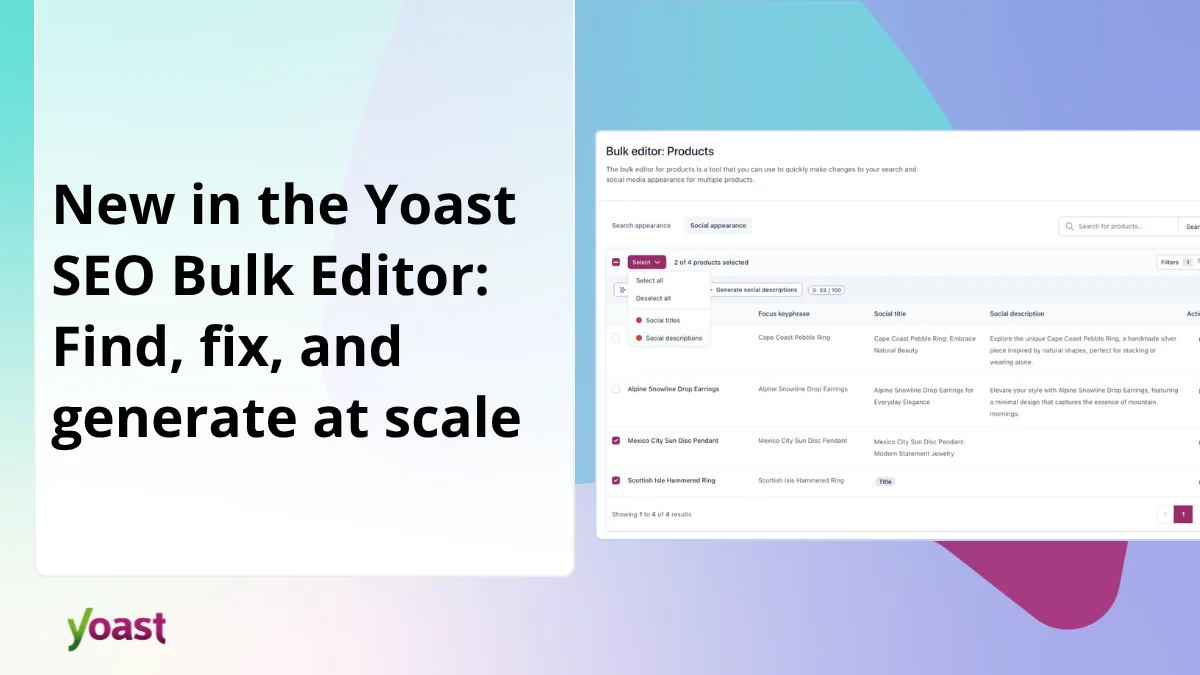
In the rapidly evolving world of Search Engine Optimization (SEO), time is the most valuable currency. For site managers handling thousands of pages, the prospect of manual metadata optimization is a logistical nightmare. Recognizing this, Yoast has unveiled a significant update to its Bulk Editor, a feature designed to transform how WordPress users handle titles, meta descriptions, and social media copy across their digital assets.
This update—the latest in a series of improvements to the Yoast SEO plugin—is not merely a minor patch. It represents a fundamental shift in how the tool integrates with the WordPress ecosystem, focusing on AI-assisted precision, workflow efficiency, and robust connectivity for restricted environments.
Main Facts: What’s New in the Bulk Editor?
The Yoast SEO Bulk Editor has long been a staple for power users, allowing for the mass editing of metadata and keyphrases. However, the new update addresses three critical friction points: the inability to easily identify "weak" content, the lack of quality control for AI-generated suggestions, and the siloed nature of the tool itself.
Key Functional Upgrades:
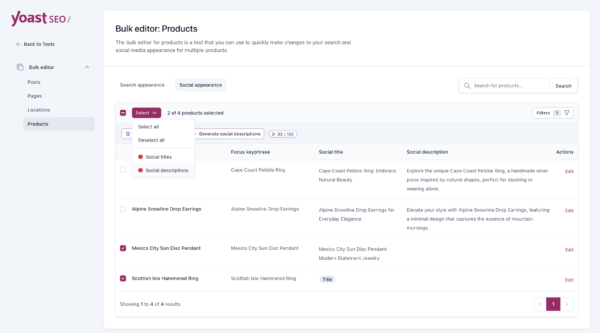
- Smart Filtering: Users can now leverage a new "needs improvement" filter in the dropdown menu. This identifies pages with empty or low-scoring SEO and social metadata automatically.
- Intelligent Selection: A new "select all" functionality allows users to highlight every post that requires attention with a single click, perfectly syncing with the filter criteria.
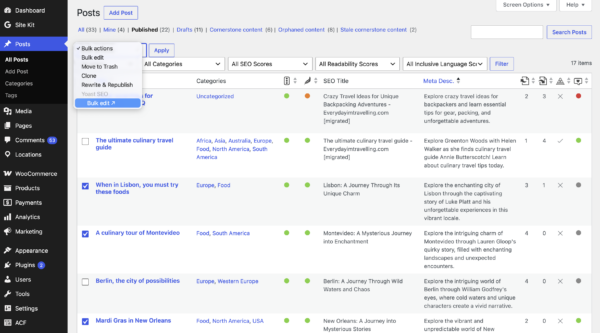
- Workflow Shortcuts: Bulk editing can now be initiated directly from the standard WordPress post list, eliminating the need to navigate to a separate dashboard.
- AI Guardrails: The integration now flags content generated by AI that may have been based on insufficient page data, ensuring users don’t publish low-quality meta tags.
- MyYoast Connectivity: A new "fail-safe" mechanism ensures that even sites behind firewalls or those with restricted REST APIs can still utilize the power of Yoast’s AI via MyYoast.
Chronology: The Evolution of Yoast’s Efficiency Tools
To understand the significance of this release, one must look at the trajectory of Yoast’s product development over the past 24 months.
Early 2023: Yoast introduced its initial AI integration, allowing for the automatic generation of meta descriptions and SEO titles. While revolutionary, it was a manual process that required users to interact with pages on an individual basis.
Late 2023: The Bulk Editor received its first major injection of AI capabilities, allowing for batch generation. However, users reported that the process felt disconnected from their standard content management workflow.
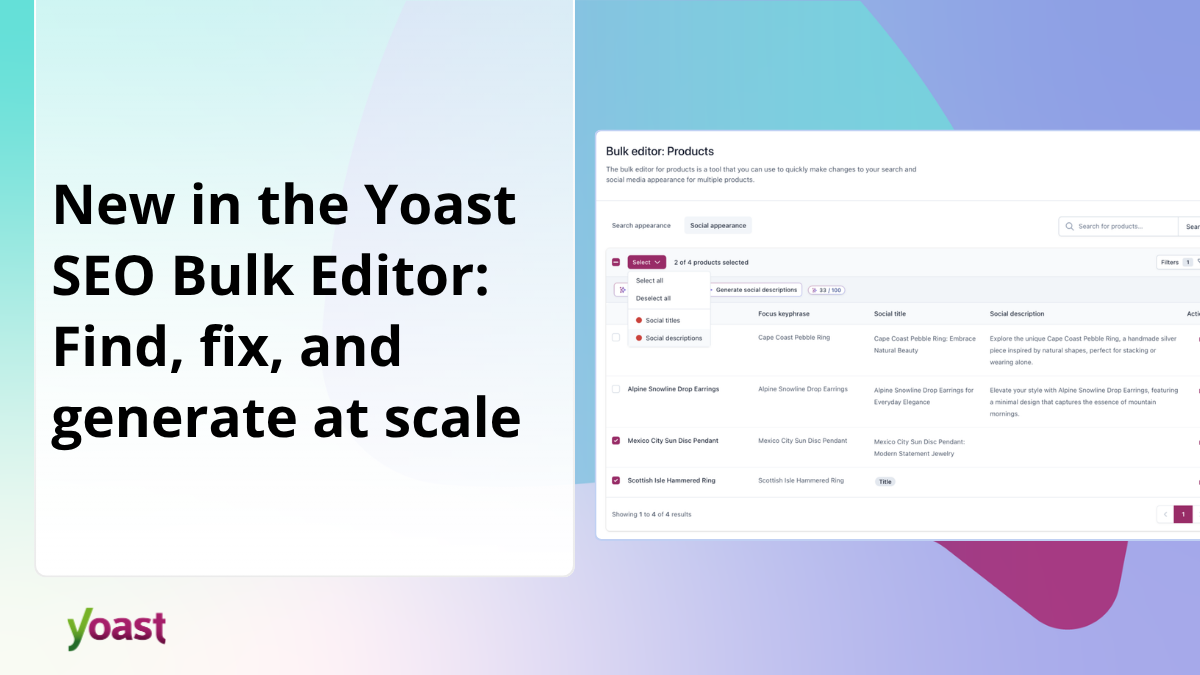
August 2026 (Current Release): The latest update represents the "maturity phase" of these tools. By shifting from simple batch processing to "intelligent identification" (where the software tells you what to fix rather than just letting you fix everything), Yoast has transitioned from a utility tool to a diagnostic assistant.
Supporting Data: Why "Needs Improvement" Matters
The importance of meta descriptions and SEO titles cannot be overstated. According to recent search industry benchmarks, a well-optimized meta description can improve Click-Through Rates (CTR) by as much as 15% to 25%. Conversely, empty or "weak" fields often lead search engines to auto-generate snippets, which frequently lack the persuasive language needed to convert a searcher into a visitor.
The new "needs improvement" filter utilizes the existing Yoast SEO scoring algorithm—the same traffic-light system (Red/Orange/Green) that users are already familiar with. By surfacing these posts automatically, Yoast is effectively helping site owners recover "lost traffic" that was previously buried under hundreds of pages of unoptimized content.
Furthermore, the introduction of "AI Guardrails" is a response to the "garbage in, garbage out" problem common with Large Language Models. When an AI attempts to write a summary for a page with only 50 words of content, the output is often generic or inaccurate. By flagging these instances, Yoast prevents the degradation of site quality, saving users from the time-consuming process of manually auditing AI output after the fact.
Official Perspective: Insights from the Product Team
Beth Parker, Product Marketing Manager at Yoast, emphasizes that this update was driven by direct user feedback. In a recent statement, Parker noted that the primary hurdle for large-scale site management isn’t just the editing process—it’s the decision-making process.
"Our users were spending more time searching for pages that needed attention than they were actually optimizing them," Parker explained. "By integrating the Bulk Editor directly into the post list and providing automated filters for ‘weak’ content, we are removing the cognitive load from the user. We want the software to tell you exactly where the most impact can be made, rather than forcing you to hunt for it."
The development team also addressed the "connectivity" issue. Many enterprise-level WordPress installations employ strict security measures, such as disabling the REST API or operating behind heavy firewalls, which often break third-party AI integrations. By allowing these users to link their site to the MyYoast cloud service, the company is ensuring that no user is left behind due to their server architecture.
Implications for Digital Strategy
The implications of this update are far-reaching for three distinct groups:
1. The Solo Entrepreneur and Blogger
For smaller sites, the ability to select multiple posts and edit them in a single flow significantly lowers the barrier to maintaining high SEO standards. Previously, keeping up with metadata was a weekly chore; now, it can be handled in a monthly "SEO hygiene" session that takes minutes rather than hours.
2. The Agency and SEO Professional
Agencies managing dozens of client sites stand to benefit most from the "Bulk Edit" shortcut from the main post list. Being able to jump straight from a client’s content overview into the editing suite reduces the time spent navigating between menus. Furthermore, the ability to identify "weak" content across hundreds of pages allows agencies to provide more tangible value to clients by quickly improving their search visibility.
3. Enterprise Content Teams
Large organizations with thousands of pages often suffer from "metadata rot"—where descriptions become outdated or are simply never written for older content. The new AI guardrails provide a layer of quality assurance that ensures that even when scaling, the brand voice and SEO accuracy remain consistent.
The Road Ahead: AI as a Partner, Not Just a Tool
As search engines continue to prioritize user experience and high-quality signals, the role of metadata remains a pillar of technical SEO. Yoast’s latest move suggests a clear future: the integration of AI into the CMS (Content Management System) is no longer a luxury, but a requirement for competitive performance.
The "rolling out" nature of the MyYoast connectivity feature indicates that this is a living, breathing update. As the company gathers more data on how users interact with these new filters, we can expect further refinements in how the software suggests improvements.
Ultimately, the goal of this update is to give users more control over their site’s presence in search results. By simplifying the technical aspects of SEO and automating the mundane tasks, Yoast is enabling creators to focus on what matters most: the actual content. In an era where AI is rapidly changing the landscape of the web, tools that prioritize precision and user-friendly workflows will define the success of digital strategies for years to come.
Whether you are a casual blogger or an enterprise SEO manager, the message is clear: the path to higher rankings has just become a little less crowded, and a lot more intuitive.



