











By Josh Gallant
Updated July 21, 2026
For small-to-medium-sized businesses (SMBs), sales and marketing misalignment rarely presents itself as an explicit, high-level strategy failure. Instead, it manifests insidiously: as "qualified" leads generated by marketing that sales teams quietly refuse to trust; as campaign messaging that frontline sales reps know nothing about; and as a revenue pipeline that looks deceptively healthy on the surface until closed deals begin to flatline.
To uncover what is truly happening inside modern go-to-market (GTM) engines, Unbounce surveyed over 500 SMB GTM professionals for its comprehensive report, The Anatomy of Aligned Go-to-Market Teams. The headline findings expose a profound corporate disconnect: 87% of teams expect better sales and marketing alignment to directly lift performance, yet only 56% describe their organizations as highly aligned.
This report examines where GTM alignment breaks down, what those fractures cost growing businesses, and the concrete operating strategies top-performing teams are using to close the gap.
Main Facts: The Anatomy of the Alignment Gap
At its core, the Unbounce data points to an industry-wide paradox: companies recognize the immense value of synchronized sales and marketing operations, yet they systematically fail to build the structural foundations required to achieve it.
While 56% of respondents claim high alignment, qualitative and quantitative deep-dives reveal that this metric often reflects nothing more than a shared meeting calendar rather than a unified operating model. True alignment requires shared data architecture, strict lead handoff protocols, and mutually agreed-upon key performance indicators (KPIs). When these elements are absent, organizations default to a fragmented state: marketing counts the lead, sales counts the close, and the revenue numbers ultimately fail to reconcile.

Furthermore, a striking perception gap divides executive leadership from frontline operators:
- 69% of executives report strong sales and marketing alignment.
- Only 47% of non-executives agree with that assessment.
- 62% of sales professionals feel highly aligned, compared to just 53% of marketers.
According to the data, executives view alignment through the lens of strategic slide decks and quarterly plans, whereas non-executives experience the daily friction of data inconsistencies, limited cross-functional communication, and rigid departmental silos.
Chronology and Evolution: How Misalignment Compounds Over Time
The path to systemic GTM misalignment typically follows a predictable lifecycle within growing companies. Understanding this chronology illustrates why surface-level fixes—such as adding more recurring meetings—fail to resolve the underlying pathology.
Phase 1: The Upstream Definition Mismatch
The friction begins at the top of the funnel. Marketing teams, tasked with generating volume, build campaigns around personas and lead definitions that do not match the day-to-day realities encountered by sales reps on discovery calls. Because sales input is rarely integrated into pre-campaign audience targeting, marketing generates a high volume of leads that fail to meet actual sales criteria.
Phase 2: The Handoff Breakdown and Operational Friction
As leads enter the pipeline, the lack of a formalized Service Level Agreement (SLA)—specifying what marketing delivers, with what contextual data, and by what deadline—causes leads to languish.
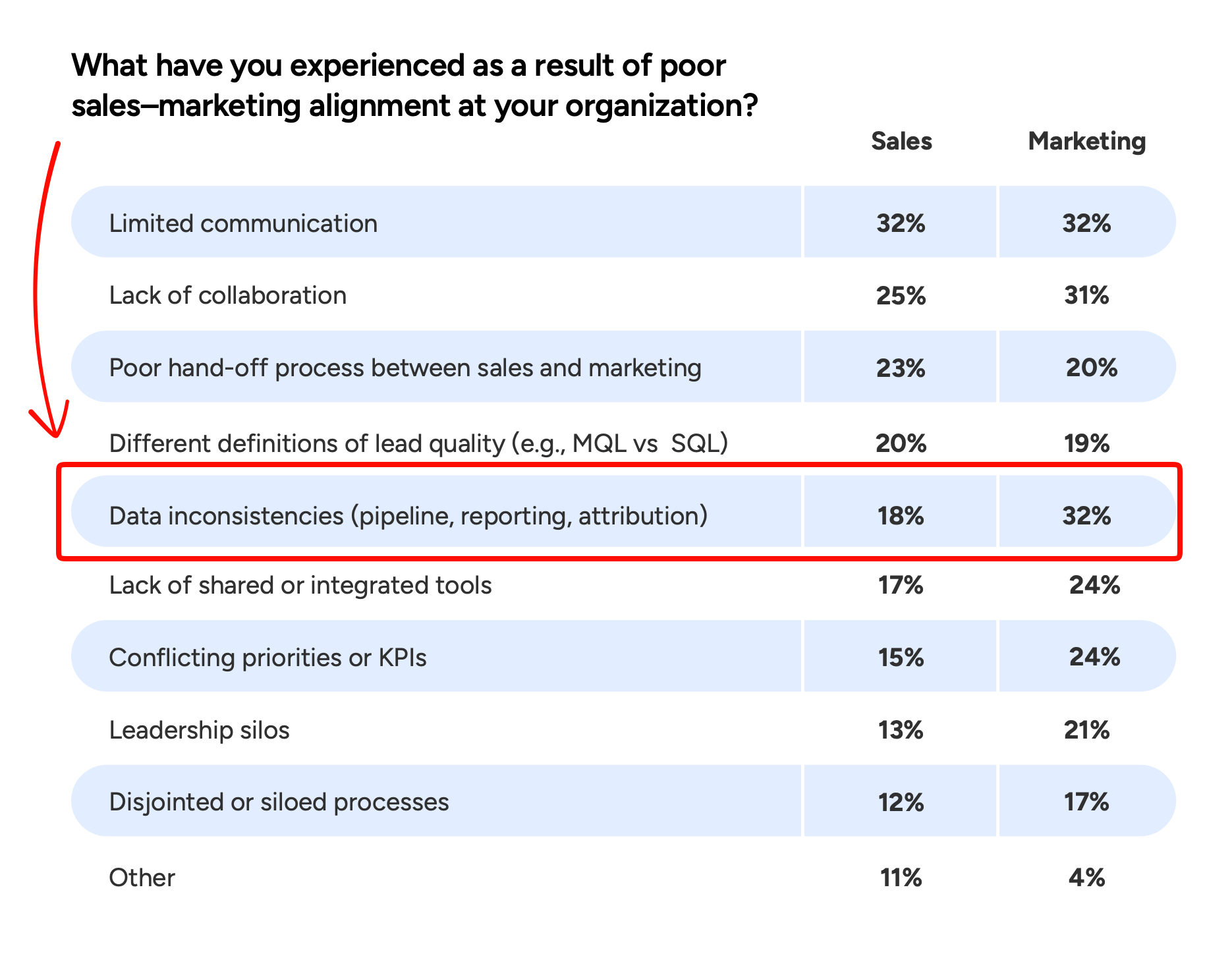
- 23% of sales professionals cite a poor handoff process as a primary operational barrier.
- 32% of marketers report delayed or inconsistent lead follow-up by sales, compared to just 22% of sales professionals who acknowledge the delay.
Phase 3: Pipeline Stagnation and Finger-Pointing
When closed-won revenue dips, the lack of unified data prevents teams from diagnosing the root cause objectively. Marketers point to high lead volume to defend their performance, while sales reps point to low lead quality to excuse missed quotas. The company is left searching for answers across completely different sets of metrics.

Supporting Data: What the Numbers Reveal
The Unbounce research underscores that misalignment is not merely a cultural annoyance—it is a measurable drain on corporate resources, team morale, and bottom-line revenue.
The Cost of Poor Alignment
When asked about the immediate consequences of poor GTM alignment, respondents highlighted significant operational pain points:
- Employee Frustration (29%): Chronic friction between departments degrades workplace morale.
- Delayed Follow-Up: Misses immediate revenue windows and squanders expensive ad spend.
- Duplicated Work: Wastes internal hours that could otherwise be redirected toward conversion optimization.
The Root Causes of Misalignment
The report categorizes the root causes of misalignment into four distinct buckets:
- Operational (53%): Broken workflows and disconnected processes.
- Goal & Incentive (43%): Divergent performance metrics and compensation models.
- Cultural (40%): Departmental tribalism and a lack of cross-functional empathy.
- Structural (34%): Organizational silos and reporting lines that prevent collaboration.
Tool Bloat vs. Lean Operations
Paradoxically, organizations often attempt to purchase their way out of alignment issues by adopting new software, resulting in severe tool bloat:
- 56% of GTM professionals acknowledge that tool bloat is an active issue in their organization.
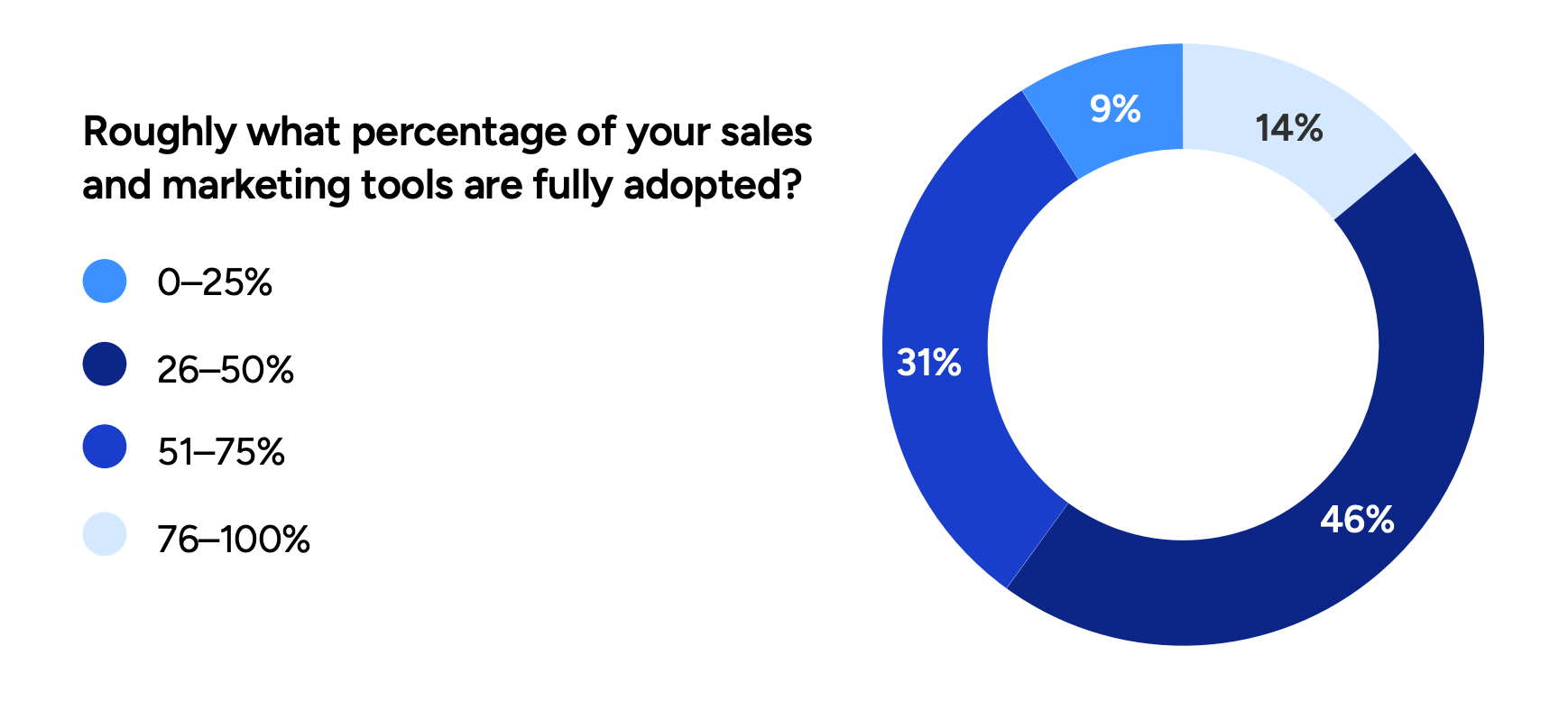
- 60% of teams use less than half of their available tech stack.
- 14% use 0% to 25% of their tools, while 46% use 26% to 50%.
Conversely, organizations that actively consolidate their tech stacks experience dramatic improvements. Teams that significantly consolidated their tools are twice as likely to rate lead quality as "excellent" (55% vs. 20%) compared to those operating with bloated, sprawling software collections.
Official Perspectives and Industry Insights
Josh Gallant, founder of Backstage SEO and author of the study’s analysis, emphasizes that alignment cannot be achieved through communication alone.
"Plenty of alignment programs chase the wrong lever," Gallant notes. "54% of GTM teams put communication frequency first—yet the data clearly points to how teams actually operate underneath those meetings. Alignment gets built in the operating model. Meetings only broadcast what’s already there."
Data from the report reinforces this perspective. While weekly cross-functional discussions help foster collaboration, they only correlate with excellent data sharing when the underlying technological infrastructure is already integrated. Without a shared source of truth, frequent meetings simply provide a formal venue for departments to debate whose numbers are correct.
Furthermore, the data highlights a major divide in how sales and marketing view data consistency: 32% of marketing teams cite data inconsistencies as a primary barrier, compared to just 18% of sales professionals. Because marketing relies heavily on attribution models and macro-analytics, while sales relies on immediate, rep-owned pipeline signals, the two functions are frequently looking at entirely different versions of reality.
Implications: What High-Performing Teams Do Differently
Examining the top-performing 56% of "highly aligned" teams reveals three distinct operational pillars that set them apart from their peers.
1. Unified Data and Lean Tech Stacks
Aligned teams are 3.5 times more likely to report strong cross-functional data sharing (59% vs. 16%). They rely on unified CRM and analytics infrastructure that feeds both departments from a single source of truth, eliminating the need to reconcile spreadsheets on a Tuesday morning. Furthermore, they maintain lean, highly adopted tech stacks rather than accumulating disconnected point solutions.
2. Joint Buyer Personas and Lead Definitions
Rather than treating buyer personas as a purely marketing-owned asset, high-performing organizations treat them as joint artifacts. By incorporating sales call recordings, real-world customer objections, and frontline insights into campaign creation, marketing ensures that outbound messaging mirrors the exact language prospects use during sales discovery calls.
3. Streamlined Lead Qualification and Handoff SLAs
High performers establish rigid, mutually agreed-upon criteria for what constitutes a Marketing Qualified Lead (MQL) versus a Sales Qualified Lead (SQL). They replace ambiguous handoffs with structured SLAs that dictate exact follow-up windows, required context fields, and transparent feedback loops when leads are disqualified.
Conclusion: Actionable Steps for SMB Leaders
Sales and marketing alignment is not an abstract corporate ideal; it is a mechanical engineering challenge within your revenue engine. As the Unbounce data demonstrates, treating alignment as a pure communication exercise ignores the operational realities of data silos, misaligned incentives, and bloated tech stacks.
For SMB leaders looking to close the gap, the path forward is clear:
- Audit your tech stack: Cut unused software and invest in robust data integration tools.
- Redefine the MQL: Force sales and marketing leadership to co-author lead qualification criteria.
- Align incentives: Tie departmental success metrics to shared revenue outcomes rather than isolated activity metrics.
By moving past the meeting-cadence layer and rebuilding the underlying operating model, growing businesses can transform their go-to-market teams into unified, high-performing revenue engines.



