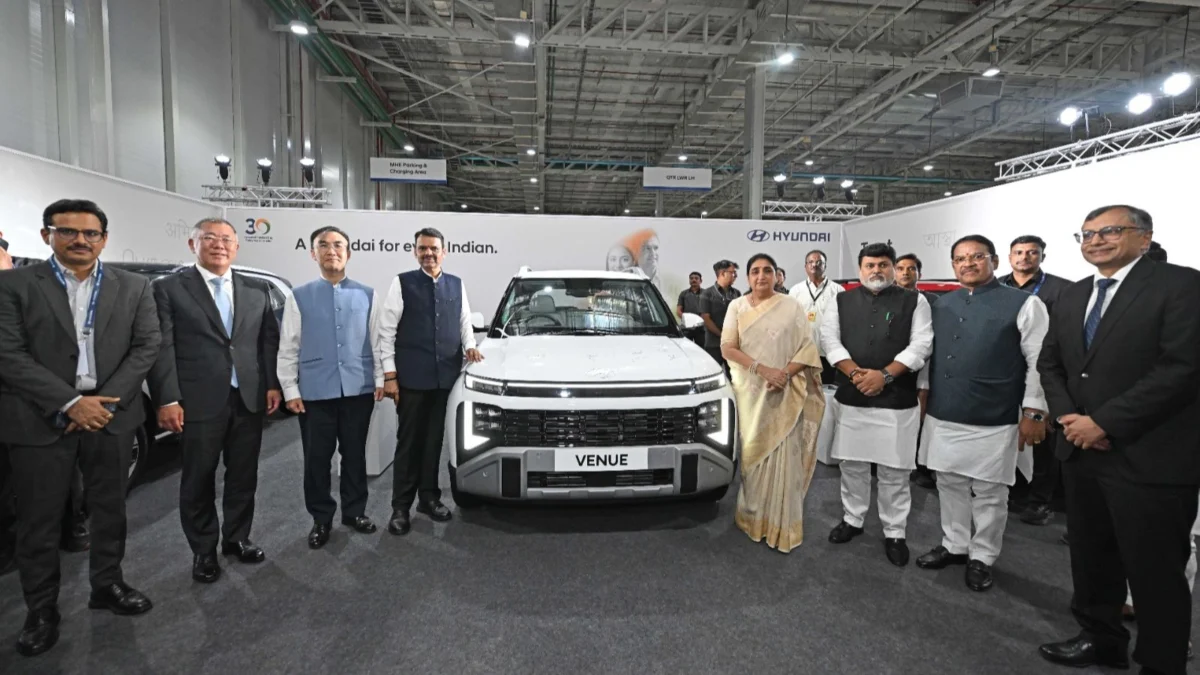
PUNE — In a landmark development for India’s burgeoning automotive sector, Maharashtra Chief Minister Devendra Fadnavis officially inaugurated Hyundai Motor India Limited’s (HMIL) cutting-edge manufacturing facility in Talegaon, Pune, on Wednesday. The grand opening was attended by senior global and domestic executives of the South Korean automotive giant, marking a pivotal chapter in the company’s expansion strategy within the Indian sub-continent.
Simultaneously, HMIL announced a massive capital expenditure commitment of ₹11,000 crore by the year 2030. This financial injection is earmarked for scaling up operations at the newly acquired Talegaon plant, aggressively expanding production capacity by nearly 90%, and fortifying the brand’s footprint in electric mobility, advanced technologies, and local research and development (R&D).
The inauguration comes on the heels of a massive global commitment made just a day prior. During a high-level strategic meeting with Prime Minister Narendra Modi, Hyundai Motor Group’s global leadership pledged a staggering $15.5 billion (approximately ₹1.5 trillion) toward Indian operations and infrastructural development through 2032.
The state-of-the-art Pune plant is poised to become a vital export and domestic manufacturing hub. It will initially roll out volume-drivers such as the popular Hyundai Venue, supplying vehicles to both the domestic market and international export destinations. According to top corporate executives, the facility is designed to play a foundational role in Hyundai’s overarching strategy to reclaim its historic second-place market share in the intensely competitive Indian passenger vehicle segment.
Chronology of Events: A Strategic Surge in the Subcontinent
The unfolding of Hyundai’s latest strategic maneuvers highlights a meticulously planned timeline aimed at deepening its roots in India:
- September 2025: The Indian automotive industry experiences a significant structural and consumer demand shift following comprehensive Goods and Services Tax (GST) rationalization measures implemented by the government.
- Early October 2026: Hyundai Motor Group global management holds high-level deliberations with Prime Minister Narendra Modi in New Delhi, committing an unprecedented $15.5 billion (₹1.5 trillion) to the Indian economy through 2032, signaling India’s elevation as a cornerstone of the automaker’s international growth map.
- Wednesday, October 14, 2026: Maharashtra Chief Minister Devendra Fadnavis travels to Talegaon, Pune, alongside HMIL leadership to officially inaugurate the company’s newest manufacturing facility.
- October 14, 2026 (Later): HMIL leadership addresses a select group of media personnel at the Pune plant, laying out a comprehensive roadmap detailing the allocation of ₹11,000 crore by 2030, an aggressive electric vehicle (EV) product offensive, and a multi-pronged approach to localizing the entire supply chain.
Supporting Data and Financial Allocations
The capital investment of ₹11,000 crore designated for the Pune plant and broader Indian operations is strategically structured to maximize operational efficiency and technological self-reliance. According to Hyundai Motor Group Executive Chair Euisun Chung, the funds have been compartmentalized into three distinct strategic pillars:
- Core Manufacturing and Production Expansion (60%): The lion’s share of the investment—representing roughly ₹6,600 crore—will be utilized to scale up manufacturing output. The Talegaon plant is targeted to nearly double its current footprint, raising total production capacity by 90% to an impressive 3.2 lakh (320,000) units annually.
- New Technologies and Emerging Mobility (20%): Accounting for roughly ₹2,200 crore, this segment will fund the development of cutting-edge automotive software, connected car solutions, and sustainable mobility frameworks.
- Research, Development, and Localisation (20%): Approximately ₹2,200 crore will flow into expanding R&D capabilities, ensuring that vehicle architectures are tailored specifically to the nuanced preferences of Indian consumers while maximizing indigenous parts sourcing.
Regional Economic Impact and Supply Chain Ecosystem
The establishment of the Talegaon manufacturing unit is expected to trigger a massive economic multiplier effect across Maharashtra. By integrating tier-1 and tier-2 local suppliers and vendors, the project will generate thousands of direct and indirect employment opportunities for engineers, floor workers, logistics personnel, and administrative staff.
In a testament to its commitment to localized manufacturing, Hyundai reported that nearly 50% of its Tier-1 supplier network is situated within a tight 50-kilometer radius of the Pune plant. This geographical proximity is designed to optimize supply chain resilience, reduce logistic overheads, and streamline just-in-time manufacturing processes.
Official Responses and Executive Insights
The leadership team at Hyundai Motor India, alongside group executives, articulated a bold vision for the brand’s future during the inauguration ceremonies.
Tarun Garg, Managing Director and Chief Executive Officer of HMIL, emphasized that the aggressive capital infusion is part of a calculated, multi-pronged growth strategy.
"Very clearly, Hyundai is accelerating investment in India, and HMIL is going to be a very big beneficiary," Tarun Garg stated during an exclusive media interaction at the Pune plant.
"We have a multi-pronged approach. Today you saw the capacity addition. As you know, we are going to launch 26 new models to marry this capacity so that we can get back the market share as well. Also, we are investing a lot in the entire EV ecosystem. So not only will we have 4 EVs by 2029, we will also be investing in the charging infrastructure. Also, we are localising the entire supply chain. The whole idea is that by 2030, 50% of our portfolio is sustainable."
Echoing a philosophy focused on organic excellence rather than numerical supremacy, José Muñoz, President and Global CEO of Hyundai Motor Company, offered a grounded perspective on market positioning:
"We’re not obsessed with that (market share)," José Muñoz remarked. "Most important is good product, good quality. And then everything else is going to come."
Maharashtra Chief Minister Devendra Fadnavis praised the partnership, emphasizing the state’s investor-friendly policies, robust infrastructure, and skilled talent pool, which continue to make Maharashtra the premier destination for global manufacturing giants.
Market Implications: The Battle for the Second Spot
To fully appreciate the significance of Hyundai’s Pune rollout, one must examine the shifting competitive landscape of the Indian passenger vehicle market.
For nearly 16 consecutive years, Hyundai comfortably held its position as India’s undisputed second-largest car manufacturer, trailing only Maruti Suzuki India Limited. However, recent quarters have seen dynamic shifts. Propelled by aggressive electric vehicle adoption, localized platforms, and aggressive SUV rollouts, domestic powerhouses such as Tata Motors and Mahindra & Mahindra have made formidable inroads, occasionally challenging or surpassing HMIL’s historical market standing.
India currently stands as Hyundai’s fourth-largest global market. Driven by strategic initiatives like the Pune facility expansion, the automaker harbors ambitions to elevate India to its second-largest market worldwide by the end of the decade.
The EV Frontier and Sustainable Portfolio Transition
A critical vulnerability for HMIL in recent years has been its comparatively slower entry into India’s rapidly accelerating Electric Vehicle (EV) segment, where competitors like Tata Motors established an early-mover advantage.
Hyundai is now moving decisively to close this gap. The automaker has outlined a robust roadmap that includes:
- The introduction of four dedicated battery electric vehicles (BEVs) tailored for the Indian market by the year 2029.
- Heavy capital investments in charging infrastructure development to alleviate range anxiety among consumers.
- Upstream investments in localized battery cell manufacturing and supply chain integration to comply with stringent government Phased Manufacturing Programme (PMP) guidelines.
- A target to ensure that 50% of its overall domestic product portfolio comprises sustainable, eco-friendly powertrains (including EVs, hybrids, and alternative fuel options) by 2030.
By combining the manufacturing might of its original Sriperumbudur plant in Tamil Nadu with the newly launched Talegaon facility in Maharashtra, Hyundai is systematically fortifying its industrial base. With 26 upcoming vehicle models scheduled for release over the next few years, matched to a near-doubling of capacity in Pune, the stage is set for a high-stakes battle for dominance in the world’s third-largest automotive market.