







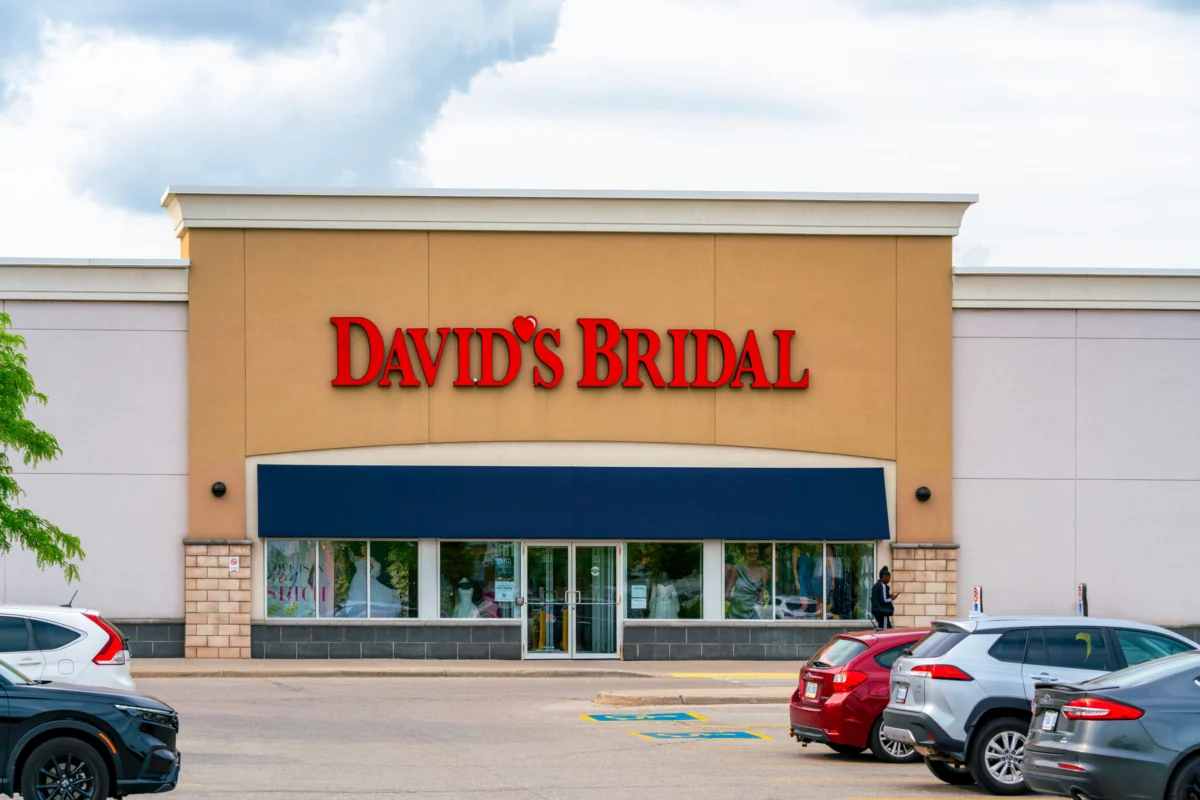
In a landmark shift for the bridal retail sector, David’s Bridal—a titan with 75 years of history—has announced a transformative plan to spin off its innovative “Pearl” wedding planning technology into a publicly traded entity. This move, executed through a nonbinding letter of intent with special purpose acquisition company (SPAC) K&F Growth Acquisition Corp. II, represents more than just a corporate restructuring; it is a pivot toward an “asset-light” software and media future.
By separating Pearl, which functions as an agentic artificial intelligence (AI) wedding planner, David’s Bridal aims to unlock significant shareholder value while allowing its core retail operations to continue their established path of brick-and-mortar and e-commerce excellence. If the deal reaches a definitive agreement, the newly formed public company would eventually assume ownership of the David’s Bridal brand and its extensive intellectual property, effectively repositioning the retailer as a software-driven ecosystem.
The Chronology of Transformation
The trajectory leading to this potential spinoff began in earnest in 2025, when David’s Bridal finalized a comprehensive transition to the Shopify platform. This migration was not merely a technical upgrade; it served as the digital foundation upon which the company could build its sophisticated AI capabilities.
Following the platform migration, David’s Bridal launched its "Pearl" wedding planner in beta, a tool designed to leverage agentic AI to automate and personalize the complex process of planning a wedding. The tool’s success was rapid, as it tapped into the company’s vast customer base. By October 2025, the strategic vision had crystallized: management realized that the technology powering Pearl held more potential as a standalone, scalable business model than as a supplementary service for a traditional retailer.
On October 22, 2025, the formal announcement of the nonbinding letter of intent with K&F Growth Acquisition Corp. II sent shockwaves through the retail technology sector. The proposed transaction values Pearl at $350 million and includes a $75 million private investment component, setting the stage for a public listing that could redefine how brides-to-be interact with the multibillion-dollar wedding industry.
Data-Driven Growth: The Economic Engine Behind Pearl
The business case for spinning off Pearl is built upon a foundation of aggressive growth projections and high-margin potential. Currently, David’s Bridal boasts that an impressive 90% of U.S. brides interact with the Pearl ecosystem in some capacity. This ubiquity provides a massive funnel for the company’s proprietary platforms.
Key Financial Projections
- Profitability: Pearl is currently operating with established profitability, a rarity for many AI-focused startups seeking public markets.
- Margin Expectations: The company forecasts that Pearl will achieve margins exceeding 30% by the end of 2026.
- Revenue Scaling: The growth trajectory is steep, with expectations that revenue will surge by more than 100% year-over-year in 2027, surpassing the $85 million mark.
The financial structure of the deal is also notable for its institutional backing. Of the $75 million in private investment, $25 million is pledged by the CION Investment Corporation, which is currently the largest shareholder in David’s Bridal. This reinvestment signals strong confidence from the company’s primary backers in the viability of the AI-led, asset-light model.
The Technological Architecture: Beyond Traditional Retail
To understand why Pearl is being valued at $350 million, one must look at the "trifecta" of services it provides. Pearl is not just a digital planner; it is an integrated platform designed to capture every stage of the wedding journey.
The Pearl Ecosystem
- Agentic AI Wedding Planner: Unlike static checklists, this AI acts as an agent, capable of managing tasks, suggesting vendors, and streamlining decision-making for couples.
- Pearl Media Network: Born from the acquisition of Love Stories TV, this retail media network provides a platform for vendors and brands to reach highly targeted, high-intent consumers.
- Pearl Connect: This proprietary conversion engine is the "closer" of the platform. It is designed to bridge the gap between initial interest and final booking, ensuring that leads generated by the AI are converted into revenue for the vendor ecosystem.
By combining these three elements, Pearl creates a "closed-loop" system. A bride starts by planning with the AI, is exposed to curated content via the Media Network, and is ultimately connected to vendors through Pearl Connect.
Official Responses and Leadership Vision
The transition to a public company will see a shift in the executive suite. Kelly Cook, currently the CEO of David’s Bridal, is expected to transition into the role of CEO for the newly independent Pearl. Joining her will be Elina Vilk, the current president and chief business officer of David’s Bridal, who will step into the role of president at Pearl.
"This is an exciting milestone in David’s Bridal’s 75-year history and a defining moment for our future," said Kelly Cook. "Pearl is shaping the next generation of wedding planning, and this next step will give both businesses room to grow independently while continuing to strengthen each other."
The partners at K&F Growth Acquisition Corp. II have echoed this sentiment, emphasizing the synergy between traditional retail and modern software monetization. "We were drawn to Pearl’s compelling trifecta of established profitability, highly attractive growth potential, and unlevered pristine balance sheet," noted Dan Fetters, co-CEO of K&F.
Edward King, co-CEO of K&F, added, "Pearl pairs longstanding relationships across the wedding industry with an asset-light software and media monetization model. We believe our capital markets and M&A expertise will help accelerate Pearl’s growth."
Implications for the Future of Retail
The implications of this move are twofold: for the future of David’s Bridal and for the broader retail industry.
For David’s Bridal Operations
For the millions of customers who rely on David’s Bridal for gowns and accessories, the company has provided clear assurances: operations will remain unchanged. The physical stores, which serve as the physical touchpoint for the brand, are expected to operate as usual. There will be no disruption to appointments, product availability, or the guest experience. The retail arm effectively becomes a brick-and-mortar "showroom" for the digital ecosystem, maintaining the brand’s physical footprint while its "brain"—the AI platform—is free to scale globally as a software-as-a-service (SaaS) entity.
For the Retail Industry
David’s Bridal is currently ranked No. 460 in the Digital Commerce 360 Top 1000 Database and No. 178 in the AI Commerce Rankings. By spinning off its AI unit, the company is demonstrating a new blueprint for legacy retailers:
- Digital Transformation as an Asset: The shift proves that digital tools, if sufficiently developed, can be spun off to generate independent value.
- Monetization of Consumer Data: By establishing a retail media network, retailers can move beyond product sales to earn revenue through advertising and lead generation.
- The Rise of Agentic AI: David’s Bridal is at the forefront of the shift from generative AI (which creates content) to agentic AI (which completes tasks). This will likely become the industry standard for high-ticket service retail.
Conclusion
As David’s Bridal maneuvers through this potential transition, the market is watching closely. If successful, the move could serve as a case study for how legacy retail brands can survive and thrive in an AI-dominated economy. By decoupling its high-tech Pearl platform from its labor-intensive retail operations, the company is effectively hedging its bets: it maintains the reliable, physical revenue stream of a traditional bridal retailer while simultaneously positioning itself as a high-growth, high-margin player in the rapidly evolving world of wedding-tech.
The road ahead requires a definitive agreement, regulatory approval, and the successful execution of a public offering. However, the vision is clear: the future of the wedding industry is not just in the dresses, but in the intelligent, data-driven orchestration of the entire wedding journey.