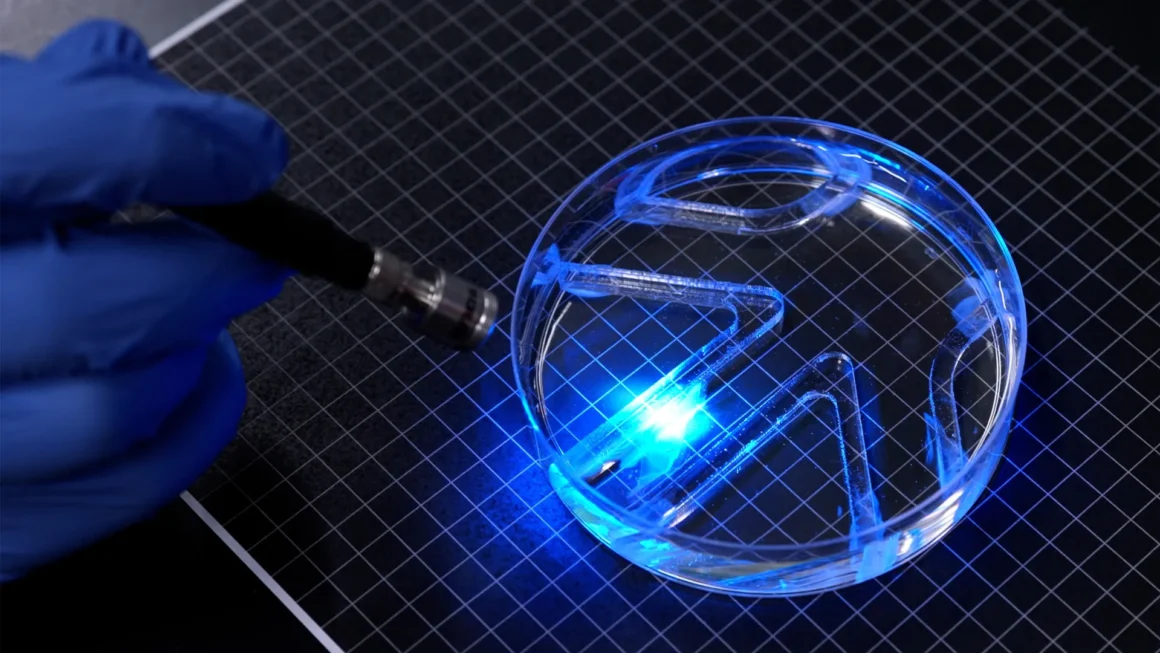


GUILDFORD, UK — In a development that could reshape the trajectory of the quantum computing industry, researchers at the University of Surrey have unveiled a radical new qubit design. Published in the journal npj Quantum Information, the proposal addresses the single greatest hurdle in the commercialization of quantum technology: scalability hindered by extreme error rates. By harnessing the peculiar, friction-free physics of superfluid helium-3, the Surrey-led team has mapped out a conceptual device that theoretical calculations show could achieve error rates roughly 100 times lower than today’s industry-standard superconducting systems.
The innovation, designated the Superfluid Helium Oscillator Quantum (SHOQ) device, introduces an entirely new class of hardware to the quantum landscape. Developed in collaboration with international partners—most notably Professor Jens Koch of Northwestern University, a key pioneer behind the widely used transmon superconducting qubit—the SHOQ architecture bypasses the electromagnetic vulnerabilities that plague conventional processors. As researchers prepare to transition from theoretical modeling to physical prototyping, the scientific community is taking a hard look at a material once thought divorced from the practicalities of modern microprocessors: liquid helium.
Main Facts
The core proposition of the University of Surrey’s research centers on the inherent fragility of quantum information. Traditional quantum computers rely on qubits (quantum bits) that can exist in superpositions of states, allowing them to process vast amounts of data simultaneously. However, these states are hypersensitive to their environment.
- The Vulnerability Problem: Most contemporary quantum systems—championed by tech giants and academic labs alike—utilize superconducting circuits. While powerful, these circuits are notoriously susceptible to electromagnetic noise, stray electrical charges, and thermal fluctuations. Much like static electricity causing a balloon to cling to a sweater, stray interference can corrupt quantum data, a phenomenon known as decoherence.
- The Scale Barrier: As engineers add more qubits to a processor to increase its computational power, controlling and correcting these errors becomes exponentially more complex. This error-scaling dilemma is the primary bottleneck preventing quantum computers from reaching fault-tolerant, commercial viability.
- The Superfluid Solution: The Surrey team’s SHOQ device avoids these electromagnetic pitfalls by utilizing charge-neutral superfluid helium-3. Because superfluid helium carries zero electric charge, it is fundamentally immune to the stray electrical fields and electromagnetic noise that disrupt superconducting circuits.
- Unprecedented Precision: Mathematical models and rigorous calculations detailed in the npj Quantum Information study indicate that the SHOQ design could slash error rates by two orders of magnitude—a 100-fold improvement over conventional superconducting qubits.
- Collaborative Pedigree: The research was spearheaded by the Quantum Sciences Group at Surrey’s School of Mathematics and Physics, led by Dr. Priya Sharma and Dr. Eran Ginossar, with vital contributions from Northwestern University’s Professor Jens Koch.
Chronology of the Discovery
The journey toward the SHOQ device did not happen overnight; it represents the convergence of decades of low-temperature physics research and modern quantum engineering.
Early Foundations in Low-Temperature Physics
For generations, superfluid helium—specifically the rare isotope helium-3 cooled to temperatures close to absolute zero—has fascinated physicists due to its ability to flow without any viscosity or friction. While its macroscopic quantum properties were well-documented, translating these fluid dynamics into the discrete, controllable states required for quantum computing remained an uncrossed bridge. Individual components of the concept, such as trapping electrons on the surface of liquid helium or manipulating helium ions, had been studied in isolation for years.
The Synthesis of Ideas (2022–2023)
The turning point came when Dr. Priya Sharma and her colleagues at the University of Surrey began investigating whether these disparate phenomena could be unified. Recognizing that microfluidic engineering had advanced sufficiently to handle ultra-pure liquid helium on a microscopic scale, the team set out to design a closed-loop system. They realized that by confining superfluid helium within a specialized microfluidic cavity coupled with electromagnetic fields, they could create a stable quantum harmonic oscillator.
International Collaboration and Mathematical Validation (2023–2024)
To refine the architecture, Surrey partnered with Professor Jens Koch of Northwestern University. Koch brought invaluable expertise, having previously co-developed the transmon qubit—a foundational element of modern superconducting quantum processors. Together, the team ran extensive mathematical simulations to test how a superfluid-based oscillator would behave under operational quantum conditions. The results exceeded expectations: the math consistently demonstrated that the charge-neutral medium provided a robust shield against environmental decoherence, resulting in the predicted 100-fold reduction in errors.
Formal Publication and the Push to Prototyping (Late 2024–Present)
Following peer review, the findings were formally published in npj Quantum Information. Momentum quickly shifted from the chalkboard to the laboratory. Backed by an IAA Commercialisation Fellowship awarded to Dr. Sharma, the Surrey team is currently engineering the first physical prototype of the SHOQ device. While experimental confirmation remains the ultimate test, the blueprint for the world’s first superfluid-based qubit is now firmly established.
Supporting Data and Technical Architecture
To understand the magnitude of the Surrey team’s proposal, one must examine the specific mechanics of the Superfluid Helium Oscillator Quantum (SHOQ) device and how it diverges from existing hardware paradigms.
The Mechanics of Superfluid Helium-3
Superfluidity in helium-3 occurs at millikelvin temperatures—fractions of a degree above absolute zero. In this state, atoms pair up in a manner akin to Cooper pairs in superconductors, allowing the liquid to flow without encountering any resistance. Crucially, helium atoms possess no net electrical charge.
In conventional quantum computers, qubits are manipulated via microwave pulses applied to metallic circuits. These circuits act as antennas, making them excellent at receiving control signals, but also disastrously efficient at absorbing stray environmental noise. The SHOQ device decouples the quantum state from electrical charge. By using the collective quantum mechanical motion of the superfluid itself as the basis for the qubit, the system bypasses charge noise entirely.
Comparative Performance Metrics
| Feature | Superconducting Qubits (Current Standard) | SHOQ Device (Proposed Surrey Design) |
|---|---|---|
| Primary Medium | Josephson junctions, metallic circuits | Charge-neutral superfluid helium-3 |
| Noise Sensitivity | Highly sensitive to electromagnetic and charge noise | Inherently shielded from charge-based noise |
| Predicted Error Rates | Higher susceptibility, requiring massive overhead for error correction | Estimated ~100 times lower baseline error rates |
| Operating Environment | Millikelvin dilution refrigerators | Millikelvin dilution refrigerators |
| Integration Potential | Standalone architectures | Designed to be hybrid-compatible with existing circuits |
The Hybrid Integration Model
Crucially, the University of Surrey researchers are not proposing that superfluid helium replace existing quantum infrastructure overnight. The quantum computing industry has invested billions of dollars into superconducting architectures, silicon spin qubits, and trapped-ion systems.
Instead, the SHOQ device is envisioned as a complementary technology. Because dilution refrigerators capable of reaching the required millikelvin temperatures are already standard across advanced quantum labs, the physical infrastructure to cool superfluid helium systems largely already exists. The SHOQ device could be fabricated on microfluidic chips that interface directly with traditional superconducting control electronics, leveraging the best of both worlds.
Official Responses and Expert Analysis
The announcement of the SHOQ device has generated considerable excitement and careful optimism within the global physics community.
Dr. Priya Sharma, a Daphne Jackson Fellow in Hybrid Quantum Systems at Surrey’s School of Mathematics and Physics and lead author of the study, emphasized the collaborative and methodical nature of the breakthrough:
"We are not the first to think about the individual components behind this idea, but what we have done for the first time is bring them together in a microfluidic device and work out the specific details that could enable the device to function as a qubit," Dr. Sharma explained.
"The maths tells us that it should work. We have taken what we already know about superfluid helium and quantum technologies and turned that into an educated design, with the parameters and specifications needed to build one. The next step is to make a prototype and put those predictions to the test."
Dr. Eran Ginossar, Associate Professor in the Department of Physics and Advanced Technology Institute at Surrey and co-author of the study, highlighted the paradigm shift away from monolithic hardware designs:
"We don’t necessarily need one type of qubit to do everything. Combining different quantum technologies could allow us to take advantage of the strengths of each," said Dr. Ginossar.
"Superfluid helium gives us a fundamentally different type of quantum hardware to explore. If the predicted performance can be demonstrated experimentally, it could eventually work alongside existing superconducting technologies as part of a larger quantum system."
Professor Jens Koch of Northwestern University, reflecting on his role in bridging solid-state superconducting physics with fluid-based quantum mechanics, noted that exploring uncharted states of matter is essential if the quantum industry is to break past its current technological plateau. While acknowledging the immense engineering challenges of working with microfluidic helium at extreme low temperatures, Koch and his peers agree that the theoretical foundation laid by the Surrey team warrants aggressive experimental pursuit.
Implications for the Future of Quantum Computing
If the University of Surrey’s prototype successfully translates its theoretical models into physical reality, the implications for the quantum computing sector will be profound, spanning error correction, hardware architecture, and specialized applications.
The Error Correction Bottleneck
Currently, quantum error correction (QEC) is the most resource-heavy aspect of building a fault-tolerant quantum computer. Because physical qubits are so prone to errors, scientists must group hundreds or even thousands of physical qubits together to create a single, highly stable "logical qubit."
If the SHOQ device achieves error rates 100 times lower than conventional superconducting qubits, the physical hardware overhead required for error correction could drop dramatically. This would mean that fault-tolerant quantum computers could potentially be scaled up with far fewer components, accelerating timelines for commercial viability by years.
A New Frontier for Quantum Memory
Beyond functioning as active processing units, the unique characteristics of superfluid helium make the SHOQ device an ideal candidate for quantum memory.
In advanced heterogeneous quantum architectures, different components are optimized for specific tasks. While high-speed superconducting circuits might handle complex logical calculations, a superfluid-based qubit system could act as a secure, highly isolated repository for storing fragile quantum states over longer periods without degradation. This division of labor mirrors classical computing, where fast CPU registers are complemented by distinct RAM and storage solutions.
Hurdles on the Road Ahead
Despite the immense promise, significant engineering trials remain. Constructing microfluidic channels that can maintain ultra-pure superfluid helium-3 under millikelvin conditions requires extreme precision. Any microscopic impurity, surface defect, or thermal fluctuation could destabilize the delicate fluid dynamics required to maintain the quantum state.
However, with funding secured through Dr. Sharma’s IAA Commercialisation Fellowship and international collaboration well underway, the University of Surrey team is fully equipped to tackle these obstacles.
Conclusion
The proposal of the Superfluid Helium Oscillator Quantum device marks a refreshing departure from conventional incrementalism in quantum engineering. By stepping outside solid-state electronics and looking to the strange, friction-free properties of liquid helium, Surrey researchers have opened a promising new chapter in the quest for stable, scalable quantum computing. As the laboratory shifts from equations to hardware, the global tech community will be watching closely to see if superfluid physics can deliver the error-free quantum future the world has been waiting for.