


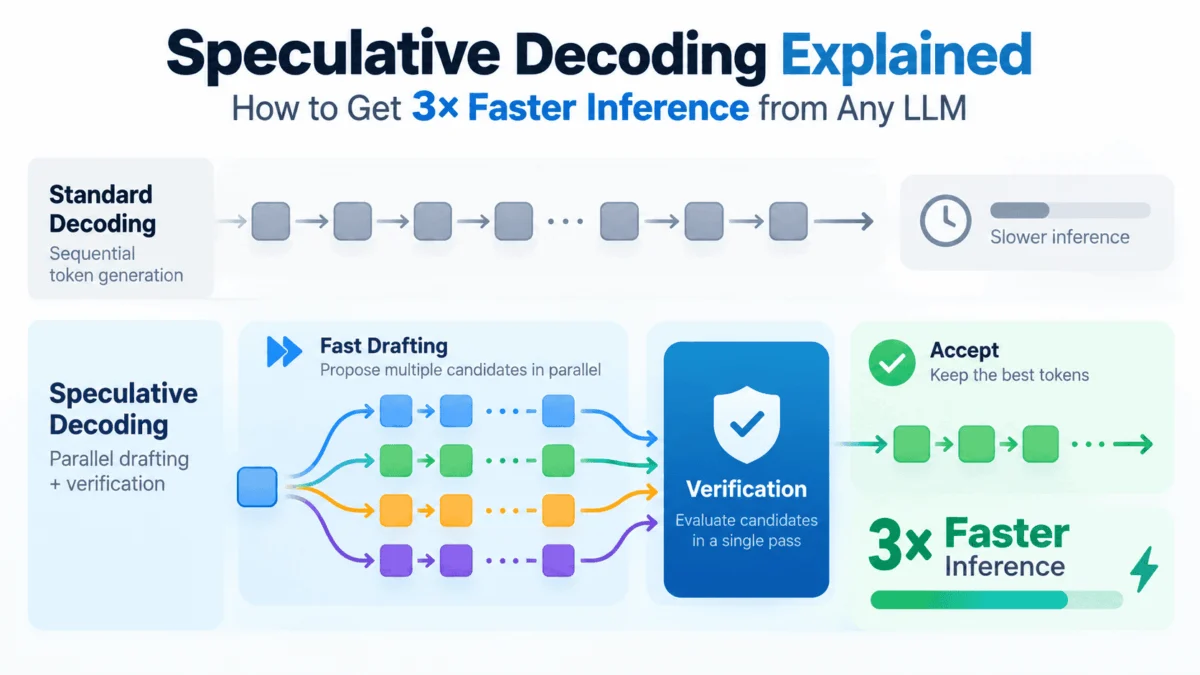
The rapid proliferation of Large Language Models (LLMs) has ushered in a new era of generative AI, but this progress has hit a stubborn physical barrier: the "token-by-token" bottleneck. As models like GPT-4, Llama 3, and Claude scale to hundreds of billions of parameters, the latency involved in producing text has become a critical pain point. Developers, enterprises, and end-users are increasingly demanding sub-second response times for real-time applications, such as coding assistants and interactive agents.
Enter Speculative Decoding, a sophisticated architectural paradigm that promises to revolutionize inference efficiency. By decoupling the generation of candidate text from the rigorous verification of that text, this technique achieves 2x to 3x faster performance without retraining models or sacrificing the mathematical integrity of the output.
The Core Problem: The Memory-Bandwidth Wall
To understand the necessity of speculative decoding, one must first look at the mechanics of LLM inference. Modern LLMs are autoregressive, meaning they generate one token at a time. To produce a single word, the model must read its entire weight matrix—often hundreds of gigabytes—from the GPU’s VRAM into its high-speed compute units.
The issue is not that our processors are slow; it is that they are "memory-bandwidth bound." The GPU can compute the next token in microseconds, but it spends the vast majority of its time waiting for the massive weight matrices to move from memory to the processing cores. Because this data transfer happens for every single token, the compute units sit idle for the majority of the cycle. Adding more raw compute power to a server does little to solve this, as the bottleneck remains the speed of the data bus, not the number of transistors.
A Chronology of Breakthroughs
The evolution of speculative decoding represents a shift in how we conceptualize neural network inference.
- Early 2023: The Theoretical Foundation. Researchers introduced the concept of speculative sampling, demonstrating that one could use a smaller, "draft" model to predict the next few tokens, which a larger "target" model would then verify in parallel.
- Late 2023: Architectural Refinements. The industry moved toward standardized implementations. Frameworks like
vLLMandllama.cppbegan integrating speculative decoding as a first-class feature, moving it from experimental research to production-grade utility. - 2024: The Era of Self-Speculation. The field evolved beyond the "two-model" requirement. Methods like Medusa and Eagle emerged, allowing models to draft their own future tokens using internal hidden states, effectively eliminating the need for a separate, secondary draft model.
- 2025 and Beyond: Standardized Integration. Today, speculative decoding is becoming an implicit expectation in model serving, with hardware-level optimizations being baked into the next generation of inference engines.
How Speculative Decoding Works: A Two-Stage Loop
The magic of speculative decoding lies in its ability to transform a serial process into a parallel one. The operation follows a precise, iterative loop:
1. The Drafting Stage
A lightweight "draft" model—often a distilled version of the target model or a specialized small language model (SLM)—generates a sequence of $N$ candidate tokens. Because the draft model is small, it can generate these tokens at high speed, utilizing significantly less memory bandwidth.
2. The Verification Stage
The "target" model receives this sequence of $N$ tokens. Because GPUs excel at batch processing, the target model can evaluate all $N$ tokens simultaneously in a single forward pass. It calculates the probability distribution for the entire sequence at once.
3. The Rejection/Acceptance Logic
Using a statistical algorithm, the target model compares its own predictions against the draft model’s candidates. If the target model’s confidence in a draft token matches or exceeds a specific threshold, the token is accepted. If a token is rejected, the target model samples a corrected token, and the sequence is truncated.
This process provides a mathematical guarantee: the output is indistinguishable from the target model’s original autoregressive generation. There is no approximation of quality; the result is statistically perfect.
Supporting Data: Efficiency Metrics
In empirical benchmarks, speculative decoding demonstrates its value through the "acceptance rate"—the percentage of tokens predicted by the draft model that the target model ultimately keeps.
- Acceptance Rates: In well-matched pairs (e.g., Llama-3-70B as the target and Llama-3-8B as the draft), acceptance rates typically hover between 60% and 80%.
- Latency Reductions: By reducing the number of memory-heavy passes required for a 100-token response, speculative decoding reduces latency by 2x to 3x.
- Hardware Efficiency: Studies show that when speculative decoding is active, the utilization of GPU compute cores increases by nearly 40% compared to standard decoding, as the cores spend less time waiting for memory fetches.
Modern Implementations: Beyond Two Models
As the industry matures, three dominant approaches have emerged that allow for faster inference without the baggage of maintaining two separate model weights.
Medusa: Multi-Head Prediction
Medusa adds "prediction heads" to the end of the target model. These heads are trained to predict the next $K$ tokens simultaneously. By predicting multiple tokens at once, the model skips the drafting stage entirely, as the model essentially "guesses" its own future output.
Eagle: Hidden State Extrapolation
Eagle takes a more nuanced approach by utilizing the target model’s hidden states—the rich, contextual numerical representations the model builds before it decides on a specific token. By leveraging these internal states, Eagle can predict future sequences with higher accuracy than Medusa, particularly in complex reasoning tasks.
Prompt Lookup Decoding
This is the most "compute-free" method. It doesn’t rely on a model at all. Instead, it scans the prompt and conversation history for patterns or phrases that are likely to recur. If the model is asked to "summarize the following legal document," the system identifies repeated legal terminology in the input and "speculates" that those tokens will appear in the output.
Implications for the AI Ecosystem
The adoption of speculative decoding has profound implications for the future of artificial intelligence deployment.
1. Democratizing Real-Time AI
Previously, high-quality, large-scale LLMs were restricted to heavy-duty server clusters. By making inference 3x faster, speculative decoding effectively increases the capacity of existing hardware, allowing smaller companies to host high-performance models at a fraction of the previous cost.
2. Shifting the Bottleneck
The industry is now focused on optimizing "KV Caches"—the memory structures that store previous tokens. As compute-heavy inference becomes faster, the industry is seeing a shift where memory capacity (the sheer size of the RAM on a GPU) is becoming more important than pure raw FLOPS (floating-point operations per second).
3. The "Batching" Trade-off
Practitioners must be aware of the "batching penalty." While speculative decoding is a miracle for single-user, real-time requests (like a chatbot), it can be counter-productive in massive, high-throughput scenarios where thousands of users are querying the same GPU simultaneously. In these cases, the extra memory used by the draft model can actually decrease overall system throughput.
Conclusion: A New Standard for Inference
Speculative decoding is not merely an optimization trick; it is a fundamental reframing of how LLMs interact with hardware. By challenging the assumption that we must read the entire model weight matrix for every single word generated, engineers have unlocked a path toward truly fluid, conversational AI.
As these techniques become standard in libraries like Hugging Face, vLLM, and TensorRT-LLM, the "latency wall" that once limited the utility of LLMs is rapidly crumbling. For developers, the message is clear: if your application requires speed, you should no longer be settling for standard autoregressive generation. The future of inference is speculative, parallel, and—most importantly—instant.