






CUPERTINO, CALIFORNIA — In what industry analysts are already calling the most significant shift in mobile hardware design since the introduction of the original iPhone, Apple Inc. has officially broken its silence on foldable technology. Released today, the latest developer dispatch from Apple outlines a new paradigm for mobile computing, moving beyond traditional rigid slabs into a versatile, multi-form-factor future.
The announcement, detailed in Apple’s October 6, 2026, developer briefing, showcases a device engineered to morph across three distinct postures: a "tent mode" optimized for ambient displays, a expansive "book mode" for productivity, and a compact "clam-shell mode" tailored for fitness and quick media consumption. As developers scramble to update their toolkits for this unprecedented hardware ecosystem, the tech world is left to ponder how Apple’s entrance will reshape the smartphone landscape.
Main Facts
Apple’s official documentation and accompanying visual assets confirm that the Cupertino giant is no longer observing the foldable category from the sidelines. The newly revealed device—tentatively referred to in developer circles as the Apple Fold—introduces hardware that fundamentally redefines how iOS and iPadOS applications interact with physical space.
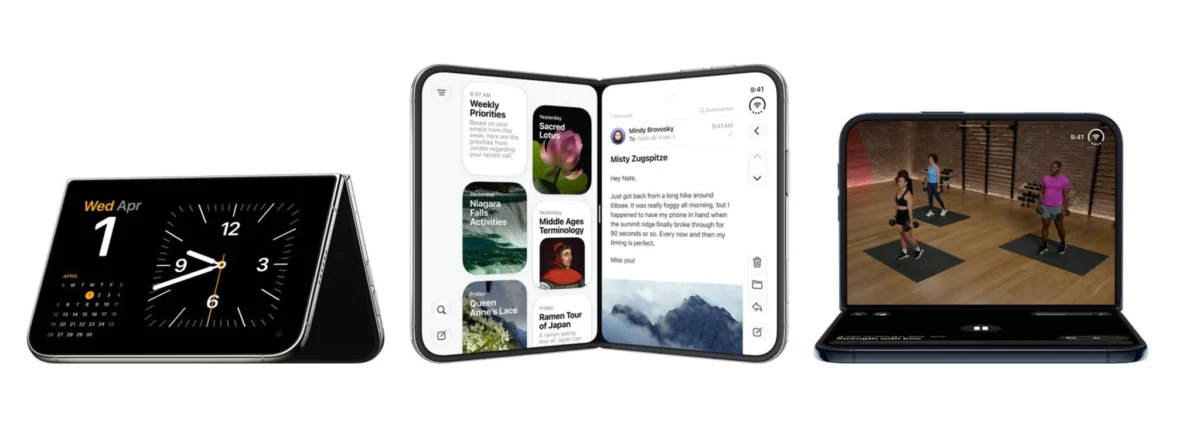
Unlike early-generation foldable devices from competitors that struggled with visible screen creases and durability concerns, Apple’s iteration emphasizes seamless mechanical transition and software adaptability. The device operates across three primary physical configurations:
- Tent Mode: Positioned like an inverted "V," this posture transforms the device into a stationary bedside or desktop hub, displaying persistent widgets such as live calendars, clocks, and ambient notifications.
- Book Mode: Unfolded fully, the device presents a massive, uninterrupted canvas. The interface dynamically splits to accommodate multitasking workflows, natively pairing applications like Notes and Messages in a side-by-side workspace that bridges the gap between smartphone portability and tablet productivity.
- Clamshell Mode: Closed down for pocketability, the exterior display takes over, optimized in the promotional materials for health and fitness tracking, specifically demonstrating a workout video playback interface that utilizes the folded lower half as a stable base.
Crucially, this release is not merely a hardware reveal; it is an invitation to the global developer community. By releasing the architectural guidelines and interface APIs early, Apple is signaling that the success of its foldable venture relies on deeply integrated software adaptations rather than simple compatibility scaling.
Chronology: The Road to Apple’s Foldable Revolution
To understand the magnitude of the October 6, 2026 announcement, one must examine the long, patient trajectory that brought Apple to this juncture. For years, skeptics wondered why Apple—a company known for pioneering premium form factors—sat out the initial foldable boom led by Samsung, Motorola, and Google.
-
2019–2021: The Formative Years of Foldables
As early competitors rushed first-generation foldable devices to market, they faced widespread consumer skepticism regarding mechanical hinge durability, software fragmentation, and fragile polymer screens. During this period, supply chain reports frequently indicated that Apple was filing patents for ultra-thin glass (UTG) and proprietary hinge mechanisms, but company executives maintained a public stance of caution, waiting for the technology to mature. -
2022–2024: The Incubation and Patent Phase
Apple quietly amassed hundreds of patents relating to flexible display panel protection, self-healing coatings, and tension-engineered hinges designed to eliminate the dreaded center crease. Industry insiders noted that Apple was prioritizing iPad and Mac concepts before finalizing a smartphone-sized foldable device, ensuring that the software operating system could fluidly scale across changing aspect ratios. -
2025: Software Foundations and Internal Testing
Ahead of hardware finalization, engineering teams began laying the groundwork within iOS architecture to support dynamic UI reflows. Rumors intensified as select enterprise partners and high-tier developers received closed-door briefings on how multi-pane interactions would function under future hardware parameters. -
October 6, 2026: The Public Unveiling
Apple publishes its developer update, offering the first official, public confirmation of the device’s multi-posture capabilities. By releasing visual assets displaying tent, book, and clamshell modes alongside integration links, Apple officially fires the starting gun for the next era of mobile computing.
Supporting Data and Technical Specifications
While complete hardware spec sheets—such as exact battery capacities, processor generations, and camera module arrays—are expected to be formally detailed at a dedicated Special Event later this quarter, early data extracted from developer documentation offers profound insight into the engineering marvel behind the device.
- Display Architecture: Industry supply chain analytics suggest that Apple has partnered exclusively with top-tier panel manufacturers to produce a bespoke OLED display featuring a proprietary multi-layer protective polymer and an ultra-thin glass substrate. This construction aims to withstand a minimum of 300,000 folds—translating to roughly a decade of heavy daily use.
- Aspect Ratio Dynamics: The transition between Book Mode and Clamshell Mode requires real-time resolution scaling. Apple’s newly updated developer APIs indicate that apps will no longer rely on simple letterboxing or stretching; instead, they will utilize a dynamic grid system that rearranges UI elements based on the hinge angle sensor data.
- Thermal Management: Foldable devices present severe engineering challenges regarding heat dissipation due to their split chassis design. Apple’s thermal architecture reportedly utilizes a custom graphite-sheet cooling system spread across both halves of the device, paired with a low-power variant of its latest silicon chip to maximize efficiency in clamshell and tent postures.
- Market Impact Projections: Financial analysts at major investment firms have revised their fourth-quarter hardware forecasts. Early estimates project that Apple could capture upwards of 45% of the ultra-premium foldable market within the first twelve months of commercial availability, largely driven by loyal iPhone upgraders looking for an iPad-like experience in a pocketable form factor.
Official Responses and Industry Reactions
The tech sector has reacted with a mixture of awe, validation, and strategic recalibration following the October 6 disclosures.
Cupertino’s Perspective
While Apple has historically maintained strict operational secrecy, senior engineering leads noted in the accompanying developer notes that the goal was never to be first to market, but rather to establish the gold standard. "True innovation is not just about bending glass; it is about bending the software to meet human intent without friction," one senior software architect noted in the developer briefing collateral. The emphasis on seamless multi-mode utility is viewed by Apple executives as the ultimate realization of the "post-PC" era vision first articulated over a decade ago.
Competitor Reactions
Rival manufacturers have issued guarded statements acknowledging the validation Apple brings to the category. Executives at major Android OEMs noted privately that Apple’s entry will legitimize foldables for mainstream consumers who previously viewed the technology as a fragile novelty. However, Android competitors also emphasized their multi-year head start in hardware refinement, setting the stage for an intense technological arms race heading into 2027.
The Developer Community
For third-party app creators, the response is overwhelmingly positive, tempered by the immediate workload required to optimize applications. Prominent indie developers took to social media to praise Apple for providing comprehensive layout guides early, allowing them to adapt productivity and media apps well before the commercial launch date.
Implications: What Apple’s Foldable Means for the Future of Computing
The introduction of Apple’s foldable hardware paradigm carries sweeping implications for the entire technology ecosystem, stretching far beyond smartphone sales.
1. The Death of the Rigid Monolith
For nearly twenty years, the smartphone has remained structurally stagnant: a rigid glass rectangle. By proving that hardware can dynamically alter its physical footprint to suit the user’s immediate context—whether working, resting, or exercising—Apple is shifting consumer expectations permanently. Users will increasingly demand versatility from their primary computing devices.
2. Tablet and Laptop Convergence
The "Book Mode" capability bridges the historical divide between smartphones and tablets. As mobile processors grow exponentially more powerful and software environments like iPadOS and iOS merge closer under unified design languages, the need to carry multiple devices for productivity and consumption diminishes rapidly. For many professionals, a pocketable device that unfolds into a full workstation screen may replace secondary tablets entirely.
3. The New UX Design Standard
Software design is entering a post-responsive era. Developers can no longer design solely for portrait or landscape orientations; they must account for fluid spatial states where the UI morphs continuously as a hinge opens or closes. Apple’s developer push guarantees that this fluid design language will quickly become the industry benchmark, forcing competitors to upgrade their own software development kits (SDKs) to match.
4. Economic Realignment in Mobile Hardware
As average selling prices (ASPs) for smartphones continue to rise, premium foldables represent the most lucrative segment for hardware manufacturers. Apple’s entry is expected to drive massive capital investment into display technology, hinge engineering, and battery innovation, ultimately accelerating trickle-down improvements that will benefit mid-range devices in the years to come.
Conclusion
Apple’s October 6, 2026 developer release marks a watershed moment in consumer electronics. By carefully biding its time, observing early market mistakes, and perfecting both the mechanical and software layers of a multi-posture device, Apple has transformed the foldable from a niche gadget category into the undisputed future of personal computing. As developers begin building for tent, book, and clamshell modes, the world watches with bated breath—anticipating the moment this visionary hardware finally lands in the hands of consumers.