










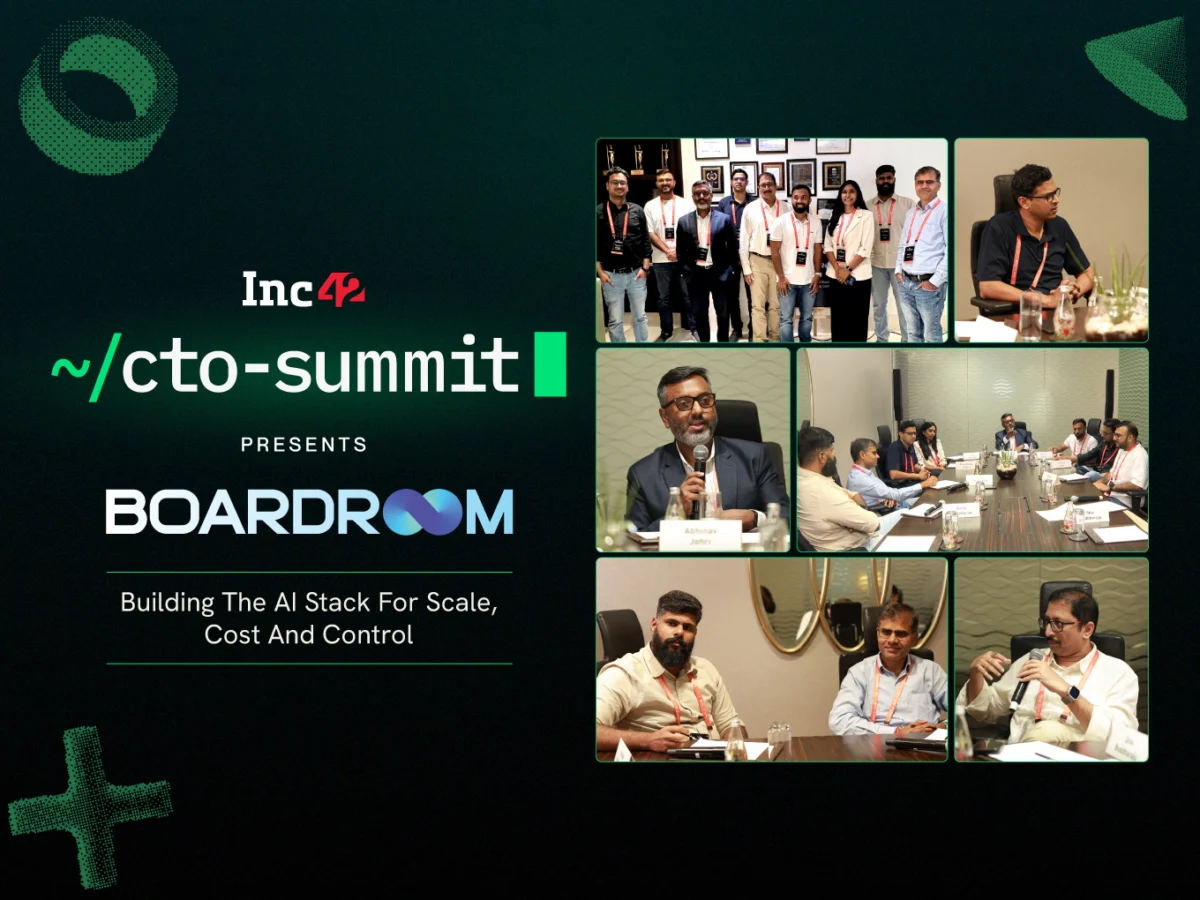
The era of “AI experimentation” is officially over. As Indian enterprises transition into 2026, the question is no longer whether to adopt artificial intelligence, but how to do so in a way that builds a sustainable, profitable, and differentiated business. At the second roundtable of Inc42’s inaugural CTO Summit 2026, industry leaders gathered to dissect the most pressing challenge facing the modern tech organization: the “Build, Buy, or Rent” dilemma.
With 87% of Indian enterprises now actively integrating AI into their workflows—a figure underscored by the government’s December 2025 backgrounder citing Nasscom’s AI Adoption Index—the boardroom conversation has shifted from hype to unit economics. Leaders are now tasked with identifying which technological layers constitute a competitive “moat” and which are merely commoditized utilities.
The Strategic Framework: Understanding the Core
The roundtable, moderated by Abhinav Johri, Partner at EY India, served as a catalyst for a sophisticated debate on the intersection of domain expertise and machine intelligence.
Domain Knowledge as the Ultimate Differentiator
A recurring theme throughout the session was the primacy of domain context. In a market flooded with frontier models—GPT-4o, Claude, Gemini, and their successors—the "intelligence" itself is increasingly becoming a commodity.
"I feel that founders and tech leaders need to know their specific domain really well," argued the representative from Matters.ai. "They must identify not only the existing gaps in their industry but also how to use AI to fill those gaps in ways that have never been attempted before."
This perspective suggests that the most successful AI implementations in 2026 are those where the model is secondary to the proprietary data and specialized workflows that surround it. As noted by the team at SeedlingLabs, while frontier models evolve at breakneck speeds, the "moat" for an AI-native business is built on the unique context it holds. "If it is around data or context, you have to own it," they noted. "The frontier models are transient, but your business context is permanent."
The Precision Imperative
For sectors involving high-stakes transactions, such as fintech, the "move fast and break things" mentality is a non-starter. At CoinSwitch and Lemonn, the approach to AI is governed by a strict requirement for historical continuity.
"When you’re dealing with customer money, accuracy cannot be compromised," the leadership noted. "We build our AI agents on top of 10 years of operational context. You cannot simply drop in a new technology in isolation and expect it to handle complex, high-risk financial decisions."
Chronology of an AI-Driven Business Shift
To understand how enterprises reached this juncture, one must look at the evolution of the AI landscape over the last three years:
- 2023 – The Exploration Phase: Enterprises focused on "playing" with LLMs, generating content, and basic automation scripts. The focus was on novelty and proof-of-concept.
- 2024 – The Integration Phase: Companies began plugging AI into existing software stacks. The primary challenge was latency and data security.
- 2025 – The Operationalization Phase: As highlighted by the Nasscom Index, the majority of the market moved toward active usage. The focus shifted to enterprise-grade security and RAG (Retrieval-Augmented Generation) architectures.
- 2026 – The Optimization Phase (Current): The present focus is squarely on unit economics, contribution margins, and defining the "Buy vs. Rent" boundary.
The "Buy vs. Rent" Calculus
The traditional "build-versus-buy" binary is insufficient for the AI era. Instead, CTOs are now looking at a more fluid model of ownership.
Renting Intelligence for Agility
For many firms, the cost of training and maintaining an in-house foundation model is not only prohibitive but strategically unwise. Netradyne emphasized the necessity of "renting intelligence."
"Unless regulation requires us to run our own models, we are better off renting," they argued. "The leaders keep changing. An open-source model that is ahead today could leave you behind within weeks. For most companies, speed and flexibility matter more than owning the model itself."
This "renting" approach allows firms to swap underlying models as new, more efficient, or more capable iterations emerge, effectively shielding the company from the technical debt associated with managing massive LLM infrastructure.
Building for Scalability
Oxmiq Labs highlighted that the "ownership" decision is often workload-dependent. Developing a prototype might require one set of tools, while serving millions of customers at scale requires an entirely different architecture. "The real question is what you want to own, what you want to rent, and for how long," they noted. CTOs must build modular systems that allow them to swap out components without re-engineering the entire product.
Economic Sustainability: The New Metric of Success
Perhaps the most significant shift observed at the CTO Summit was the emergence of "AI Economics" as a primary product filter. It is no longer enough for an AI feature to be "cool" or "impressive." It must be profitable.
The Contribution Margin Test
At BigHaat, the threshold for deploying AI is strictly tied to business metrics. "Whether it is fulfilment, RTOs (Return to Origin), users, or technology costs, we need to understand the economics before we scale," the leadership explained. If an AI feature increases the cost of serving a customer without a proportional increase in revenue or a reduction in operational overhead, it is abandoned.
Long-term Unit Economics
Gravitas provided a pragmatic example from the healthcare sector: converting clinical charts into ICD and CPT codes. While AI can certainly handle the task, the company compares the AI-driven cost to the existing, optimized BPO-led process.
"We have to ask whether the economics will be sustainable within one or two years," they noted. This filter ensures that AI is used as a tool for efficiency rather than a sink for capital. Similarly, at Vahan.ai, the success of AI is measured by tangible productivity gains—specifically, how many more placements a single telecaller can manage. If the AI doesn’t directly facilitate that outcome, it fails the viability test.
Implications for the Future of Indian Enterprise
The roundtable conclusions paint a clear picture of the future. The "AI-first" enterprise of 2026 is defined by:
- Contextual Moats: Protecting proprietary data and unique operational workflows as the primary source of competitive advantage.
- Model Agnosticism: Refusing to be locked into a single AI provider, preferring a modular architecture that allows for rapid shifts in technology.
- Fiscal Discipline: Treating AI investment with the same rigor as capital expenditure in physical infrastructure. If it doesn’t move the needle on contribution margins, it doesn’t get deployed.
- Human-in-the-Loop Productivity: Focusing AI investment on augmenting human capability (e.g., helping telecallers handle more volume) rather than replacing human decision-making entirely, especially in high-stakes environments.
Final Thoughts
As the Indian tech ecosystem continues to mature, the lessons shared at the Inc42 CTO Summit suggest a transition toward a more sober, disciplined, and strategic application of artificial intelligence. The hype cycle has receded, replaced by the reality of building businesses that can survive the long term.
For the modern CTO, the mandate is clear: own the domain, rent the intelligence, and obsess over the economics. By adhering to these principles, enterprises can move beyond the ephemeral excitement of the "AI revolution" and build companies that offer genuine, sustainable value in an increasingly automated world.



