







SAN FRANCISCO & SEATTLE — In a landmark development for modern cloud architecture, Vercel and Amazon Web Services (AWS) have announced a strategic native integration that brings Amazon Simple Storage Service (Amazon S3) directly into the Vercel Marketplace and v0 by Vercel.
This new capability allows developers building web applications, analytics pipelines, and generative AI agents to provision enterprise-grade S3 resources—including specialized Amazon S3 Tables and Amazon S3 Vectors—without ever leaving the Vercel ecosystem. By streamlining the intersection of front-end deployment workflows and back-end cloud storage, the integration eliminates traditional configuration overhead, establishing a unified application stack built entirely on AWS infrastructure.
Main Facts
The core of this new integration is the seamless provisioning of Amazon S3 storage classes through familiar, developer-centric interfaces. Rather than manually navigating the AWS Management Console to configure complex IAM policies, security credentials, and access control lists, developers can now deploy and link storage buckets with a few clicks or conversational prompts.
The integration natively supports three distinct, high-demand workloads:
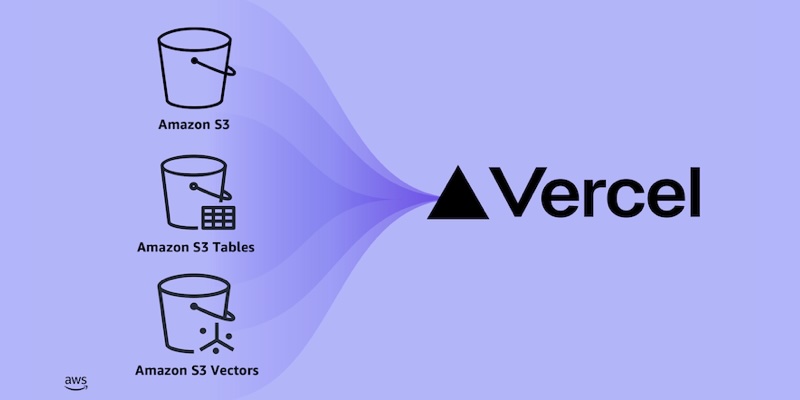
- Everyday Object Storage: General-purpose S3 buckets designed for traditional web assets, media uploads, and document management.
- Analytics (
Amazon S3 Tables): Purpose-built object storage optimized for analytical workloads, providing fully managed Apache Iceberg tables with automated maintenance and compaction. - AI Workloads (
Amazon S3 Vectors): Cost-optimized vector storage explicitly built for Retrieval-Augmented Generation (RAG), semantic search, and AI agent inference.
Security is handled via ephemeral, secure architecture. The integration utilizes OpenID Connect (OIDC) authentication through @vercel/functions/oidc, exchanging short-lived tokens with the AWS Security Token Service (AWS STS). Consequently, no static AWS access keys are ever stored on Vercel servers, mitigating a common vector for data breaches.
Chronology and Evolution of the Vercel-AWS Partnership
The path to this native S3 integration reflects a broader industry trend toward unified, serverless developer experiences.
- Early Phase (The Decoupled Era): Historically, deploying Next.js or other modern web applications on Vercel while leveraging AWS for heavy lifting required managing two disparate systems. Developers built front-ends on Vercel, but had to manually provision, secure, and connect S3 buckets, databases, and microservices through the AWS console.
- The Database Expansion: Vercel gradually bridged this gap by introducing native integrations for enterprise AWS databases, including Amazon Aurora, Amazon DynamoDB, and Amazon OpenSearch Serverless. This allowed developers to manage relational, NoSQL, and search capabilities under a single billing and authentication umbrella.
- The AI Boom and S3 Tables/Vectors: As generative AI transformed software engineering, the demand for vector search and open table formats surged. AWS responded by launching specialized features like S3 Vectors and S3 Tables. Recognizing the friction developers faced in wiring these advanced storage layers into fast-moving AI applications, AWS and Vercel collaborated to bring these capabilities directly into the Vercel Marketplace and the generative UI tool,
v0. - Today: Amazon S3 is universally available across all commercial AWS regions supported by Vercel, cementing a unified stack where web, database, object, table, and vector storage coexist natively.
Supporting Data and Technical Implementation
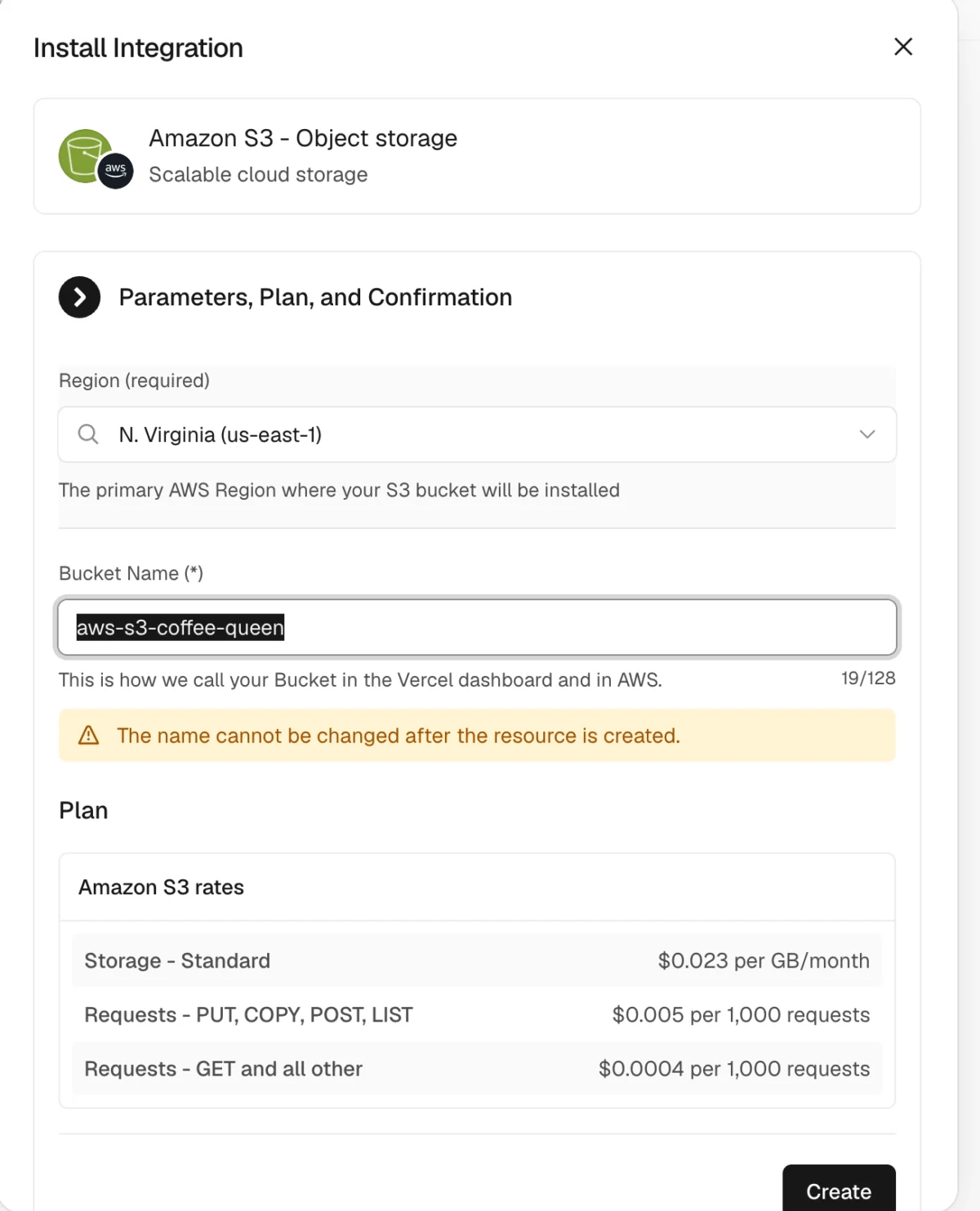
The engineering behind the integration focuses heavily on developer ergonomics and runtime efficiency. Setting up a bucket requires selecting an AWS region and a resource name within the Vercel dashboard. Once linked, environment variables (AWS_REGION, AWS_ROLE_ARN, and bucket identifiers) are automatically injected into the project using the Vercel CLI (vercel link and vercel env pull).
1. General-Purpose Object Storage
For standard web workflows, such as handling file uploads in a Next.js application, developers interact with the standard @aws-sdk/client-s3 coupled with Vercel’s OIDC credentials provider:

import  S3Client, PutObjectCommand  from "@aws-sdk/client-s3";
import  awsCredentialsProvider  from "@vercel/functions/oidc";

const s3 = new S3Client(
  region: process.env.AWS_REGION,
  credentials: awsCredentialsProvider(
    roleArn: process.env.AWS_ROLE_ARN,
  ),
);

export async function POST(request)
  const formData = await request.formData();
  const file = formData.get("file");

  await s3.send(new PutObjectCommand(
    Bucket: process.env.S3_BUCKET_NAME,
    Key: file.name,
    Body: Buffer.from(await file.arrayBuffer()),
    ContentType: file.type,
  ));

  return Response.json( success: true );
2. High-Performance Analytics with S3 Tables
Handling massive analytical queries directly from serverless functions is made possible via S3 Tables and Apache Iceberg. Developers can leverage tools like DuckDB running inside Vercel Functions to query object storage dynamically without maintaining a separate data warehouse:
import  DuckDBInstance  from "@duckdb/node-api";
import  awsCredentialsProvider  from "@vercel/functions/oidc";

const creds = await awsCredentialsProvider(
  roleArn: process.env.AWS_ROLE_ARN,
)();

const db = await DuckDBInstance.create();
const conn = await db.connect();

await conn.run("INSTALL aws; LOAD aws; INSTALL httpfs; LOAD httpfs; INSTALL iceberg; LOAD iceberg;");

await conn.run(`
  CREATE SECRET s3cred (
    TYPE s3,
    KEY_ID '$creds.accessKeyId',
    SECRET '$creds.secretAccessKey',
    SESSION_TOKEN '$creds.sessionToken',
    REGION '$process.env.AWS_REGION'
  );
`);

await conn.run(`
  ATTACH '$process.env.AWS_RESOURCE_ARN' AS s3tables (
    TYPE iceberg,
    ENDPOINT_TYPE s3_tables
  );
`);

const rows = await (await conn.run(`
  SELECT town_city, AVG(median_price) AS avg_price
  FROM s3tables."$process.env.S3_TABLES_NAMESPACE".town_monthly
  GROUP BY town_city
  ORDER BY avg_price DESC
  LIMIT 10
`)).getRowObjects();
3. Native Vector Search for AI Agents
With S3 Vectors, teams building Retrieval-Augmented Generation (RAG) applications no longer need to manage a standalone vector database. Embeddings generated by external models can be queried directly:
import  S3VectorsClient, QueryVectorsCommand  from "@aws-sdk/client-s3vectors";
import  awsCredentialsProvider  from "@vercel/functions/oidc";

const vectors = new S3VectorsClient(
  region: process.env.AWS_REGION,
  credentials: awsCredentialsProvider(
    roleArn: process.env.AWS_ROLE_ARN,
  ),
);

export async function POST(request)
  const  embedding  = await request.json();

  const result = await vectors.send(new QueryVectorsCommand(
    vectorBucketName: process.env.S3_VECTOR_BUCKET_NAME,
    indexName: "documents",
    queryVector:  float32: embedding ,
    topK: 5,
    returnMetadata: true,
  ));

  return Response.json( matches: result.vectors );
Furthermore, through v0 by Vercel, developers can utilize natural language prompts to provision these resources automatically. Typing requests like "Build a support bot that answers questions from my PDFs" instructs v0 to provision an S3 Vectors bucket, wire the proper OIDC credentials, and generate a complete, working codebase.
Official Responses and Strategic Vision
While the partnership emphasizes developer velocity, engineering leaders from both companies stress the underlying enterprise architecture.
"Millions of developers build, deploy, and scale web and AI applications on Vercel," product engineering representatives noted during the rollout. "Storage is essential to performant applications, but provisioning it previously required leaving the context of our workflow. By bringing S3, S3 Tables, and S3 Vectors directly into the Vercel Marketplace and v0, we are offering a complete, end-to-end application stack—from the database layer through to object, vector, and open table storage—all anchored within a single AWS account and billed on a single invoice."
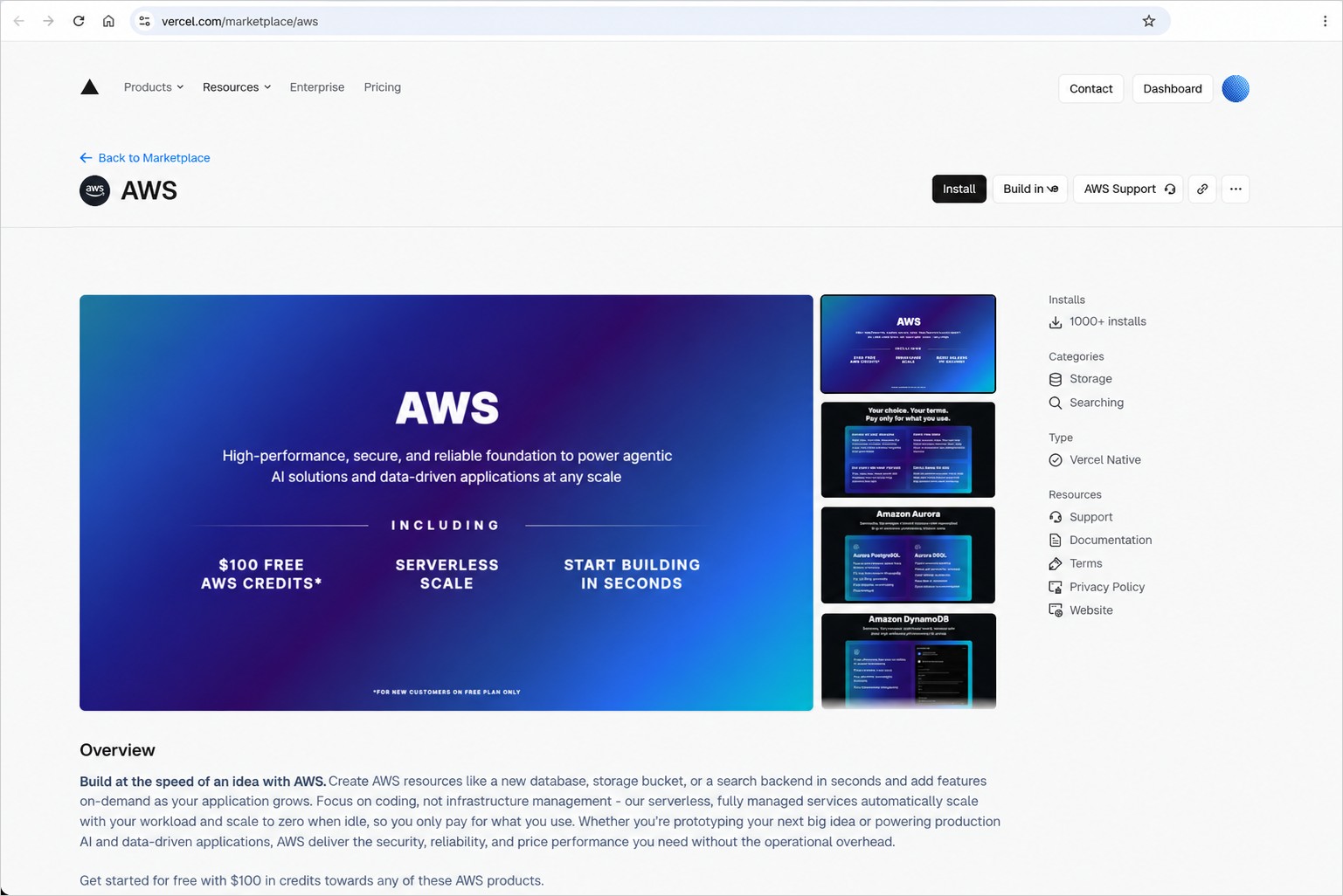
The integration is architected to respect existing enterprise cloud governance. Organizations can either create brand-new AWS accounts directly through Vercel—complete with a promotional incentive of $100 in AWS credits valid for six months—or link their pre-existing enterprise AWS accounts. When linking an existing account, Vercel interfaces exclusively with newly created buckets managed through the platform, ensuring that internal security guardrails, compliance mandates, and AWS-native tooling remain entirely intact.
Implications for the Industry
The arrival of native Amazon S3 support on Vercel signals several significant shifts for software engineering, cloud architecture, and artificial intelligence development:
- Erosion of Infrastructure Friction: The boundary between frontend hosting platforms and deep cloud storage infrastructure continues to blur. By abstracting IAM configuration and credential management via OIDC tokens, platforms like Vercel make enterprise-grade cloud primitives accessible to solo developers and small teams who might otherwise lack dedicated DevOps personnel.
- Consolidation of the AI Stack: The inclusion of S3 Vectors directly challenges the necessity of standalone, single-purpose vector databases for many common use cases. By enabling semantic search natively within object storage, teams can build sophisticated RAG applications with fewer moving parts, lowering operational costs and architectural complexity.
- Open Table Formats in Web Apps: The support for S3 Tables and Apache Iceberg via serverless runtimes like DuckDB opens new doors for web developers. Applications can now perform complex analytical queries on massive datasets directly within standard serverless functions, moving analytical capabilities closer to the application layer.
- Unified Billing and Governance: Enterprises increasingly demand consolidated visibility into cloud expenditures. By keeping all S3 resources anchored in the customer’s native AWS account while managing them via Vercel’s control plane, organizations retain granular auditing capabilities without sacrificing developer velocity.
Availability and Getting Started
There is no additional charge from Vercel to use the integration; developers simply pay standard, consumption-based Amazon S3 pricing for the resources they consume. The feature is available today across all commercial AWS regions supported by Vercel. Developers can begin building immediately by visiting the AWS page on the Vercel Marketplace or leveraging natural language generation through v0.