The rapid proliferation of high-level frameworks—such as LangChain, CrewAI, and LlamaIndex—has democratized the creation of LLM-based agents. It has never been easier to script a local Python loop that allows an agent to reason, access external tools, and refine its output. However, as developers move from the comfort of a Jupyter Notebook to the volatile environment of production, they frequently encounter the "deployment gap."
This gap represents the chasm between a script that works on a developer’s laptop and a resilient system capable of handling thousands of concurrent, high-latency requests. In production, agent workflows are rarely linear; they are riddled with API latency, non-deterministic reasoning loops, and external dependencies. Failing to architect for these realities leads to system timeouts, memory leaks, and catastrophic user experience failures. To bridge this gap, engineers must adopt mature distributed system paradigms, specifically choosing between synchronous and asynchronous execution patterns.
The Architecture of "Wait and See": Synchronous Execution
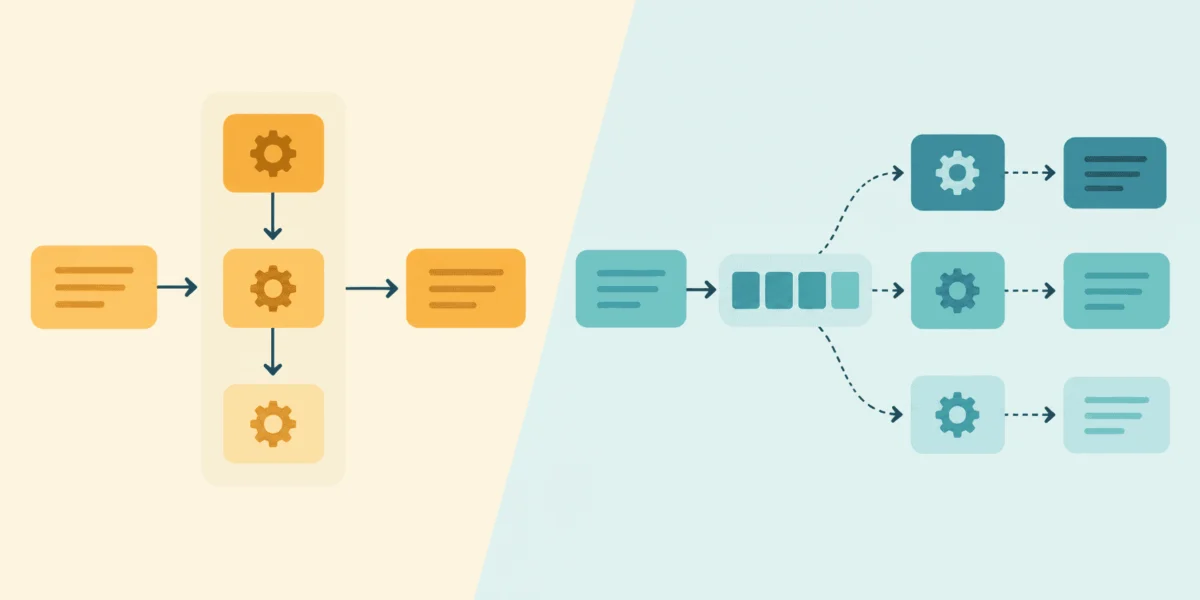
The synchronous execution pattern is the digital equivalent of a traditional telephone call: the initiator must remain on the line until the recipient has finished their task and provided a response. In the context of AI agents, this follows the classic HTTP request-response lifecycle.
The Mechanism of Synchronous Flows
In a synchronous agent architecture, an external client sends a prompt to an API endpoint. The server receives this request and immediately triggers the agent’s execution thread. This thread is then "blocked"—it cannot perform any other tasks—until the agent has completed its entire chain-of-thought, invoked any necessary tools, and generated a final response.
This model is inherently intuitive. It is the default for standard Retrieval-Augmented Generation (RAG) pipelines where the user expects an instantaneous answer to a query.
The Fragility of Synchronous Scaling
While simple to implement, the synchronous pattern is remarkably fragile when applied to advanced agentic workflows. Cloud infrastructure, such as AWS API Gateway, typically enforces a hard 29-second timeout. Consider an agent tasked with planning a multi-step research project: it must search the web, parse multiple documents, and summarize findings. If this process takes 45 seconds, the underlying connection will drop long before the agent returns a result. This leads to wasted computational tokens, disconnected clients, and "zombie" processes that consume resources without delivering value.
The Paradigm of "Fire and Forget": Asynchronous Execution
As agent workflows grow in complexity—incorporating multi-agent debates, code refactoring, or human-in-the-loop (HITL) approval gates—the synchronous model becomes a bottleneck. This is where asynchronous, event-driven architecture becomes the industry standard.
Decoupling Submission from Execution
The asynchronous pattern fully decouples task submission from task completion. When a client triggers an agent, the system does not wait for the output. Instead, it generates a job_id and returns it to the client immediately. The request is pushed into a message broker, such as RabbitMQ or Redis, where it waits to be claimed by a fleet of background worker nodes.
This "fire and forget" methodology allows the agent to run for minutes or even hours without blocking the user interface. Because the state is frequently checkpointed to a persistent store like PostgreSQL or MongoDB, the system gains a critical advantage: resilience. If a worker node crashes during a long-running task, the system can detect the failure and resume the agent’s work from the last saved state rather than restarting from scratch.
Comparative Analysis: Synchronous vs. Asynchronous
| Feature | Synchronous (Request-Response) | Asynchronous (Event-Driven) |
|---|---|---|
| Complexity | Low (easy to debug) | High (requires infrastructure) |
| User Experience | Instant feedback | Requires polling/webhooks |
| Scalability | Limited by connection timeouts | Highly scalable via worker pools |
| Resilience | Poor (connection drops break task) | High (checkpointing/retries) |
Implementation: From Theory to Code
To understand these patterns, we can emulate them using Python. Below, we simulate a synchronous agent that performs a "research" task.
The Synchronous Implementation
The core of the synchronous agent is the blocking loop. In this simulation, the mock_llm_call function mimics the latency of a real LLM, while the synchronous_agent function manages the decision-making steps until a final answer is reached.
import time

def mock_llm_call(prompt):
    time.sleep(1) # Simulate network latency
    if "research" in prompt.lower():
        return "action": "tool_call", "tool": "web_search", "query": "latest agent news"
    return "action": "final_answer", "text": "Found the data! Agents are scaling."

def synchronous_agent(query):
    max_steps = 3
    for step in range(max_steps):
        response = mock_llm_call(f"query (step step)")
        if response["action"] == "final_answer":
            return response['text']
        # Simulate tool execution
        query = "Tool output: 'Agents require async architecture for scale.' Summarize this."
    return "Agent failed to complete in time."
The Asynchronous Implementation
In contrast, the asynchronous model uses asyncio and a task queue. This structure is designed for high-concurrency environments where multiple agents may be operating simultaneously.
import asyncio
import uuid

task_queue = asyncio.Queue()
database =

async def agent_worker():
    while True:
        task = await task_queue.get()
        task_id = task['id']
        database[task_id] = "Running step 1 (Planning)..."
        await asyncio.sleep(1.5)
        database[task_id] = "Completed: Comprehensive report generated."
        task_queue.task_done()

async def submit_job(prompt):
    task_id = str(uuid.uuid4())[:8]
    await task_queue.put("id": task_id, "prompt": prompt)
    database[task_id] = "Pending"
    return task_id
Implications for Enterprise AI
The architectural choice between these two patterns is not merely a technical preference; it is a strategic business decision.
- Cost Efficiency: Synchronous agents often lead to "request duplication," where users refresh their browsers because they perceive the application as frozen, triggering multiple redundant LLM calls. Asynchronous systems provide status updates, reducing user frustration and redundant billing.
- Observability: Asynchronous systems, by nature of using queues and persistent state stores, are easier to audit. Every step of the agent’s thought process can be logged in the database, providing a "black box" recording of the agent’s decision-making journey.
- Operational Overhead: The drawback of asynchronous architecture is the operational burden. Managing a message broker (like Redis or RabbitMQ) and a persistent database requires a more sophisticated DevOps team. However, as the AI agent space matures, managed services (e.g., Temporal, AWS Step Functions) are making this transition significantly easier.
Conclusion: Designing for Tomorrow
As the capabilities of LLM-based agents evolve, the definition of "production-ready" is shifting. Simple question-answering bots that fit within a synchronous request-response window are becoming the baseline. The next generation of agents—those that perform autonomous research, maintain long-term memory, and collaborate with other agents—will be defined by their ability to operate reliably in the background.
For developers, the journey begins with identifying the complexity threshold. If your agent’s task is simple and fast, maintain the simplicity of a synchronous architecture. However, as soon as you anticipate multi-step reasoning, external tool usage, or a high volume of users, it is time to invest in an asynchronous, event-driven foundation. By decoupling your API layer from your agentic execution, you are not just building a script; you are building a scalable, resilient system capable of surviving the realities of the modern internet.