










In an era where the internet serves as the primary gateway to commerce, healthcare, and civic participation, the concept of digital accessibility—once a niche technical consideration—has moved to the forefront of corporate strategy. With over 1.3 billion people globally living with some form of disability, the failure to provide an inclusive digital experience is no longer just a social oversight; it is a significant legal, financial, and ethical liability.
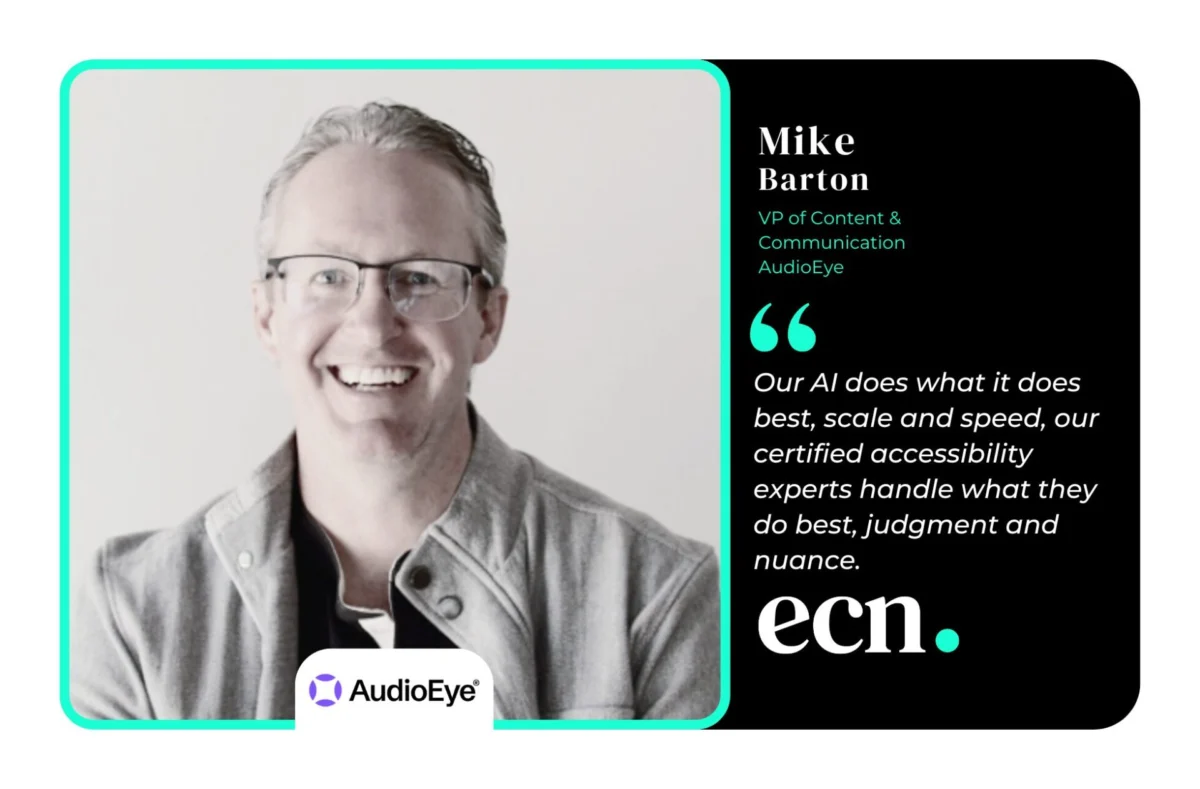
At the center of this transformation is AudioEye, a digital accessibility platform that has spent nearly two decades refining the intersection of artificial intelligence and human expertise. We sat down with Mike Barton, VP at AudioEye, to explore how the company is moving the needle on web inclusivity and why, for modern businesses, accessibility is no longer a "nice-to-have" feature, but a fundamental business imperative.
The Core Mission: Making the Web Universal
AudioEye operates on a simple, yet ambitious premise: every person should be able to navigate the web with ease. For over ten years, the company has provided a sophisticated digital accessibility platform that combines AI-driven automation with human-led oversight. Currently, more than 127,000 organizations trust AudioEye to manage their digital environments, ensuring they remain accessible to users who rely on assistive technologies like screen readers.
“Our mission is to deliver the strongest, most cost-effective accessibility protection in the industry,” explains Barton. “But our vision is broader: we want to create a digital world where accessibility isn’t an afterthought or a frantic response to a lawsuit, but the default setting for every website.”
A Brief Chronology: From Niche Concern to Global Standard
When AudioEye was founded, digital accessibility was largely viewed as a checkbox exercise—or ignored entirely by the majority of corporations. However, the landscape has shifted dramatically.
- The Early Years: Accessibility was treated as a secondary technical task, often delegated to developers who lacked specialized knowledge in assistive technology.
- The Litigation Wave: Over the last five years, accessibility-related lawsuits have surged, effectively doubling in frequency. This trend has forced boardrooms to view accessibility through the lens of risk mitigation.
- The Regulatory Shift: With the introduction of the European Accessibility Act (EAA), accessibility is now a cross-border legal requirement. Companies operating globally can no longer rely on localized standards; they must adhere to a new, rigorous international baseline.
- The AI Revolution: As AI-driven web development tools become ubiquitous, the internet is becoming more complex. AudioEye has evolved its platform to stay ahead of this complexity, proving that automation is the only way to scale accessibility, while human judgment remains the only way to perfect it.
The Business Case: Why Accessibility is a Revenue Driver
Many business leaders mistakenly categorize accessibility as a cost center. In reality, it is a significant growth engine. According to data cited by AudioEye, people with disabilities represent $18 trillion in global spending power.
Key Data Points:
- The Bounce Rate Penalty: Seven out of ten users with disabilities will abandon a website if it is inaccessible.
- Brand Loyalty: A vast majority of individuals with disabilities limit their online shopping to platforms they know are compatible with their assistive devices.
- Legal Exposure: E-commerce remains the primary target for litigation, accounting for 78% of current accessibility lawsuits.
- The AI Discovery Gap: Modern AI agents—which now navigate the web on behalf of users—rely on a site’s "accessibility tree" to process information. If a site is inaccessible, it is effectively invisible to these new discovery channels.
By ignoring accessibility, businesses aren’t just risking lawsuits; they are actively alienating a massive, loyal, and economically significant segment of the market.
The AudioEye Approach: The Hybrid Methodology
AudioEye’s platform differentiates itself through a "hybrid" model. In a world of black-box AI, AudioEye balances machine speed with human nuance.
How It Works in Practice
The platform deploys via a single line of JavaScript, similar to a standard cookie banner. Once live, the AI scans the site against WCAG (Web Content Accessibility Guidelines) standards. According to a 2026 independent study by Adience, AudioEye’s platform detects up to 2.5 times more issues than competing solutions.
Approximately 50% of these issues are resolved automatically in real-time. However, the remaining, more complex barriers—those requiring context or understanding of user intent—are addressed by certified human auditors. These experts, many of whom have disabilities themselves, provide the nuanced fixes that software alone cannot replicate. This combination leads to a 97% resolution rate before the customer’s internal team even needs to intervene.
Implications for Modern Industry
The pressure to comply with accessibility standards is hitting specific sectors harder than others.
- E-commerce: As noted, this is the current epicenter of litigation. Brands that prioritize accessibility see lower bounce rates and higher conversion, essentially turning compliance into a competitive advantage.
- Healthcare & Finance: These sectors face intense regulatory scrutiny. Inaccessible portals here can deny patients access to health records or prevent customers from managing their finances, creating a moral and legal crisis.
- Government & Public Sector: Accessibility is a mandate for serving the public. For government entities, AudioEye provides the scale necessary to maintain large-scale public websites.
Official Perspective: The Future of the Digital Ecosystem
Looking toward the future, Mike Barton highlights two critical trends that will define the next decade of the web.
1. The Global Regulatory Map
"The European Accessibility Act is just the beginning," says Barton. "Jurisdictions globally are catching up. Companies that have only focused on U.S. ADA (Americans with Disabilities Act) compliance will soon find that their compliance map is much larger than they anticipated."
2. AI as a Double-Edged Sword
There is a paradox in the current tech climate: while AI tools are becoming excellent at building websites, they are often trained on historically inaccessible data. This means that generative AI is currently creating inaccessible code at a faster rate than ever before.
"Solving this gap is one of the most important problems in our industry," Barton notes. "At the same time, we are entering an era where AI agents are the ‘new front door’ for users. If your site isn’t readable by an AI agent, you are losing that traffic. Accessibility and AI discovery are going to be the same conversation in the near future."
Conclusion: The Path Forward
For organizations looking to future-proof their digital presence, the path is clear. Accessibility is no longer a peripheral legal task—it is a cornerstone of modern digital architecture. AudioEye’s ability to integrate into existing tech stacks—whether CMS-based, headless, or custom—makes it a practical solution for companies of all sizes.
By combining the speed of AI with the lived experience of human auditors, AudioEye provides a robust framework for ensuring that the internet remains a universal tool. As Barton concludes, "The internet should work for everyone who uses it. Our job is to make sure it does."
In a digital landscape that is evolving at breakneck speed, the companies that thrive will be those that embrace inclusivity not as a burden, but as the standard for excellence.



