










Main Facts: Redefining the Road Trip Experience
For most people, long-distance driving is viewed through a lens of utilitarian necessity—a means of getting from point A to point B. Hours blur together, landscapes fade from memory, and the soundtrack of the drive is instantly forgotten the moment the engine shuts off. A new indie application aims to permanently alter this dynamic.
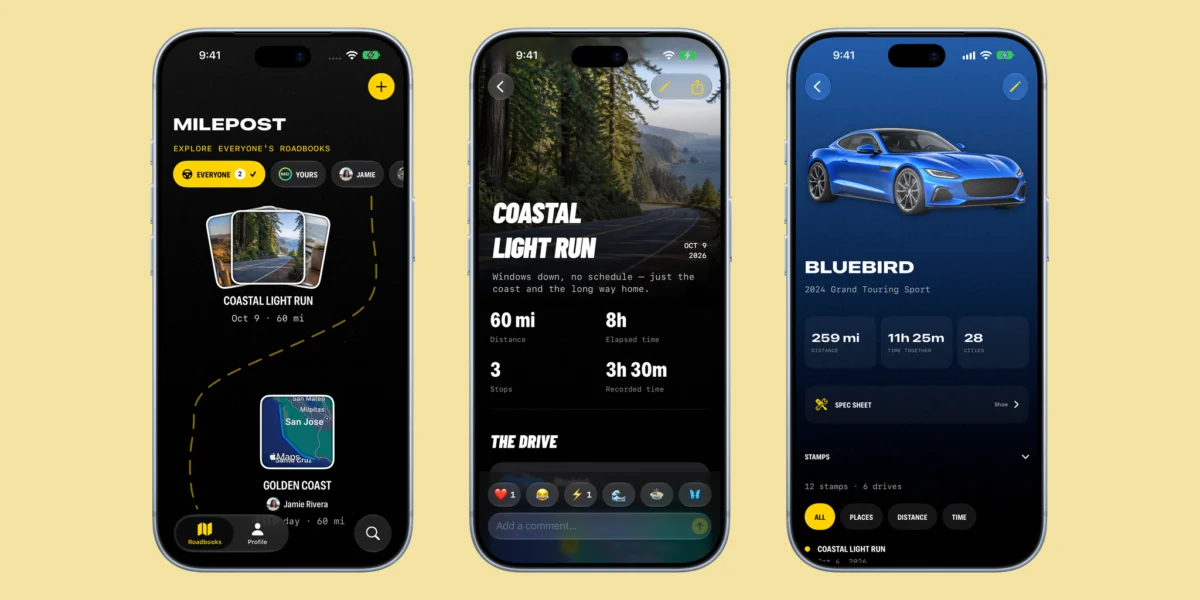
Milepost, a freshly launched iOS application featured in the 9to5Mac Indie App Spotlight, is designed to transform routine road trips and spontaneous weekend getaways into meticulously documented digital journeys. Rather than letting drives dissolve into brief blips of time, Milepost acts as an automated yet deeply personal copilot, recording telemetry data, environmental conditions, and multimedia memories.
At its core, Milepost captures the complete metrics of a drive—tracking precise routes, total distance covered, average and peak speeds, duration, and the prevailing weather conditions along the way. However, the app distinguishes itself by bridging raw data with creative journaling. Users can seamlessly drop geolocated notes, capture and upload photography, and build what the developers call "roadbooks." These roadbooks function as rich, chronological timelines of travel, even integrating with Apple Music to log the exact soundtracks that accompanied specific stretches of highway.
Beyond solo documentation, Milepost functions as a lightweight social network for automotive enthusiasts. The app features a dedicated "garage" where users can showcase their vehicles, alongside a social feed that allows friends to follow live or completed journeys, leaving comments and reactions.
Engineered natively for the Apple ecosystem, Milepost supports Siri, Shortcuts, and CarPlay, while offering a dedicated macOS application for users who prefer to analyze their travel data on a larger screen. True to modern tech trends, the app even includes an MCP (Model Context Protocol) server integration, allowing AI agents to review past travel data to assist in planning future trips.
Chronology: The Evolution of Travel Logging and the Rise of Milepost
To understand the innovation behind Milepost, it helps to look at how humans have historically recorded travel, and how software development has slowly bridged the gap between raw GPS tracking and narrative journaling.
The Era of Analog Maps and Paper Journals (Pre-2010s)
- The Paper Roadbook: For decades, drivers relied on physical road maps, paper logbooks, and physical cameras to capture road trips. Documenting a trip required active friction: pulling over to write entries, developing film days later, and manually plotting courses on folded paper maps.
- The Rise of Dedicated GPS: The introduction of consumer GPS units in the 2000s digitized navigation, but data remained ephemeral. Once a destination was reached, route histories were typically wiped, preserving only the odometer reading.
The Smartphone and Fragmented Tracking (2010s–Early 2020s)
- Fitness vs. Automotive Tracking: As smartphones saturated the market, fitness apps like Strava revolutionized how runners and cyclists tracked their journeys, turning physical exertion into shareable digital assets. Meanwhile, automotive apps remained strictly utilitarian—focusing entirely on turn-by-turn navigation (Apple Maps, Google Maps, Waze) or OBD-II vehicle diagnostics.
- The Gap in the Market: While millions of people embarked on scenic road trips, no single consumer app gracefully combined vehicle telemetry, environmental data, photography, and music history into an emotionally resonant travel journal.
The Launch of Milepost (2026)
- Debut and Feature Rollout: Released on the iOS App Store, Milepost entered the indie developer scene with a fully realized vision. Rather than focusing solely on tracking, the app prioritized aesthetics and ecosystem integration.
- Ecosystem Expansion: Within its initial launch window, the development team integrated deep Apple ecosystem support—incorporating CarPlay for seamless in-dash logging, Siri shortcuts for hands-free entries, a Mac app for desktop trip planning, and forward-thinking AI agent compatibility via an MCP server.
Supporting Data and Feature Breakdown
The utility of Milepost relies on a robust architecture of data points, software integrations, and flexible monetization tiers designed to appeal to both casual drivers and dedicated automotive hobbyists.
Core Feature Matrix
| Feature Category | Specific Capabilities | Ecosystem / Tech Integration |
|---|---|---|
| Telemetry & Metrics | Route mapping, total distance, speed analytics, travel duration, local weather conditions. | Core Location Services, WeatherKit |
| Media & Journaling | "Roadbooks" (visual timelines), photo galleries, text notes, Apple Music synchronization. | Apple Music API, Photos Framework |
| Social & Community | Shared user profiles, "Garage" feature to display owned vehicles, peer comments and reactions. | CloudKit / Built-in Social Network |
| Ecosystem & AI | CarPlay interface, Siri voice commands, Shortcuts support, macOS desktop companion, MCP server. | CarPlay framework, App Intents, MCP protocol |
Pricing and Monetization Structure
Milepost follows a freemium business model designed to offer immediate value to casual users while reserving advanced analytical and personalization tools for power users through its Milepost Pro subscription tier:

- Free Tier: Access to core drive tracking, basic logging, and standard map views.
- Milepost Pro (Monthly): $4.99 per month, featuring a 7-day free trial.
- Milepost Pro (Annual): $29.99 per year (offering a substantial discount over the monthly rate).
- Milepost Pro (Lifetime): $199.00 for permanent, unhindered access.
Pro Perks Include:
- Full, unconstrained drive history archives.
- Advanced layout designs and customization options for roadbooks.
- Exclusive alternative app icons to customize the home screen.
- Deep driving insights and statistical breakdowns over time.
Developer Insights and Industry Implications
The emergence of apps like Milepost highlights a broader shift in indie software development: the move away from generalized utility tools toward hyper-niche, emotionally resonant experiences that leverage the deep hardware and software capabilities of modern operating systems.
The Shift Toward Experiential Software
In an app marketplace saturated with productivity tools and corporate utilities, indie developers are increasingly finding success by targeting lifestyle hobbies. By turning an everyday commute or a cross-country road trip into an interactive artifact, Milepost taps into nostalgia and self-documentation—impulses that historically fueled the success of photo-sharing and journal-keeping platforms.
Leveraging the Apple Ecosystem
One of the most notable technical aspects highlighted in Milepost’s rollout is its commitment to the breadth of Apple’s platform architecture. Many indie applications focus exclusively on the iPhone. Milepost, however, treats the entire ecosystem as a cohesive canvas:

- CarPlay ensures that data collection begins safely and automatically from the dashboard.
- The Mac application provides a comfortable desktop environment for reviewing high-resolution maps and curating large media galleries.
- Siri and Shortcuts lower the friction of capturing spontaneous thoughts mid-drive without violating hands-free driving laws.
The Future of AI Integration via MCP Servers
Perhaps the most forward-thinking inclusion in Milepost is its Model Context Protocol (MCP) server support. By allowing AI agents to access past travel histories, the app opens the door to personalized travel recommendations. Future road trip planning can theoretically be automated based on verified historical preferences—such as preferred driving speeds, favored scenic routes, weather tolerances, and geographic waypoints visited in previous roadbooks.
Conclusion: Is Milepost Worth the Journey?
For daily commuters, Milepost might feel like an over-engineered logbook. But for road trip enthusiasts, weekend explorers, and automotive hobbyists who view the open road as a destination in its own right, the app fills a long-standing void in the digital landscape.
By elegantly fusing hard telemetry data with the soft storytelling elements of photography, music, and social sharing, Milepost ensures that future travels are never lost to time. With a free entry point on the App Store and a robust 7-day trial for its Pro tier, exploring your own driving history has never been more accessible—or more engaging.



