










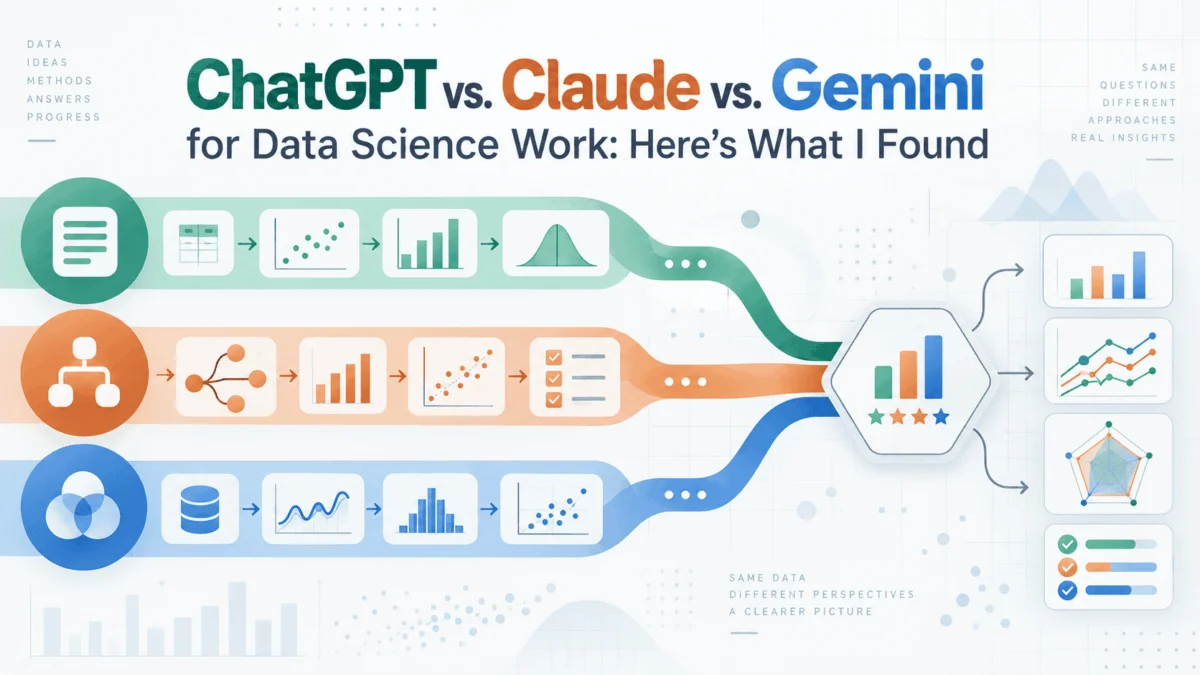
For the modern data professional, the arrival of Large Language Models (LLMs) has fundamentally altered the daily workflow. What was once a process defined by manual environment configuration, hours of Stack Overflow browsing, and tedious boilerplate coding has evolved into a collaborative dialogue with AI. Today, ChatGPT, Claude, and Gemini serve as the "Big Three" assistants in the data science ecosystem.
However, choosing the right tool is no longer a matter of simple preference; it is a strategic decision that affects productivity, code quality, and analytical accuracy. This article provides a comprehensive evaluation of these platforms, exploring their nuanced capabilities in statistical reasoning, code generation, and large-scale data analysis.
The Core Landscape: A Comparative Overview
Data science tasks are rarely monolithic. They shift from exploratory data analysis (EDA) and cleaning to rigorous statistical modeling and long-form technical documentation. To understand how these models compare, it is essential to view them as specialized tools rather than general-purpose chatbots.
ChatGPT: The Operational Generalist
OpenAI’s ChatGPT, particularly with its Advanced Data Analysis environment, has become the industry standard for quick-turnaround data tasks. Its primary strength lies in its "sandbox" approach. By allowing users to upload CSV, Excel, or JSON files directly into the chat, ChatGPT writes, executes, and iterates on Python code in real-time. This creates a feedback loop where a user can request a visualization, identify a trend, and pivot to a new hypothesis without ever opening an Integrated Development Environment (IDE) like Jupyter or VS Code.
Claude: The Structured Logical Thinker
Anthropic’s Claude has carved out a niche as the preferred tool for complex instruction-following and technical precision. Known for its "Constitutional AI" approach and large context window, Claude excels at maintaining logical consistency over long, multi-turn conversations. Its ability to generate and execute Python code directly—combined with a propensity for detailed, step-by-step explanations—makes it the go-to for professionals dealing with convoluted logic or requiring high-quality, well-commented production code.
Gemini: The Ecosystem Powerhouse
Google’s Gemini is distinguished by its seamless integration with the Google Workspace and Cloud infrastructure. For organizations heavily invested in Google Sheets, BigQuery, or Google Drive, Gemini offers a friction-reducing advantage that competitors cannot match. Its ability to ingest vast amounts of data via massive context windows, paired with live web-search capabilities for real-time library documentation, makes it uniquely positioned for research-heavy data science tasks.
Statistical Reasoning: Beyond Surface-Level Answers
When a data scientist asks an AI to select a statistical test—for instance, deciding between a Welch’s t-test and an independent samples t-test—the primary goal is not just an answer, but a justification rooted in statistical theory.
Accuracy and Methodology
A 2025 peer-reviewed study confirmed that across 20 distinct statistical selection scenarios, the three leading AI models achieved 100% accuracy in identifying the correct test. However, the quality of the explanation varied.
- Claude consistently provided the most rigorous, step-by-step breakdown of assumptions (such as homoscedasticity or normality) and their implications.
- Gemini excelled in pedagogical value, framing answers in a way that helps practitioners understand the "why" behind the methodology by linking concepts to broader data theory.
- ChatGPT leaned into the practical, providing context-aware suggestions that align with typical business use cases, which is highly beneficial for analysts under tight deadlines.
The Risk of Over-Reliance
Despite these high accuracy rates, a critical caveat remains: AI assistants can exhibit "methodological blindness." They often perform calculations without verifying if the data meets the necessary prerequisites. An AI might correctly calculate a p-value for a linear regression while completely ignoring the presence of influential outliers or heteroskedasticity. Data professionals must treat AI output as a draft, not an audit.
Code Generation and Workflow Integration
The shift from writing manual code to prompting for code has changed the barrier to entry for complex analysis. Yet, the quality of the generated output remains the differentiator.
The Sandbox Advantage (ChatGPT)
For rapid EDA, ChatGPT’s environment is currently unrivaled. It allows for a dynamic workflow:
- Upload: Input the raw dataset.
- Execute: Run automated cleaning and summary statistics.
- Iterate: Request immediate adjustments ("remove outliers," "normalize this column," "plot a heatmap").
This workflow saves significant time for analysts who spend 80% of their day on data preparation.
The Engineering Focus (Claude)
Claude is arguably the superior choice for building reusable, modular code. If the objective is to write a data-preprocessing class, a transformation pipeline, or a refactored script for a production environment, Claude’s output tends to be cleaner, better commented, and more adhere-to-best-practices. It handles multi-file contexts better, allowing for more complex software engineering tasks within a data science project.
The Cloud-Native Approach (Gemini)
Gemini’s strength manifests when the code interacts with live data environments. Because it is deeply tied to the Google Cloud ecosystem, it can write queries for BigQuery or interact with data living in Google Sheets with minimal configuration. This makes it an essential tool for data engineers and analysts working within a Google-centric stack.
Large-Scale Context and Memory
The "Context Window"—the amount of information an AI can hold in its "short-term memory" at once—is the ultimate bottleneck for large-scale data projects.
- Gemini currently leads in sheer capacity, allowing for the ingestion of massive technical reports, entire codebases, or extended documentation. This is ideal for research-heavy tasks where you must synthesize information from multiple sources.
- Claude provides a middle ground, offering a large context window that maintains high levels of instruction-following, making it excellent for reviewing long, complex project requirements.
- ChatGPT utilizes "persistent memory," which remembers user preferences across different sessions. For a data scientist who consistently uses specific libraries (e.g.,
pandas,seaborn) or prefers a specific coding style, this feature creates a personalized experience that saves time on setup prompts.
Navigating Limitations: The "Human-in-the-Loop" Mandate
Regardless of the model chosen, three persistent challenges remain:
- Hallucinations: All three models can, at times, invent library functions or reference non-existent documentation. This is particularly problematic with obscure Python packages where the model may "guess" a syntax based on its training data.
- Methodological Oversight: AI models are prone to "path of least resistance" logic. They prioritize providing a result over questioning the underlying assumptions of the dataset.
- Data Privacy: This is the most significant hurdle for enterprise adoption. Uploading proprietary datasets—even to paid, non-training tiers—requires careful vetting of compliance and data retention policies. Before feeding sensitive data into any model, data scientists must ensure they are using enterprise-grade, privacy-compliant interfaces.
Strategic Implementation: Matching the Tool to the Task
Data science is not a one-size-fits-all discipline. Success in the age of AI requires a "polyglot" approach to tool selection:
- For Exploratory Data Analysis (EDA): Use ChatGPT. Its sandboxed environment is designed to go from raw file to visual insight faster than any competitor.
- For Complex Logic and Clean Code: Use Claude. When building pipelines or writing complex functions that require strict adherence to constraints, its logical rigor and code quality are superior.
- For Research and Cloud Integration: Use Gemini. When your work requires deep integration with Google’s ecosystem or synthesizing massive amounts of external documentation, its web-connected, high-context capabilities are invaluable.
- For General Daily Use: ChatGPT remains the most broadly capable assistant for the widest range of tasks, serving as a reliable Swiss Army knife for the modern data professional.
Conclusion: The Future of AI-Assisted Analysis
The "Big Three" of AI—ChatGPT, Claude, and Gemini—are not merely chatbots; they are the new standard-issue tools for the data science workbench. The most successful professionals are those who recognize that these tools are not replacements for statistical expertise, but force multipliers for it.
By understanding the distinct strengths of each—ChatGPT’s operational speed, Claude’s logical precision, and Gemini’s vast connectivity—data scientists can build a more efficient, accurate, and innovative workflow. The era of the "lone coder" is fading, replaced by the era of the "AI-augmented analyst." As these models continue to evolve at breakneck speed, the key to staying competitive will not be sticking to one platform, but mastering the art of knowing exactly when to reach for which tool.
Ultimately, while the AI can write the code and explain the p-value, the human remains the final arbiter of truth. Always verify, always iterate, and always maintain your foundational understanding of the data.



