










By Tech Desk
Published October 12, 2026
Main Facts
In an extraordinary intersection of retro nostalgia and modern DIY engineering, developer and game designer Hoani Bryson has successfully resurrected the iconic Nokia 3310. By gutting the vintage device and installing a custom-designed printed circuit board (PCB) powered by a Raspberry Pi Pico microcontroller, Bryson has enabled the legendary "indestructible" mobile phone to run complex retro-style games that far exceed the computational capabilities of its original 2000-era hardware.
The project stems from the annual "Nokia 3310 Jam 8," a specialized game development competition where creators design games adhering strictly to the aesthetic and physical limitations of classic monochrome mobile phones. Bryson’s winning submission, Trick Shot II, proved so advanced that the native processor of a real Nokia 3310 could not handle the computing load. Rather than leaving the game strictly in browser emulators, Bryson engineered a hardware modification that merges modern microcontroller power with classic mobile phone architecture, retaining the tactile feel of the original keypad and the distinct look of the monochrome display while introducing a brand-new digital beating heart.
Chronology: From Digital Jam to Physical Reality
The journey of this high-tech mod began not in a hardware laboratory, but within the confines of a digital game jam.
The Nokia 3310 Jam 8
The Nokia 3310 Jam series challenges independent game developers to evoke the golden era of early 2000s mobile gaming. Participants must design experiences constrained by specific parameters:
- A rigid display resolution mimicking the original 84×48 pixel screen.
- A restricted color palette consisting of only three choices, each utilizing a maximum of two contrasting colors.
- Strict audio limitations allowing for only a single audio channel, meaning sound effects and music must play sequentially rather than simultaneously.
- Input mapping restricted to a maximum of 12 controller buttons to mirror the alphanumeric Nokia keypad.
Crucially, the jam’s rules did not require entries to run on actual vintage Nokia handsets; they only needed to emulate the stylistic constraints. Developers built their projects using modern game engines and web technologies, targeting browsers and modern desktop environments.
Triumph with Trick Shot II
Hoani Bryson entered the competition with his physics puzzle game, Trick Shot II. Demonstrating a masterful grasp of pixel-art design and constrained game loops, Bryson’s title resonated deeply with judges and players alike, ultimately securing first place in the jam.
However, achieving victory was only the first step for Bryson. Driven by a desire for absolute authenticity, he resolved to take the project off the computer screen and load Trick Shot II onto an actual Nokia 3310 chassis.
The Hardware Bottleneck
Upon attempting to flash and run the game on unmodified vintage hardware, Bryson encountered an inevitable wall. The original Nokia 3310 internal architecture featured a low-power application processor designed primarily for basic telephony, text messaging, and rudimentary games like Snake. The graphical processing overhead, collision detection physics, and asset management required by Trick Shot II caused severe lag, freezing, and memory allocation failures. The stock hardware simply lacked the horsepower.
The Raspberry Pi Pico Intervention
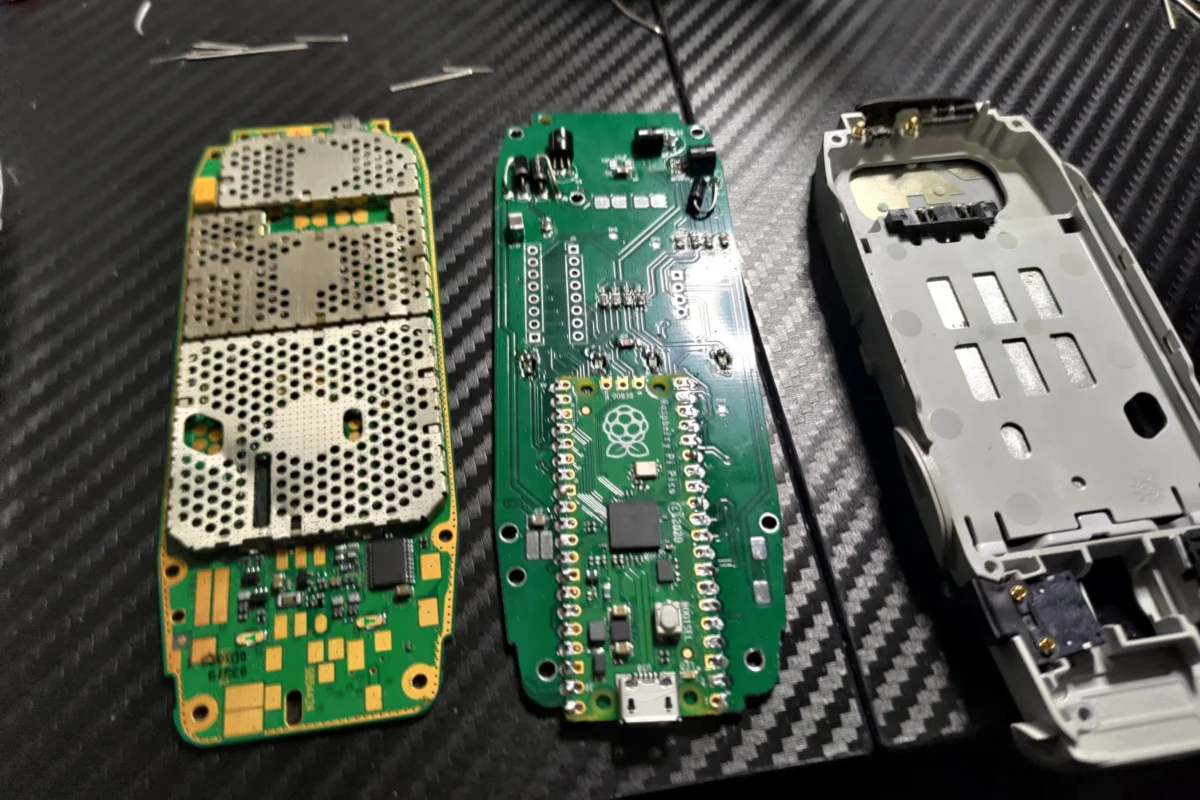
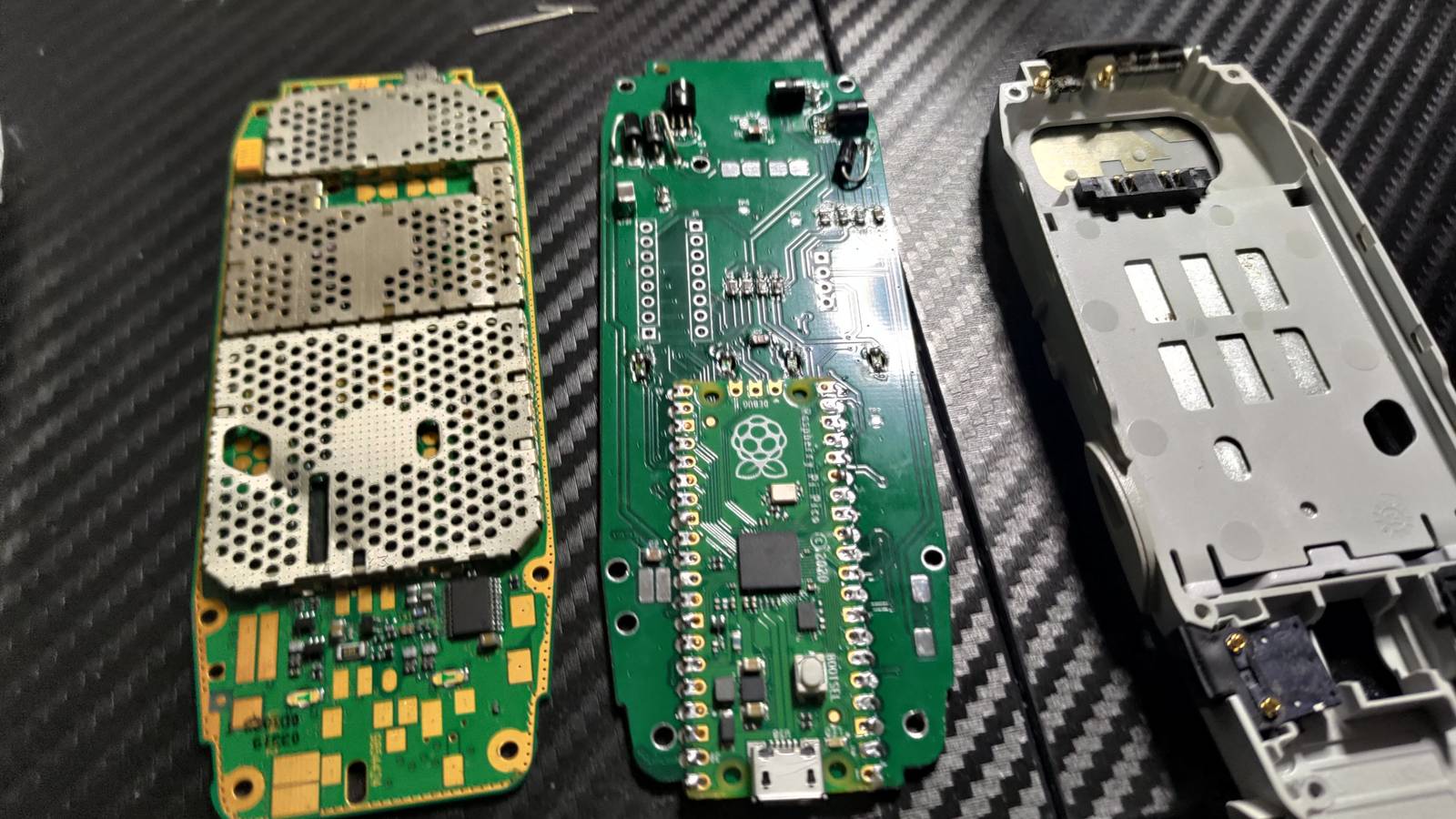
Refusing to compromise, Bryson pivoted from software optimization to hardware modification. He designed a custom PCB engineered to fit precisely within the hollowed-out casing of the Nokia 3310. At the center of this custom board, he integrated a Raspberry Pi Pico—a tiny, low-cost, yet remarkably powerful microcontroller board built around the RP2040 chip.
By wiring the Raspberry Pi Pico directly to the original phone’s physical components, Bryson bridged a 26-year technological gap. The Pico provided the necessary processing cycles and RAM to run modern builds of Trick Shot II smoothly, while seamlessly routing inputs from the classic tactile rubber keypad and outputting crisp visuals to the device’s display.
Supporting Data: Specifications and Hardware Architecture
To understand the scale of the upgrade, it is helpful to compare the original 2000 Nokia 3310 hardware specifications with the modernized Raspberry Pi Pico-powered mod:
| Metric | Original Nokia 3310 (2000) | Modified Raspberry Pi Pico Edition (2026) |
|---|---|---|
| Processor | Single-core 16-bit ARM7TDMI-based microcontroller | Dual-core ARM Cortex-M0+ running at up to 133 MHz |
| RAM | A fraction of a megabyte (Internal SRAM) | 264 KB on-chip SRAM |
| Storage | Non-volatile internal ROM for firmware and pre-installed games | Variable flash memory via Pico integration (supports expanded game libraries) |
| Display | 84 x 48 monochrome graphic LCD | Retained original 84 x 48 display (or compatible modern equivalent driven by Pico GPIO) |
| Input | 12-button physical alphanumeric keypad | Original keypad wired directly to Pico General Purpose Input/Output (GPIO) pins |
| Audio | Single-channel piezoelectric buzzer / mono sound | Enhanced PWM audio routed through original speaker architecture |
| Primary Software | Nokia proprietary OS (DCT3 platform) | Custom bare-metal C/C++ or MicroPython runtime executing modern jam games |
The Raspberry Pi Pico’s dual-core architecture running at 133 MHz represents an exponential leap over the processing capabilities available to mobile engineers at the turn of the millennium. This computational headroom allows the modded device to handle complex game state management, advanced frame-rate locking, and smooth asset rendering without breaking a sweat.
Official Responses and Developer Insights
The maker and retro-tech community reacted with immense enthusiasm following documentation of the build. Hardware hacking platforms and enthusiast blogs, notably Hackster.io, highlighted the project as a masterclass in creative electronics repurposing.
Hoani Bryson documented the entire development cycle on his personal website and technical blog, providing schematics, code snippets, and post-mortem reflections on the engineering challenges he faced. In his documentation, Bryson emphasized that the project was born out of a desire to push boundaries rather than practical necessity:
"The rules of the jam gave us freedom, but true satisfaction came from closing the loop. Playing a modern creation on the physical artifact that inspired its aesthetic constraints feels like completing a circle across generations of technology," Bryson noted in his technical overview.
Industry analysts and retro gaming advocates have praised the project for demonstrating the longevity of classic industrial design. While modern smartphones trend toward ever-larger glass slabs and complex multi-lens camera arrays, the tactile ergonomics of early 2000s feature phones continue to captivate developers who grew up pressing physical buttons.
Implications for the Retro-Tech and DIY Communities
Hoani Bryson’s successful integration of a Raspberry Pi Pico into a Nokia 3310 carries several broader implications for the DIY electronics, retro-gaming, and electronic-waste reduction movements.
1. Breathing New Life Into E-Waste
Millions of older mobile phones sit forgotten in drawers, basements, and recycling centers worldwide. While these devices are functionally obsolete for modern cellular networks—especially given the widespread shutdown of 2G and 3G infrastructures—their physical shells, displays, and keypads remain remarkably durable. Projects like Bryson’s provide a blueprint for upcycling electronic waste into functional, entertaining hobbyist platforms.
2. The Evolution of Game Jams
The success of the Nokia 3310 Jam series, paired with physical hardware mods, could influence future game development competitions. Organizers may increasingly encourage or reward developers who bridge the gap between digital simulation and physical hardware deployment, fostering a sub-genre of indie development explicitly tailored for micro-controller-driven retro handhelds.
3. Democratization of Hardware Modding
The Raspberry Pi Pico has fundamentally changed the landscape of custom electronics. At an accessible price point of around $4, the RP2040-powered board offers hobbyists professional-grade processing power that can be easily programmed using C/C++ or MicroPython. Bryson’s project demonstrates that advanced custom hardware mods are no longer restricted to engineers with access to expensive industrial fabrication tools; a soldering iron, a 3D printer (where applicable), and basic microcontroller knowledge are sufficient to reinvent classic consumer electronics.
Availability and Getting Involved
For technology enthusiasts eager to experience the project firsthand, multiple avenues are available:
- For Tinkers: Detailed documentation, circuit diagrams, and build logs can be found directly on Hoani Bryson’s official website. Enthusiasts with a spare Nokia 3310 chassis and a Raspberry Pi Pico can follow the guide to construct their own customized gaming phone.
- For Gamers: Those without soldering skills who still wish to experience the award-winning gameplay can play a browser-optimized version of Trick Shot II directly on Itch.io without any hardware modification required.
As retro-futurism continues to capture the imagination of a new generation of developers, projects like the Pico-powered Nokia 3310 prove that old technology never truly dies—it simply waits for the right mind to give it a modern upgrade.



