










In the rapidly evolving landscape of artificial intelligence, real-time communication remains the "holy grail" of natural language processing. Today, the Qwen team has taken a significant leap toward seamless global interaction with the release of Qwen3.8-LiveTranslate. This next-generation model is engineered specifically for simultaneous interpretation, designed to process live speech—optionally supplemented by video frames—and provide instantaneous, high-fidelity translation while the speaker is still mid-sentence.
By moving beyond the traditional limitations of standard sequence-to-sequence models, Qwen3.8-LiveTranslate promises to transform how we approach cross-lingual meetings, international broadcasting, and real-time accessibility.
The Core Innovation: The Interleave Architecture
Simultaneous interpretation has historically been defined by a fundamental tension: the "Latency-Quality Tradeoff." If a system waits for a speaker to finish a full sentence, the translation is accurate but delayed, rendering it useless for real-time conversation. If the system translates word-for-word, it risks losing context, nuance, and grammatical correctness.
Qwen3.8-LiveTranslate resolves this through a sophisticated new Interleave architecture. By optimizing the way the model processes incoming audio streams and generates outgoing tokens, the architecture allows the system to remain "live" without sacrificing structural integrity.
Redefining Latency with LAAL
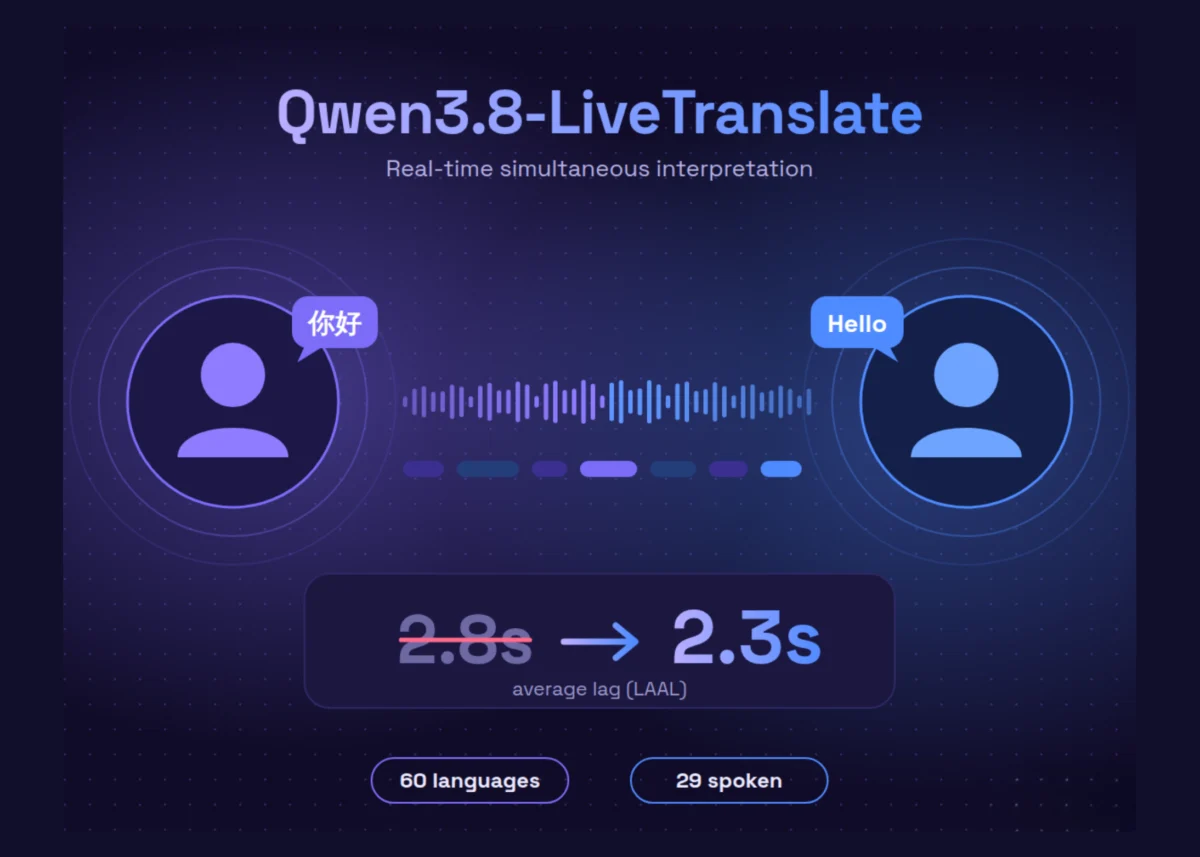
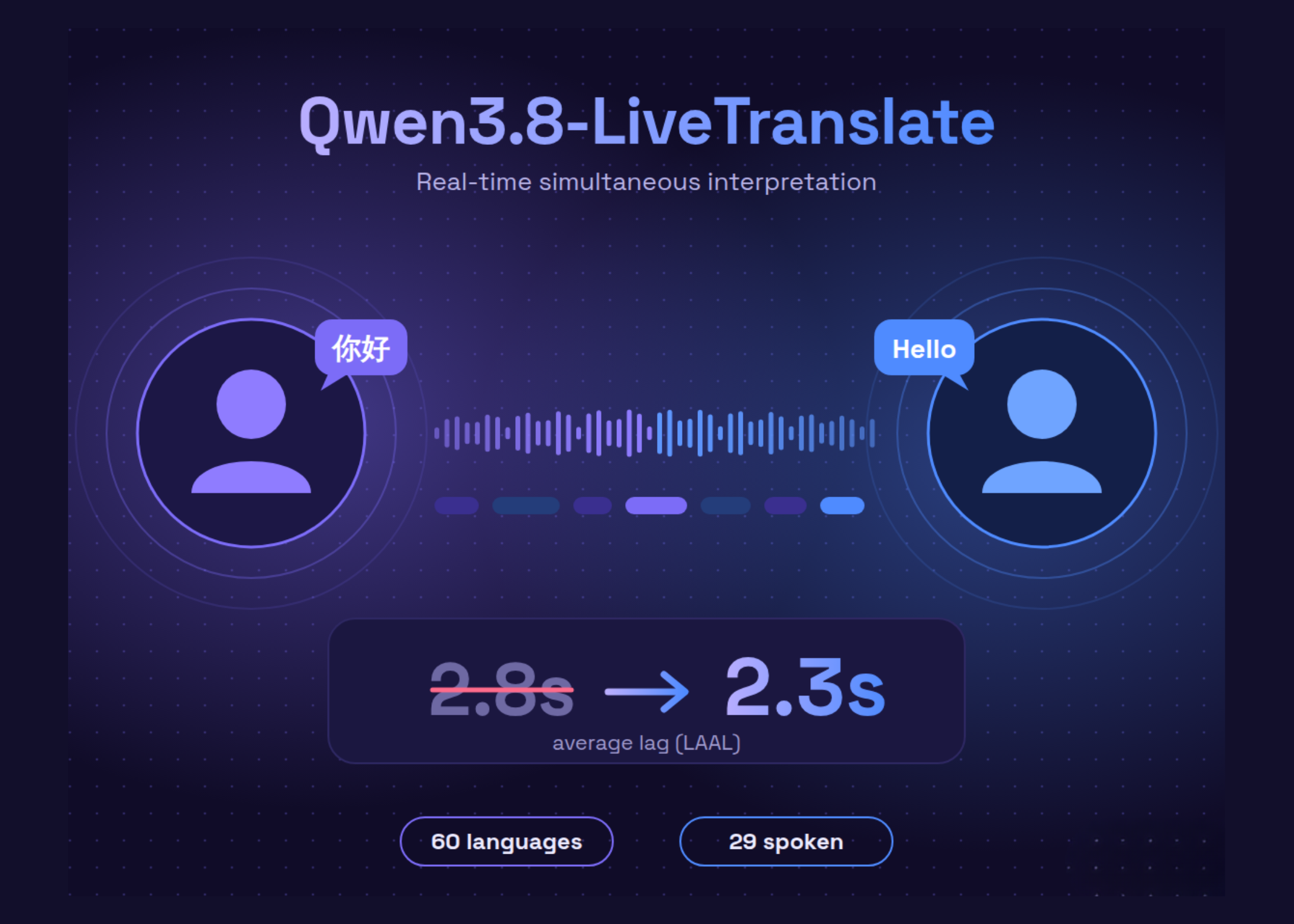
To quantify this success, the Qwen team utilizes Length-Adaptive Average Lagging (LAAL). Unlike simple delay metrics, LAAL measures the average time gap between the source speech and the translated output, while penalizing systems that "over-generate" or chatter unnecessarily.
Under the new architecture, Qwen reports that the average LAAL has dropped from 2.8 seconds to 2.3 seconds. While an 18% reduction might seem incremental to the layperson, in the world of high-speed simultaneous interpretation, this half-second gain is monumental. It represents the difference between a jarring, delayed echo and a fluid, conversational experience.
Chronology and Technical Evolution
The journey to Qwen3.8-LiveTranslate is rooted in the broader development of the Qwen-Omni stack. The model builds upon a foundation of massive, multimodal training data designed to align cross-language and cross-modal inputs.
- Foundational Research: The Qwen team began by focusing on cross-modal alignment, ensuring that the model could map audio signals directly to translated text/speech vectors with high precision.
- The Flash Precursor: Before the release of the 3.8-LiveTranslate iteration, the team refined the "Flash" model, which provided the backbone for offline audio and video translation.
- The Live Breakthrough: The current iteration represents the marriage of the Flash model’s linguistic capabilities with the real-time, low-latency streaming requirements of a live interpretation engine.
- Deployment: The model is now available via Alibaba Cloud Model Studio and QwenCloud, marking its transition from a research project to a production-ready API service.
Multimodal Capabilities and Intelligence
Qwen3.8-LiveTranslate is not merely an audio-to-text engine; it is a context-aware multimodal system. By incorporating optional video frames, the model can interpret non-verbal cues that are essential for accurate translation.
Visual Contextualization
In noisy environments or during technical presentations, audio input can often be ambiguous. The model’s ability to process visual data—such as lip movements, gestures, and on-screen text—allows it to disambiguate words that might sound identical but have different meanings based on the speaker’s environment. The developers recommend a frame rate of no more than two images per second, which provides sufficient context for the model to "see" the speaker’s intent without overwhelming the processing pipeline.
Speaker Diarization and Bilingual Display
A key feature of this release is the integration of real-time speaker diarization. In multi-speaker environments, such as a panel discussion or a boardroom meeting, the model can identify and tag different speakers, ensuring that the output clearly distinguishes between participants. Coupled with a synchronized bilingual display, the system provides a robust transcript that mirrors the flow of the conversation, making it an invaluable tool for record-keeping and live transcription services.
Language Coverage and Operational Limits
The linguistic reach of Qwen3.8-LiveTranslate is expansive, covering 60 languages in terms of comprehension. Of these, 29 languages are supported for full speech-to-speech output, while the remaining 31 are supported for text-based translation.
Audio-Visual Parameters
- Input/Output: The system defaults to 16 kHz PCM for input and 24 kHz PCM for output.
- Voice Personalization: The standard output voice, "Tina," provides a natural, human-like cadence.
- Hotwords: For specialized domains—such as medical, legal, or technical conferences—users can configure up to 1,000 "hotwords." These function as a custom dictionary, ensuring that industry-specific terminology is consistently mapped to the correct target translation.
API Integration, Pricing, and Economic Implications
For developers and enterprises, the model is accessible via the WebSocket Realtime API using the identifier qwen3.8-livetranslate-flash-realtime. The implementation requires careful handling of the session, specifically the session.finish command; failure to signal the end of a session can result in the loss of the final, often crucial, segments of a conversation.
Cost Structure
The cost of the service varies by region, with Singapore and Beijing acting as primary data centers. Using the Singapore list pricing as a benchmark, the costs are competitive for high-volume enterprise use.
- Efficiency: Audio input consumes approximately 7 tokens per second, while audio output consumes 12.5 tokens per second.
- Total Cost: For a standard hour of continuous speech-in/speech-out translation, the estimated cost is approximately $1.54 USD, excluding additional text and image processing tokens.
This pricing model makes the service highly scalable for businesses looking to implement live translation for global webinars, international client meetings, or real-time news broadcasting without the prohibitive costs of human interpreters.
The Road Ahead: Implications for Industry
The release of Qwen3.8-LiveTranslate signals a shift in the AI industry toward "Real-Time Utility." As models become faster and more efficient, the focus is shifting from simple text generation to active, real-world engagement.
1. Breaking the "Tower of Babel"
By reducing the LAAL to 2.3 seconds, Qwen is nearing the threshold of "human-like" interaction. This has immediate implications for diplomacy, international business, and education. It effectively lowers the barrier to entry for collaboration between non-native speakers, allowing them to communicate in their native tongues without the friction of a middle-man interpreter.
2. Accessibility
For individuals with hearing impairments, the combination of real-time speaker diarization and high-accuracy transcription offers a level of accessibility that was previously only achievable through expensive, manual captioning services.
3. Limitations and Future Considerations
Despite its capabilities, users should be aware that certain enterprise features, such as function calling, structured outputs, and fine-tuning, are currently unsupported. The model is designed as a specialized tool for translation rather than a general-purpose agent. Developers must also respect the rate limits of 10 requests and 100,000 tokens per minute, which, while generous for most applications, may require architectural planning for massive, multi-tenant platforms.
Conclusion
Qwen3.8-LiveTranslate is a testament to the progress being made in latency-sensitive AI. By rebuilding the interpretation loop through the Interleave architecture and prioritizing multimodal context, the Qwen team has delivered a tool that is not only faster but significantly more intelligent than its predecessors. As we move into an increasingly connected global economy, the ability to transcend language barriers in real-time will not just be a luxury—it will be a fundamental component of the digital infrastructure.
For those interested in integrating this technology, the documentation on Alibaba Cloud Model Studio provides a comprehensive roadmap. As always, the rapid evolution of this technology suggests that even lower latencies and higher accuracy rates are on the horizon, further blurring the line between human and machine communication.
For more in-depth coverage of machine learning and deep learning news, stay tuned to our ongoing reports and subscribe to our newsletter for the latest updates in the AI field.



