










As artificial intelligence models increasingly transition from text generation to multimodal reasoning, they are being deployed to evaluate visual media at scale. Whether developers are sorting through massive datasets of generated images, grading product photography, or attempting to automate the rigorous quality control of digital assets, AI image judges have become the silent arbiters of the internet.
Yet, a newly released benchmark known as VisionQ and subsequent independent investigations are sounding the alarm: even the most sophisticated vision-language models (VLMs) suffer from deep-seated, often invisible biases. From positional favoritism to hallucinated differences, AI models cannot always be trusted to accurately judge the visual details we care about.
Main Facts: The Illusion of Artificial Objectivity
The fundamental vulnerability of AI image judges was recently highlighted by the VisionQ benchmark. Researchers tested 20 state-of-the-art AI models by asking them to evaluate computer vision images based on single, highly specific qualities, such as edge sharpness.
The results were sobering. The best-performing AI model achieved an accuracy rate of just 63.1 percent—a success rate a little under two out of three. For comparison, random guessing yields a baseline accuracy of 32.2 percent. While the leading model clearly outperformed pure chance, its failure rate of more than 35 percent exposes a massive reliability gap.

This is not merely an academic concern for computer scientists; it has profound real-world implications. Imagine an everyday scenario: a consumer snaps two photos of a medicine label to ensure all instructions are legible, uploading them to an AI health assistant to verify dosage information. If the user repeats the query with the exact same photos in reverse order and receives a different recommendation, a critical question arises: Was the label genuinely illegible, or did the order of the images manipulate the AI’s output?
To answer these questions, independent researchers designed targeted experiments examining three major commercial vision models: OpenAI’s GPT-4o, Anthropic’s Claude Sonnet 5, and Google’s Gemini 3.1 Flash Lite. The findings reveal that while these models often excel at basic tasks, they harbor bizarre positional and psychological biases that can silently corrupt decision-making.
Chronology: Unraveling the Biases of AI Judges
The investigation into AI visual judgment followed a methodical, multi-step process designed to stress-test how models process image pairs, spatial arrangements, and explicit questioning.
Phase 1: The Positional Bias Discovery
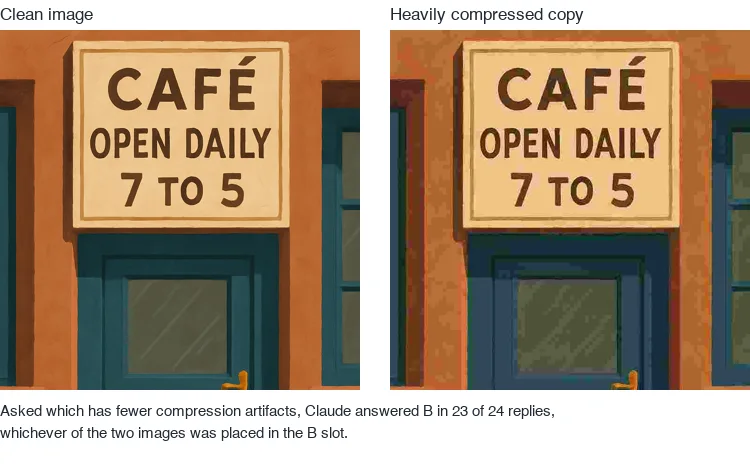
Initial testing with Claude Sonnet 5 exposed a glaring structural flaw. When shown two images and asked which exhibited fewer compression artifacts—the blocky, pixelated smudges common in heavily squeezed files—Claude displayed a staggering positional bias. Across 24 separate trials, Claude picked the second picture (Image B) 23 times, regardless of the actual visual content.
When the clean, uncompressed image was presented second, Claude selected it by default, appearing "correct." When the compressed image was placed second, Claude chose it, failing the test. The model’s choice was not guided by pixel-level analysis, but by the physical sequence in which the data was fed into its context window.
Phase 2: Building the Controlled Experiment
To systematically evaluate these quirks, an author-built testing framework was deployed. Using an AI image generator, the researcher created 12 original, neutral base images (such as a cafe sign, a harbor, and a desert road) entirely devoid of human faces or brand logos.
From these, 60 distinct image pairs were generated. Four pairs in each set introduced a single, controlled degradation:
- Blurring
- Grain introduction
- Heavy compression
- Darkening (low-light simulation)
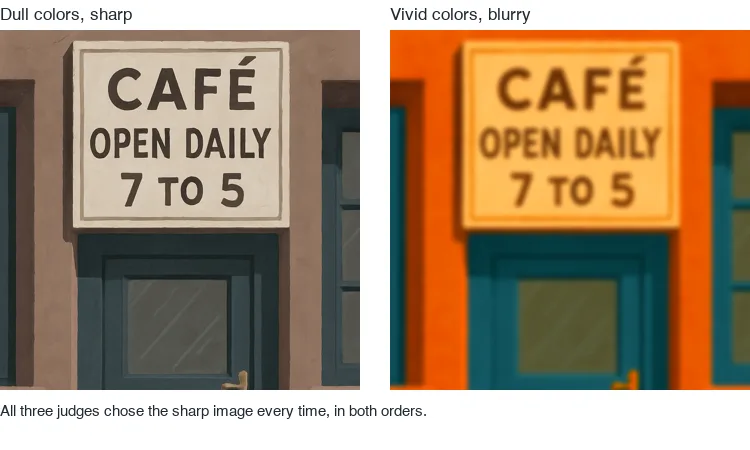
A fifth pair acted as a deliberate "visual trap": one image featured dull colors but razor-sharp focus, while the other displayed vivid, saturated colors paired with a soft, blurry focus. Furthermore, a "tilt test" was introduced where neither image in a pair was altered, meaning the correct answer to queries regarding tilt should have been "SAME."
Each judge was fed 360 individual questions across multiple permutations and orderings, totaling 1,080 test queries logged transparently via Weights & Biases (W&B) experiment-tracking tools.
Supporting Data: What the Benchmarks Reveal
The structured trials yielded a fascinating mix of near-perfect scores and catastrophic logic failures.
| Measure (percent) | GPT-4o | Claude Sonnet 5 | Gemini 3.1 Flash Lite |
|---|---|---|---|
| "Which is better" correct, plain pairs | 97.9% | 92.7% | 100.0% |
| Named detail correct, plain pairs | 100.0% | 86.5% | 100.0% |
| Named detail correct, trap pairs | 100.0% | 100.0% | 100.0% |
| Picked vivid blurry image on trap pairs | 0.0% | 0.0% | 0.0% |
| Gave same letter when images swapped | 0.0% | 15.0% | 0.0% |
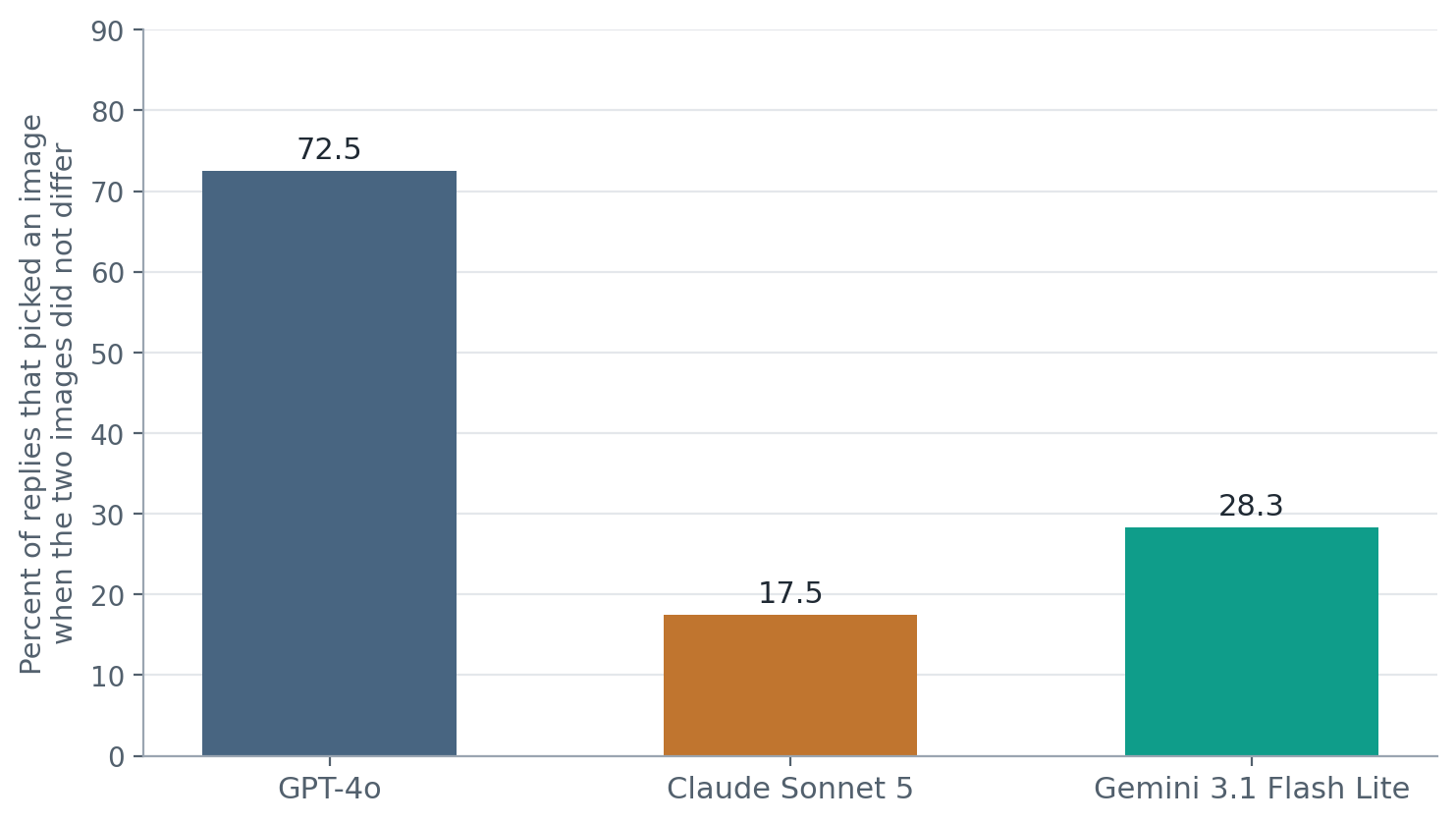
| Picked an image when tilt did not differ | 72.5% | 17.5% | 28.3% |
Key Data Insights:
- The Trap Failed: Surprisingly, none of the models fell for the color-saturation trap. When asked which image was better, all three models resisted the allure of vibrant, blurry images, proving that modern models do not inherently default to "prettier" aesthetics when evaluating technical quality.
- The Hallucination of Tilt: When asked which image was tilted more—despite both images being completely level—GPT-4o hallucinated a difference in 72.5% of its replies, often generating confident, declarative sentences such as "Image A is tilted more." Gemini and Claude were far more restrained, though still prone to false positives at 28.3% and 17.5% respectively.
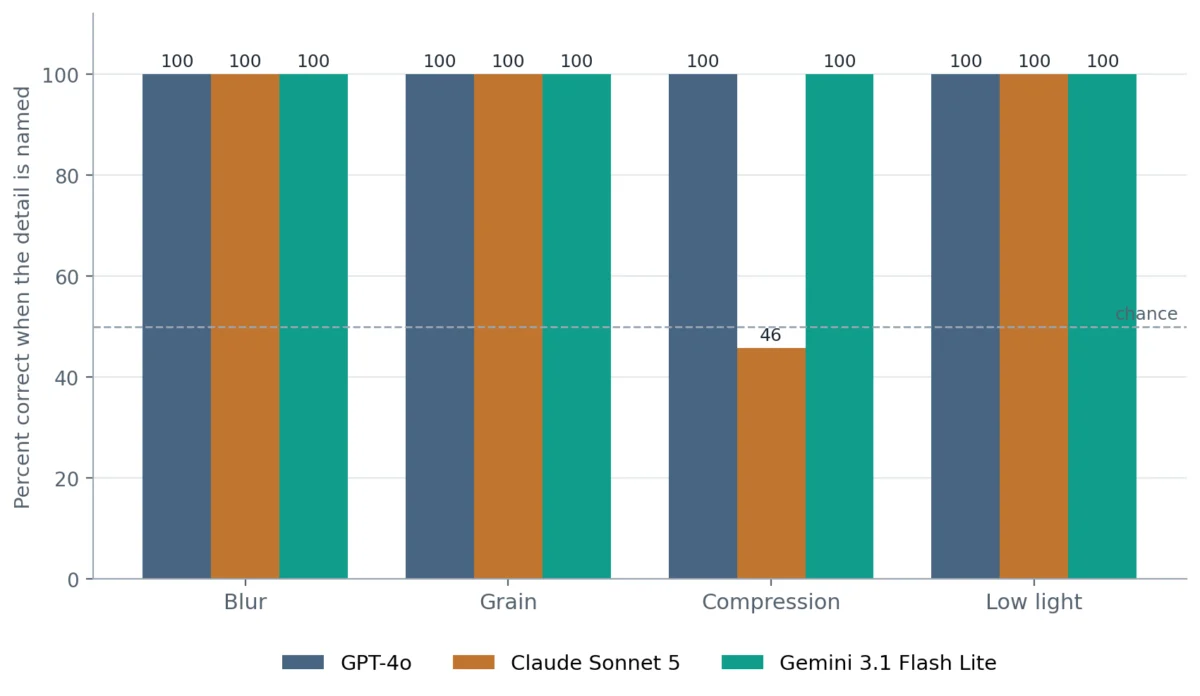
- Claude’s Compression Blindspot: While GPT-4o and Gemini scored 100% on named detail questions for blur, grain, and lighting, Claude faltered significantly on compression tests due to its overwhelming reliance on choosing the second image presented.
Official Responses and Industry Context
As multimodal AI architecture becomes standard across tech ecosystems, developers at OpenAI, Anthropic, and Google face mounting pressure to address output variance driven by prompt engineering and spatial sequencing.
While individual platform developers have continuously updated their system instructions to mitigate sycophancy and positional bias, independent benchmarks like VisionQ demonstrate that these architectural flaws remain deeply entrenched. Vision-language models process images by converting them into sequential tokens; consequently, the order in which visual data enters the transformer layers can disproportionately weight the final attention scores—explaining why models like Claude disproportionately favor "Image B."
Furthermore, the tendency of models like GPT-4o to manufacture definitive answers in the absence of a real distinction (the tilt-test hallucination) highlights a core design philosophy of conversational assistants: they are optimized to satisfy the user prompt rather than admit agnosticism or neutrality.
Implications: How to Audit Your Own AI Image Judges
The takeaway for developers, data scientists, and digital creators is clear: Never trust an out-of-the-box AI image judge without running localized validation tests.
Relying on generic API calls to evaluate product catalogs, fine-tune generative models, or grade visual media can introduce silent, systemic errors into automated pipelines. To safeguard workflows against hidden biases, experts recommend implementing a localized testing script that evaluates three critical metrics:
- Targeted Focus: Does the judge actually evaluate the specific detail requested (e.g., sharpness vs. exposure), or is it distracted by superficial elements?
- Positional Invariance: Does the model’s answer change simply because the order of the images (
Image Avs.Image B) was swapped? - Hallucination Resistance: When presented with identical images on a given metric, does the model correctly recognize parity (returning a "SAME" or null response), or does it stubbornly invent a non-existent difference?
By establishing rigorous validation protocols and tracking experiments with tools like Weights & Biases, organizations can isolate model flaws before deploying automated visual judges into production environments where accuracy is non-negotiable.



