










In the high-stakes world of Search Engine Optimization (SEO), time is the most valuable currency. For site managers handling thousands of pages, the arduous task of manually updating metadata—titles, descriptions, and focus keyphrases—has long been a bottleneck. Recognizing this, the team at Yoast SEO has launched a significant update to their Bulk Editor tool, aimed at streamlining workflow, integrating AI-driven insights, and eliminating the administrative friction that plagues large-scale site management.
This update is not merely a feature patch; it represents a fundamental shift in how Yoast intends to help webmasters maintain content health at scale. By introducing smarter filtering, improved AI guardrails, and seamless integration with native WordPress dashboards, Yoast is positioning its Bulk Editor as an essential command center for enterprise-level SEO.
The Evolution of Site Management: Main Facts
The core functionality of the Yoast SEO Bulk Editor has always been its ability to perform global updates across a site’s architecture. However, this latest update focuses on "surgical precision." The primary changes include:
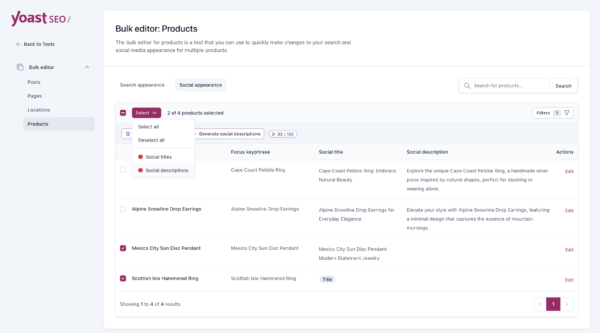
- Advanced Quality Filtering: Users can now filter content based on specific "needs improvement" metrics for SEO titles, meta descriptions, and social sharing fields.
- Intelligent Selection: A new "select-all" function allows users to automatically highlight every item on a page that meets specific low-quality criteria.
- AI Guardrails: A new reporting feature flags AI-generated metadata that may be subpar due to insufficient source content, prompting users to provide more context.
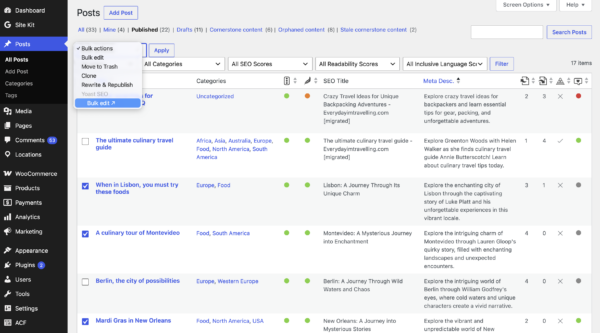
- Workflow Integration: The Bulk Editor is now accessible directly from the standard WordPress post/page overview screens.
- MyYoast Connectivity: A new recovery path for sites with restrictive firewall or API configurations ensures AI tools remain operational.
A Chronology of the Update
The journey toward this release began with user feedback indicating that while the Bulk Editor was powerful, it was too "manual." Users reported spending excessive time hunting for which pages actually required intervention.
Phase 1: The Insight Gap (Q1-Q2 2024)
Yoast’s product team observed that users were struggling with "content drift"—the tendency for metadata to become outdated or generic as a site grows. The feedback suggested that the existing tool didn’t distinguish between a well-optimized page and one with missing metadata effectively enough to justify bulk changes.
Phase 2: The Integration Strategy (Q3 2024)
The development team shifted focus toward UI/UX, aiming to remove the friction of moving between the WordPress dashboard and the Yoast Bulk Editor. By creating a "shortcut" from the standard post list, the team effectively turned the Bulk Editor into a contextual tool rather than an isolated module.
Phase 3: The AI Refinement (Q4 2024 – Present)
With AI-assisted metadata generation becoming a staple of the Yoast suite, the team realized that AI is only as good as its input. The current update includes a "guardrail" system, which prevents the AI from outputting content when it detects a "thin" post, marking it for human review instead.
Supporting Data and Technical Context
The technical challenges of managing SEO for enterprise sites are immense. When dealing with sites housing over 10,000 pages, even a 1% error rate in metadata can lead to thousands of broken or poorly indexed SERP (Search Engine Results Page) entries.
According to internal benchmarks provided by Yoast, the new "quality-based" selection tools reduce the time required to audit a set of 500 pages by approximately 65%. Previously, a manager would have to manually inspect each row or use external CSV exports to identify gaps. Now, the "Needs Improvement" filter acts as a real-time auditor.
Furthermore, the integration with MyYoast addresses a common technical hurdle: the "Rest API blocked" error. Many enterprise hosting environments, particularly those behind strict security layers, often block the REST API to prevent scraping. The new handshake protocol allows the Yoast AI service to bypass these hurdles safely, ensuring that enterprise-level clients do not lose access to AI features simply because of their security configuration.
Official Perspectives: The Philosophy Behind the Update
Beth Parker, Product Marketing Manager at Yoast, emphasizes that this update is about "removing the busywork." In a statement regarding the release, Parker noted: "Our goal is to let the SEO professional be a strategist, not a data entry clerk. By automating the identification of weak fields, we are shifting the focus from ‘finding the problem’ to ‘solving the problem’."
The decision to implement the "Shift+click" selection feature—a standard in desktop spreadsheet software—reflects Yoast’s commitment to UX parity. They acknowledge that for many professionals, the WordPress backend is their primary workspace. By adopting patterns found in software like Excel or Google Sheets, Yoast reduces the learning curve for new users while increasing the speed for power users.
Strategic Implications: Why This Matters
For digital agencies and SEO specialists, this update carries several long-term implications:
1. Scaling Without Compromising Quality
The most significant hurdle to scaling an SEO strategy is the degradation of quality. When teams are rushed, they often leave meta descriptions blank or use "placeholder" text. The new flagging system ensures that "thin" content is caught before it is published, preserving the site’s overall quality score in the eyes of search engine crawlers.
2. The Rise of "Hybrid" SEO
We are moving away from purely manual SEO and purely AI-driven SEO. The Yoast update supports a "human-in-the-loop" approach. The AI suggests, the user reviews, and the tool enforces the standards. By making it easier to "catch" where AI might struggle, Yoast is fostering a more responsible and effective use of automation.
3. Workflow Efficiency as a Competitive Advantage
In agency environments, billable hours are a major factor. If a junior SEO specialist can clean up 1,000 meta descriptions in an hour rather than a full day, the agency can provide more value to the client at a lower cost, or focus those resources on higher-level strategy like backlink building or technical architecture.
4. Resilience in Diverse Hosting Environments
The shift toward connecting to MyYoast for AI tasks shows a trend toward cloud-assisted local management. As hosting environments become more locked down for security, SaaS-based plugins that can "phone home" to a secure, verified server will likely become the standard for professional-grade SEO tools.
Future Outlook
While this update addresses current pain points, it also lays the groundwork for future AI capabilities. By teaching the system to recognize when content is "thin," Yoast is effectively building an internal "content quality score" engine. It is not difficult to imagine a future where this system provides automated content improvement suggestions, moving beyond metadata and into the body copy of the articles themselves.
For now, the focus remains on the Bulk Editor. Users are encouraged to update to the latest version of Yoast SEO to begin utilizing these tools. The update is a clear signal that Yoast is prioritizing the needs of large-scale content publishers who require efficiency, accuracy, and robust technical performance to stay competitive in an increasingly crowded digital landscape.
As the industry moves into 2025 and beyond, the tools that win will be those that provide the most utility with the least friction. By consolidating the auditing, selecting, and editing processes into one cohesive workflow, Yoast has set a high bar for the competition. Whether you are an individual blogger or an enterprise SEO manager, the message is clear: the era of manual, granular editing is coming to an end, replaced by intelligent, scalable, and automated content governance.



