










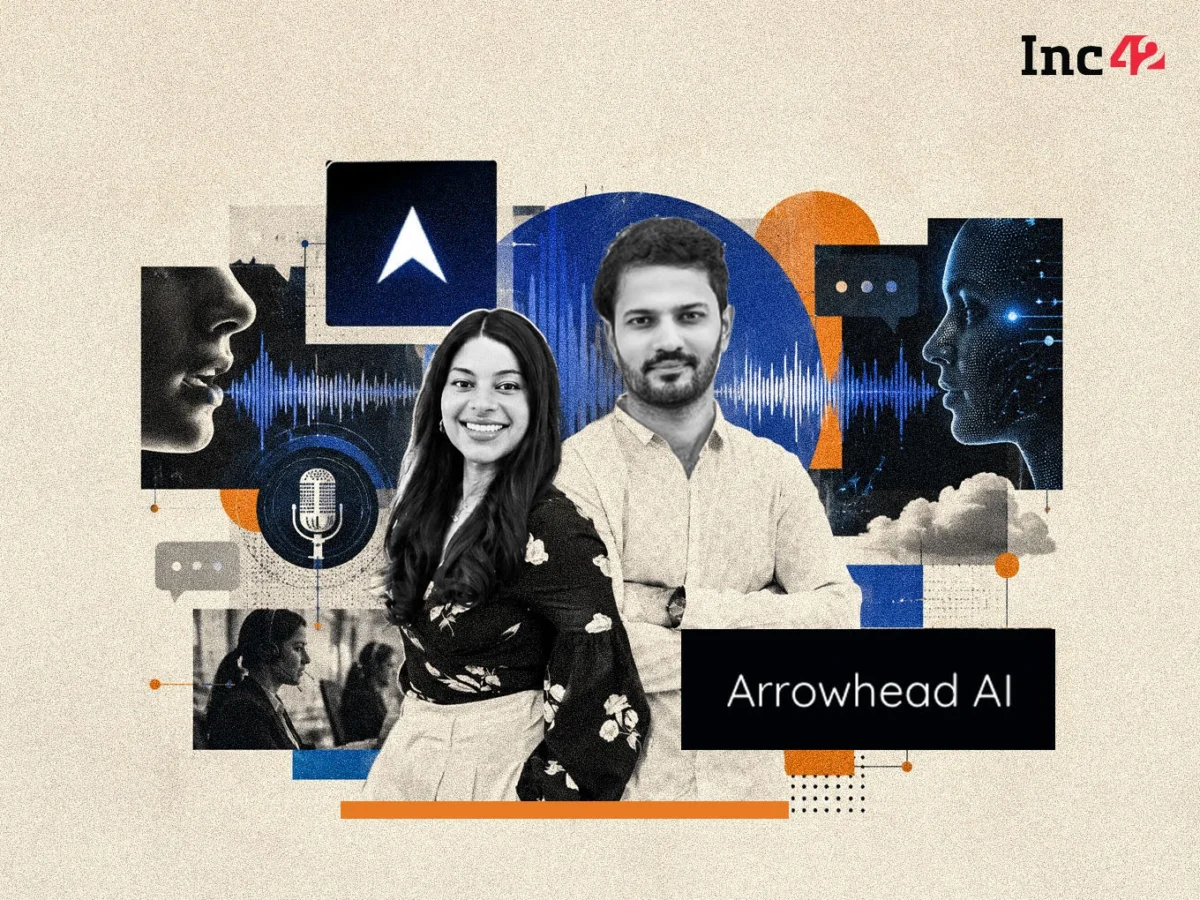
For decades, the enterprise "calling floor" has been a monument to human labor. Thousands of agents—hired, trained, and managed—spent their days tethered to headsets, navigating complex CRM scripts in a perpetual struggle to sell loans, resolve queries, and recover lost revenue. Despite massive headcount investments, the reality of high-volume customer engagement remained plagued by inconsistency. Prospects were lost to long hold times, agents were hindered by uneven training, and thousands of high-value leads simply slipped through the cracks every single day.
For years, the corporate consensus was that the solution was purely operational: hire more people, improve the training modules, and optimize the scripts. But Devyani Gupta and Vengadanathan Srinivasan, the founders of the voice AI startup Arrowhead, saw the landscape differently. They identified a fundamental flaw: human-driven phone processes are inherently unscalable.
With the rapid maturation of generative AI, the duo made a strategic pivot that would define the trajectory of their startup. They realized that optimizing human-led call centers was a losing battle; the future belonged to total automation.
A Calculated Pivot: When Analytics Was No Longer Enough
Founded in 2022, Arrowhead did not begin its life as a voice automation powerhouse. Its genesis was in conversation intelligence—a tool designed by Gupta, leveraging her deep experience at the Boston Consulting Group (BCG), to audit recorded sales calls for compliance and quality control. Early clients, including edtech giant upGrad, utilized the software to identify mis-selling and toxic sales pitches that were damaging brand reputation and inflating refund rates.
However, the GenAI explosion of 2023 and 2024 served as a watershed moment. The founders were forced to confront a sobering reality: they were building a tool to audit human performance in a field that was rapidly moving toward obsolescence.
"We quickly realized that if we continued analyzing just human sales calls, we would soon be analyzing something that would potentially go extinct," Gupta told Inc42.
Recognizing that the traditional call center was on borrowed time, Arrowhead executed a sharp pivot in late 2024. Rather than competing in the crowded chatbot space, the company doubled down on voice-first enterprise workflows. In a twist of fate, the very enterprises that had signed on for Arrowhead’s compliance analytics software became the startup’s first customers for its autonomous voice agents. They didn’t just want to watch their agents perform; they wanted to replace the manual calling queues entirely.
Building the Engine: A Vertical Stack Approach
To build a system capable of handling high-stakes financial interactions, Arrowhead realized that off-the-shelf APIs would not suffice. To achieve the level of fluidity required for enterprise-grade adoption, the team had to control every layer of their technological stack.
Engineering Low-Latency Intelligence
Arrowhead has moved away from third-party reliance, instead developing proprietary small language models (SLMs) fine-tuned specifically for the nuances of enterprise conversations. Unlike general-purpose models that prioritize broad knowledge, Arrowhead’s models are optimized for two things: conversational intent and speed.
Latency is the silent killer of voice AI. Even a delay of a few seconds creates an "uncanny valley" effect that ruins the user experience. Arrowhead claims its latest deployments achieve response latency below 500 milliseconds—a threshold that allows for natural, rhythmic human-like conversation.
The Nuance of Voice
Beyond the language model, the startup has invested heavily in custom text-to-speech (TTS) engines. Rather than using generic datasets, Arrowhead employed professional voice artists to record thousands of hours of audio across multiple Indian languages. This allows the AI to replicate the subtle markers of human speech—hesitations, filler words, empathy, and natural cadence—that generic systems often strip away.
CTO Vengadanathan Srinivasan emphasizes that this vertical integration is a competitive moat. By hosting their own models, Arrowhead achieves cost efficiency, predictable latency, and, crucially, data sovereignty. For highly regulated sectors like banking, keeping sensitive customer data within India is not just a preference; it is a regulatory mandate.

The Triple-Threat Workflow: Where Arrowhead Operates
Arrowhead’s platform is currently deployed across three high-impact workflows, each serving as a revenue-generating engine for their clients:
1. Autonomous Loan Sales
This is the most complex application of their tech. Arrowhead’s agents do not merely qualify leads; they manage the entire loan application journey. During a live call, the AI handles objections, guides the customer through document submission, performs real-time OCR (Optical Character Recognition) verification, and pushes the completed, verified file to the underwriting team.
2. Intelligent Inbound Support
Moving beyond the static IVR (Interactive Voice Response) systems of the past, Arrowhead’s agents analyze customer intent in real-time. They tap into enterprise databases to provide granular, account-specific answers—whether it is a complex insurance policy query or a real-time update on a loan status—without ever needing human intervention.
3. Abandoned Cart Recovery
For ecommerce and fintech players, the gap between a customer adding an item to their cart and finalizing the payment is where millions of dollars are lost. Arrowhead’s agents proactively reach out to customers, negotiate discount codes, update shipping details, and process transactions on the spot. The results have been tangible; a recent deployment with Tata 1mg demonstrated a 15% higher conversion rate compared to human-led recovery campaigns.
Financials and Market Positioning
In January 2026, the startup solidified its market position by raising $3 million in seed funding, led by Stellaris Venture Partners. With a client roster that includes industry heavyweights like Aditya Birla Capital, Bank of Baroda Cards, IndiaMART, Paytm, Turtlemint, and InsuranceDekho, Arrowhead has successfully transitioned from the pilot stage to deep-rooted enterprise integration.
Currently, 80% of the company’s revenue is derived from the BFSI (Banking, Financial Services, and Insurance) sector, though they are rapidly scaling into healthcare and ecommerce.
A Hybrid Monetization Strategy
Arrowhead employs a sophisticated, dual-layer pricing model:
- Per-Minute Usage: Charging for the raw compute and interaction time.
- Outcome-Based Pricing: A percentage of revenue linked to successful conversions or collections.
The founders argue that this hybrid approach aligns the startup’s incentives with the client’s bottom line. While they remain tight-lipped on specific revenue figures, they indicate that the business is already operating with gross margins between 25% and 30%.
The Road Ahead: Challenges and Competitive Moats
Despite its rapid rise, the path forward for Arrowhead is fraught with complexity. The Indian AI ecosystem is currently in a "voice war," with deep-pocketed competitors like Observe AI, Bolna, and Gnani.ai all fighting for the same enterprise mindshare.
Furthermore, the unit economics of AI remain a challenge. The cost of LLM reasoning, combined with specialized TTS, makes the infrastructure expensive to scale. As voice AI technology commoditizes, Arrowhead will have to prove that its "human-like" quality is not just a novelty, but a durable business advantage.
The company is also contending with the inherent friction of mobile voice navigation and the difficulty of integrating legacy enterprise software. However, the founders remain undeterred. They view the replacement of the call center as merely the first chapter. Their ultimate vision is the creation of "Autonomous Business Agents"—AI entities capable of managing end-to-end business operations without human oversight.
For now, Arrowhead is a case study in the power of the pivot. By realizing that they were building tools for a dying industry, Gupta and Srinivasan successfully repositioned their firm at the vanguard of a technological revolution. As they continue to refine their proprietary stack and deepen their penetration into the BFSI sector, they are proving that in the future of work, the most efficient customer service representative may not be a person at all—but a line of code that sounds, acts, and thinks like one.



