










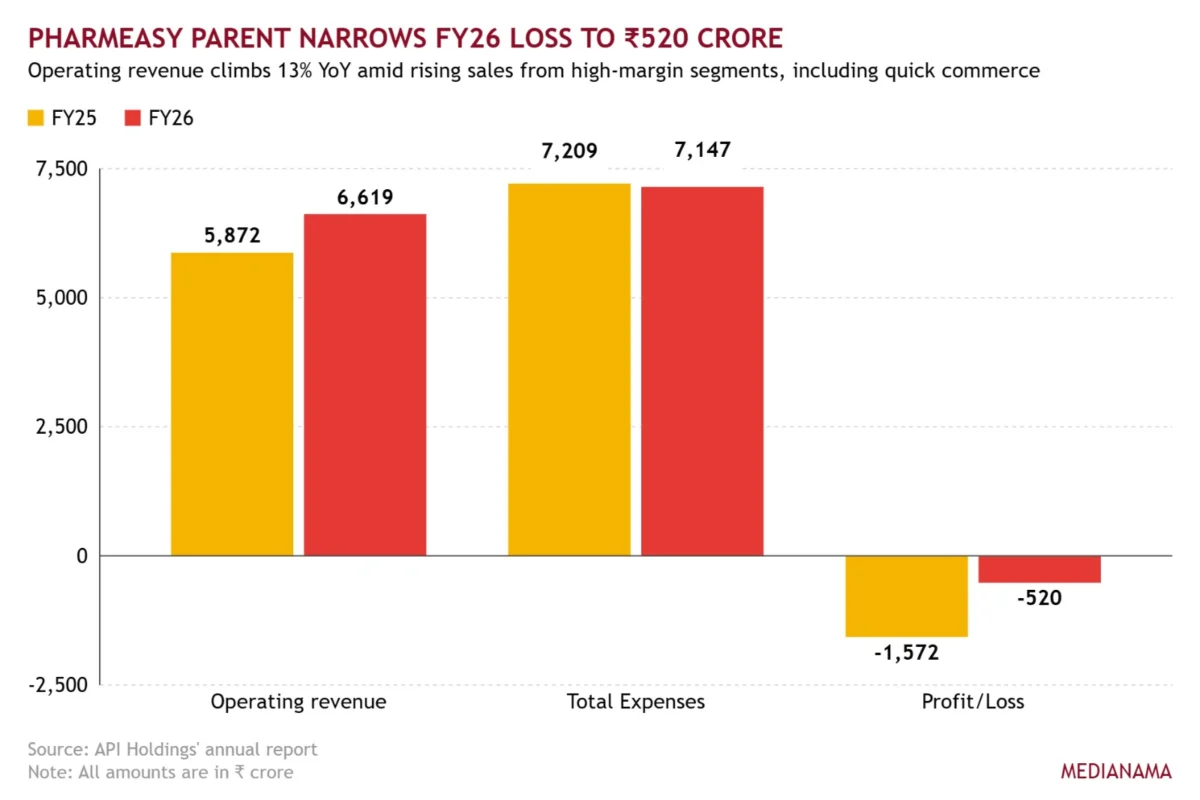
NEW DELHI — In a resounding turnaround for India’s heavily scrutinized healthtech sector, API Holdings—the parent entity of leading digital healthcare platform PharmEasy—has reported a monumental 67% reduction in its consolidated net loss for the financial year ended March 2026 (FY26). According to the company’s recently released annual report, net losses plummeted to Rs 520 crore, a sharp recovery from the Rs 1,572 crore net loss recorded in the previous fiscal year.
The significant narrowing of losses underscores a strategic evolution across India’s digital health landscape. Moving away from a pure top-line chase defined by indiscriminate cash-burning customer acquisition, API Holdings orchestrated a calculated pivot toward higher-margin verticals, operational efficiency, and cutting-edge retail models such as quick commerce. This trajectory highlights a broader maturation within the Indian startup ecosystem, where sustainable unit economics and profitability have taken precedence over unbridled expansion.
Main Facts: Financial Resilience and Revenue Expansion
The latest financial disclosures reveal a multi-pronged recovery story characterized by top-line growth coupled with strict fiscal discipline.
For FY26, API Holdings registered an operating revenue of Rs 6,619 crore, marking a 13% year-on-year (YoY) increase compared to Rs 5,872 crore in FY25. This revenue expansion was bolstered by strategic entry into the burgeoning quick commerce sector, which introduced a high-intent, high-margin customer demographic to the platform.
Furthermore, the company maximized the utilization of its existing physical infrastructure—including warehousing networks, logistics execution frameworks, and sales architecture—while concurrently optimizing marketing expenditures.
The company’s revenue streams are broadly categorized into two major verticals: Products and Services.
- Product Sales: The sale of pharmaceutical, over-the-counter (OTC), surgical, consumable, and private-label products remained the core revenue engine, raking in Rs 5,670 crore in FY26.
- Service Offerings: Diagnostics, teleconsulting, licensing, fulfillment, and technology-driven services contributed an additional Rs 941 crore to the top line.
Simultaneously, total expenses remained remarkably flat, contracting marginally to Rs 7,147 crore in FY26 from Rs 7,209 crore in FY25. The most notable expenditure adjustment occurred in employee benefit expenses, which nearly halved by 48% to Rs 477 crore down from Rs 908 crore in FY25. This reduction was primarily driven by a steep decline in Employee Stock Ownership Plan (ESOP) costs, which dropped to Rs 62 crore from Rs 482 crore the previous year.
Chronology: From Pandemic-Era Hypergrowth to Margin-Driven Consolidation
To fully appreciate API Holdings’ current trajectory, one must examine the chronological arc of India’s healthtech evolution over the past half-decade:
- 2020–2021 (The Pandemic Catalyst): Propelled by lockdowns and a sudden surge in demand for online medicine deliveries and home-based diagnostic tests, PharmEasy and its parent entity, API Holdings, expanded aggressively. This period was marked by massive market consolidation, including the strategic acquisition of diagnostic titan Thyrocare in 2021 to fortify the company’s offline-to-online healthcare offerings.
- 2022–2023 (The Correction Phase): As global macroeconomic conditions shifted and venture capital funding dried up, high-burn consumer tech models faced intense scrutiny. API Holdings encountered mounting losses, delayed public listing plans, and a pressing need to restructure its debt and operations to survive the "funding winter."
- 2024–2025 (The Structural Overhaul): Management initiated a radical operational overhaul, trimming workforce overheads, renegotiating vendor terms, and pivoting internal resources toward high-margin business-to-business (B2B) and diagnostic divisions.
- FY26 (The Turning Point): API Holdings successfully stabilized its cost structures, lowered net losses to Rs 520 crore, and initiated high-margin quick commerce integrations. This paved the way for early profitability milestones, notably in its B2B supply-chain subsidiaries by the first quarter of the subsequent fiscal year (Q1 FY27).
Supporting Data: Dissecting the Business Model and Cost Centers
API Holdings operates a diversified ecosystem spanning B2B pharmaceutical distribution, consumer-facing e-commerce (PharmEasy), and pathology diagnostics (Thyrocare). A granular look at these segments illuminates the drivers behind the company’s improved financial health.
1. B2B Operations: Ascent Health and Wellness Solutions & AknaMed
The B2B arm forms the structural backbone of API Holdings’ inventory and institutional supply chain:
- Ascent Health: Operates as a critical supply-chain intermediary, sourcing pharmaceutical products directly from manufacturers and supplying them to standalone chemists and institutional clients via an efficient Order Management System (OMS) platform.
- AknaMed: Specifically caters to hospitals, providing an integrated supply chain for pharmaceuticals, surgical consumables, and specialized medical supplies.
Performance Metrics: In FY26, the combined B2B businesses clocked revenues of Rs 4,082 crore, restricting their EBITDA loss to a negligible Rs 3.6 crore. Demonstrating rapid improvement, Ascent and AknaMed officially crossed into EBITDA profitability in the quarter ended June 2026 (Q1 FY27), posting a combined profit of Rs 70 lakh on a revenue base of Rs 1,006 crore.
2. Diagnostics: Thyrocare Technologies
Acquired to establish a robust omnichannel healthcare presence, Thyrocare offers an expansive portfolio of 1,375 diagnostic tests across India. Operating through a hybrid model of company-owned and third-party laboratories, collection centers, and a dedicated network of phlebotomists, Thyrocare serves retail consumers, hospitals, and corporate clients alike.
Consumers can access these services via physical walk-ins, home collection helplines, or digital bookings through PharmEasy, the Thyrocare app, and partner aggregators. In Q1 FY27, Thyrocare sustained its upward momentum, posting a revenue of Rs 240 crore—a robust 24% year-on-year jump.
3. B2C Operations: PharmEasy Marketplace
Serving as the consumer-facing frontend, the PharmEasy app operates as an e-commerce marketplace facilitating transactions between retail pharmacies and end-users. It also cross-sells diagnostics and teleconsultation services alongside on-demand home delivery of medicines. In FY26, the PharmEasy marketplace generated Rs 1,335 crore in revenue with an EBITDA loss of Rs 44 crore. By Q1 FY27, its revenue stood at Rs 348 crore against an EBITDA loss of Rs 17 crore.
4. Cost Center Breakdown
A detailed analysis of API Holdings’ Rs 7,147 crore total expenditure for FY26 highlights where capital was deployed:
- Purchase of Stock-in-Trade: This remained the company’s largest operational cost center, rising 11% to Rs 5,245 crore from Rs 4,730 crore in FY25, directly correlating with increased product sales volumes.
- Employee Benefit Expenses: Dropped drastically to Rs 477 crore, down 48% YoY, primarily due to the normalization of ESOP-related non-cash charges.
- Other Expenses: Rose 8% YoY to Rs 657 crore. This envelope included Rs 112 crore allocated to contractual payments for delivery associates and Rs 73 crore directed toward targeted sales promotions and marketing initiatives.
Official Responses and Strategic Commentary
While detailed public statements from executive leadership accompanying the FY26 annual report emphasize a resolute commitment to operational excellence, market analysts have taken note of the company’s tactical shifts.
Industry observers point out that the decision to lean heavily into high-margin segments—such as pathology laboratories, hospital procurement systems (AknaMed), and generic pharmaceuticals—has fundamentally altered the risk profile of API Holdings. By integrating quick commerce delivery channels, the company has successfully captured an urban demographic that demands hyper-fast fulfillment, translating higher delivery frequency into improved gross margins.
Management has consistently reiterated that future capital allocation will prioritize sustainable unit-level profitability over aggressive, cash-subsidized geographic expansion. This philosophy is visibly reflected in the shrinking gap between operational revenues and total expenditures.
Implications: What This Means for India’s Healthtech Ecosystem
The financial trajectory of API Holdings carries profound implications for the broader Indian startup and digital healthcare landscape:
- Validation of Omnichannel Models: Pure-play digital healthcare aggregators that relied solely on deep-discounting models have largely struggled to achieve sustainability. API Holdings’ results suggest that a hybrid ecosystem—anchored by robust B2B institutional supply chains, high-margin diagnostics (Thyrocare), and agile consumer-facing quick commerce—provides a viable blueprint for long-term survival.
- Shift in Venture Capital Expectations: The dramatic cut in net losses signals to investors that Indian healthtech unicorns are successfully transitioning from adolescent growth phases to mature, disciplined corporate governance. This recalibration is vital for restoring investor confidence ahead of eventual public market debuts.
- Intensifying Competition in Quick Commerce Healthcare: With API Holdings reaping the benefits of quick-commerce integrations, incumbent quick-commerce giants and rival e-pharmacies are likely to accelerate their own pharmacy delivery capabilities. This convergence of quick commerce and healthcare delivery could redefine consumer expectations around delivery timelines for chronic and acute medications across urban India.
As API Holdings steps into the second half of fiscal 2027 with pockets of its business already turning EBITDA positive, the company stands as a compelling case study of post-correction resilience in India’s modern digital economy.



