










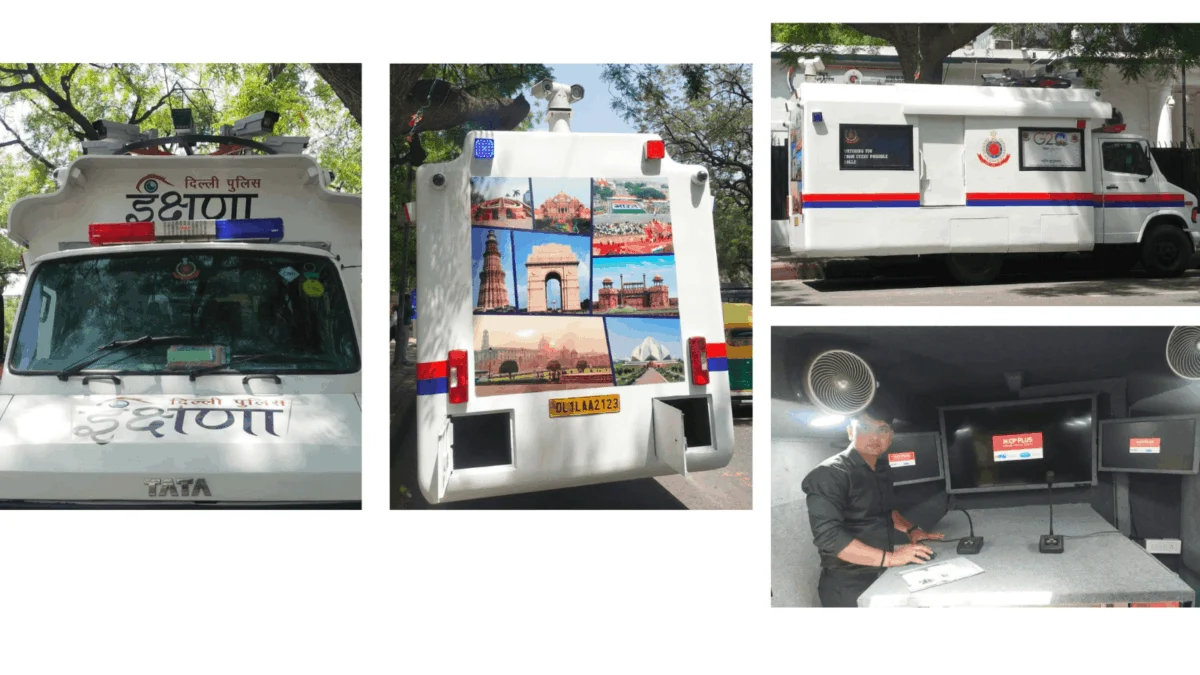
New Delhi: In an era where advanced policing technologies are quietly reshaping the public sphere, the boundary between maintaining law and order and state overreach has become razor-thin. Recent revelations surrounding the deployment of live Closed-Circuit Television (CCTV) surveillance vans and facial recognition technology (FRT) during student-led protests at New Delhi’s historic Jantar Mantar have ignited a fierce debate over privacy, accountability, and the rule of law.
At the center of this controversy is a chilling disconnect: while judicial affidavits and public demonstrations confirm the aggressive deployment of biometric surveillance tools by law enforcement, official administrative responses—secured through Right to Information (RTI) filings—reveal a systemic wall of evasion, non-acknowledgment, and regulatory ambiguity.
Main Facts: The Clash Between Digital Surveillance and Public Privacy
The controversy came to a head following the July 2026 student-led demonstrations at Jantar Mantar. During these protests, mobile surveillance units—specifically advanced monitoring vans equipped with real-time video feeds—were visibly deployed to monitor crowds. Civil liberties organizations, notably the Internet Freedom Foundation (IFF), moved swiftly to uncover the legal and technical frameworks authorizing these operations.
However, the responses to RTI applications filed with the Delhi Police paint a troubling picture of missing oversight.
- The Missing Framework: An RTI response yielded a Delhi Police standing order dated June 9, 2022 (previously cited by the Ministry of Home Affairs as a governing safeguard for facial recognition). Crucially, this document does not mention facial recognition at all.
- Total Omission of Biometric Safeguards: The reviewed documentation contains zero references to biometrics, underlying databases, watchlists, match thresholds, data retention periods, deletion protocols, privacy protections, or independent audits.
- Denial of Surveillance Assets: Despite being publicly photographed and documented operating mobile CCTV monitoring systems, the Delhi Police’s Special Cell formally claimed that "no such type of vehicle is being used/purchased" when asked for tenders, contracts, and data-handling terms concerning the "Ikshana" surveillance van.
This pattern of deflection is not isolated. Independent RTI probes conducted by digital rights platforms have similarly found a complete absence of public records, tenders, or grievance mechanisms regarding other high-tech policing tools, such as AI-powered smart glasses deployed during public events.
Chronology of Events: From Pilot Projects to Courtroom Disclosures
Understanding the current surveillance apparatus requires tracing its development over the past several years:
- 2010: The Delhi Police establishes its Integrated Command, Control, Coordination and Communication (C4i) system as a central hub for city-wide camera feeds. By contemporary standards, this infrastructure is nearing its "end-of-life stage," making way for the broader, highly digitized Safe City project.
- June 9, 2022: The Delhi Police issues a foundational standing order concerning real-time city-wide CCTV surveillance and "predictive policing" tools, later cited by government bodies as the operational bedrock for their tech deployments. Simultaneously, updated protest guidelines formally designate Jantar Mantar and Ramlila Ground as permitted demonstration sites, linking them directly to the command center.
- 2023: Technology firm CP PLUS publicly announces the design and development of "Ikshana"—a prototype mobile surveillance vehicle tailored for the Delhi Police. Promotional materials and press releases highlight that the vehicle features advanced monitoring capabilities, with pilot projects rolling out in select regional sectors.
- February 2026: RTI inquiries regarding the Delhi Police’s procurement of AI-powered smart glasses hit a dead end, with law enforcement units maintaining that no records, approvals, or tenders exist.
- July 2026: A wave of student-led and political demonstrations—including actions by the Crockroach Janta Party (CJP)—takes place at Jantar Mantar. Protesters and journalists document remote police vans actively monitoring live feeds and cross-referencing crowds with external or internal databases. The protests are marked by severe police interventions and subsequent internet restrictions.
- Post-July 2026: Legal challenges immediately reach the Delhi High Court and the Supreme Court of India. Under judicial scrutiny, the Delhi Police submits an explosive affidavit detailing the efficacy of its software during the protests.
Supporting Data and Technical Disclosures: The "Ikshana" Van and Judicial Affidavits
While administrative transparency remains stifled, technical specifications and legal filings have inadvertently exposed the vast scale of the state’s surveillance capabilities.
The "Ikshana" Mobile Surveillance Vehicle
According to developer disclosures from CP PLUS, mobile monitoring units like Ikshana are engineered to transform standard law enforcement vehicles into mobile intelligence hubs. Equipped with high-definition PTZ (Pan-Tilt-Zoom) cameras, onboard computing power, and direct connectivity to central command grids, these vans allow police forces to conduct high-density surveillance far beyond fixed pole-mounted cameras.
The Judicial Affidavit Contradiction
The true operational reach of these systems was accidentally brought to light through the Delhi Police’s defense in the Supreme Court. In an affidavit responding to queries regarding student protests, law enforcement asserted that its facial recognition software successfully identified 2,873 individuals with criminal antecedents at the Jantar Mantar protest site between July 20 and 26.

According to the breakdown provided:
- 2,402 individuals were flagged as matches against a database known as "Crime Kundli."
- 471 individuals were matched against general "criminal records."
However, investigative reporting by outlets like The Indian Express exposed profound flaws in the reliability and oversight of these automated systems. Cross-referencing the police’s own flagged data revealed that at least 25 of the individuals supposedly identified at the protest site were actually incarcerated in jail at the very moment the system claimed to have detected them. Such staggering false-positive rates highlight the inherent dangers of relying on opaque, unverified AI algorithms to track citizens in public spaces.
Official Responses and the Legal Vacuum
The core grievance raised by legal experts and advocacy groups is not merely the adoption of modern technology, but the clandestine manner in which it is introduced without statutory backing.
The Internet Freedom Foundation (IFF) has consistently argued that these internal executive orders fall woefully short of constitutional requirements. In a scathing critique of the Delhi Police’s evasive RTI replies, IFF emphasized the landmark constitutional precedent set by the Supreme Court in Justice K.S. Puttaswamy v. Union of India:
"This is the gap in the law that we have been pointing out since 2020. In Justice K.S. Puttaswamy v. Union of India, the Supreme Court held that any intrusion into privacy must first be authorised by law, and an internal order that does not bind anyone outside the force, and does not even mention the intrusion in question, cannot be treated as such a law."
By relying on internal standing orders rather than explicit, publicly debated legislation passed through parliament or state assemblies, authorities bypass democratic checks and balances. Furthermore, the Delhi Police’s SOP documents outline extensive parameters for "digital and virtual patrolling"—empowering operators to monitor specific online and offline activities and dispatch real-time alerts to local police stations—without ever defining the legal thresholds, scope, or retention limits of such monitoring.
Implications for Democratic Rights and Public Accountability
The normalization of pervasive surveillance at traditional democratic assembly points like Jantar Mantar carries profound implications for the future of civil liberties in India.
- The Chilling Effect on Free Assembly: When citizens know that attending a peaceful protest subjects them to automated biometric tracking, predictive policing models, and cross-referencing against opaque criminal databases, a profound chilling effect settles over public discourse. The constitutional right to assemble freely is inherently compromised when dissent is met with digital profiling.
- Accountability Deficit: The blatant contradiction between public police affidavits (bragging about thousands of automated matches) and administrative RTI replies (claiming zero knowledge of surveillance vans or AI tools) creates an accountability vacuum. If law enforcement agencies can selectively deny the existence of technologies to information-seekers while utilizing them in the field, oversight mechanisms become entirely toothless.
- The Urgent Need for Data Protection Legislation: The deployment of sensitive technologies—such as live facial recognition, predictive policing algorithms, and mobile biometric vans—by the Ministry of Home Affairs and state police forces underscores the urgent necessity of comprehensive legislative guardrails. Without statutory frameworks that mandate transparency, independent audits, strict data minimization, and robust grievance redressal mechanisms, the digital panopticon will continue to expand unchecked.
As legal battles persist in India’s highest courts, the fundamental question remains: Can a democracy sustain the unchecked expansion of surveillance state apparatuses in the absence of clear, legally binding protections for the privacy and dignity of its citizens? For now, the answers remain locked behind closed doors and heavily redacted bureaucratic denials.



