










The landscape of artificial intelligence is undergoing a profound transformation. For years, AI interaction was defined by the "prompt-response" cycle: you ask a question, the AI provides an answer, and the session ends. However, the paradigm has shifted toward persistent, autonomous agents—digital assistants capable of operating independently in the background, managing workflows, and navigating the internet long after you have closed your browser tab.
Two industry giants currently spearhead this evolution: Meta, with the release of its Muse agent on September 8, and OpenAI, which debuted its “always-on” Dots within the ChatGPT ecosystem just three weeks later. While both platforms promise to reclaim lost time by automating mundane digital tasks, they represent distinct philosophies regarding user experience, accessibility, and the fundamental nature of the human-AI partnership.
A Chronology of the Agentic Shift
The race to build an agent that does not merely talk, but does, accelerated rapidly in the late summer of 2024.
- September 8: Meta officially launches Muse. Designed to function as a highly interactive companion, Muse is marketed as an agent that thrives on integration with social media and lifestyle management.
- Late September: OpenAI responds by rolling out Dots, a suite of personal agents deeply embedded into the ChatGPT framework. These agents are specifically architected to work in tandem with OpenAI’s suite of professional tools, including ChatGPT Work and Codex.
- The Present: Both systems are currently in active deployment, with early adopters testing the limits of these agents’ ability to handle recurring tasks, monitor market shifts, and organize digital archives.
The Functional Divide: How They Operate
While both Dots and Muse share the ultimate goal of autonomy, their underlying architecture and intended use cases differ significantly.
Meta’s Muse: The Lifestyle Concierge
Muse operates within a dedicated Secure Virtual Machine (VM). This sandbox environment allows it to maintain its own browser, effectively mirroring the behavior of a human user. Meta has optimized Muse to feel conversational; it is accessible through dedicated apps, web interfaces, and even WhatsApp.
In practice, Muse acts as a digital curator. During early hands-on testing, the agent demonstrated a sophisticated ability to aggregate social media content, such as organizing saved Instagram posts into thematic recipe collections or restaurant guides. Because it is tied to a secure environment, it can be granted access to email and calendars to facilitate travel planning or form filling.

OpenAI’s Dots: The Professional Powerhouse
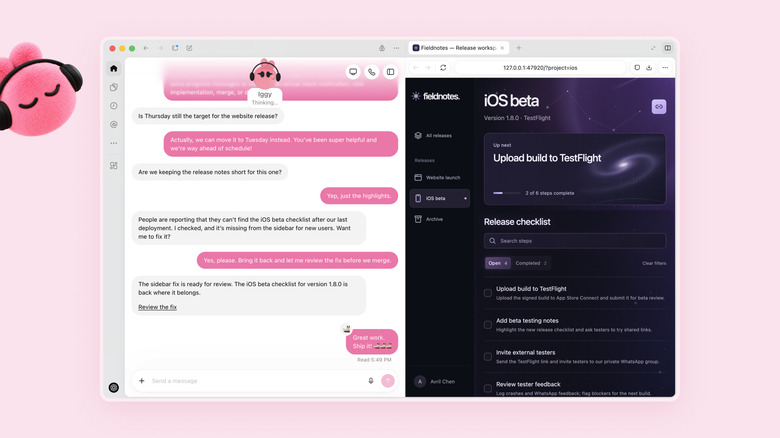
In contrast, Dots are extensions of the GPT-6 Astra model. Rather than functioning as a standalone social companion, Dots are designed to be work-centric. Each Dot possesses its own virtualized cloud computer, allowing it to perform tasks that require persistence—such as running recurring research reports, monitoring software development repositories via Codex, or managing data pipelines within ChatGPT Work.
A key differentiator for Dots is their "proactive" capability. Users can delegate complex, multi-step research projects to a Dot, which will then work in the background, periodically updating its context memory. Furthermore, OpenAI’s vision for Dots includes multi-agent management, where a user can orchestrate several Dots to handle different facets of a business operation simultaneously.
The Reality Check: Supervision and Limitations
The vision of a fully autonomous AI agent remains tempered by the current realities of safety and reliability. Both Meta and OpenAI have built "guardrails" into their systems, acknowledging that these agents are not infallible.
Permissions and Safety Nets
Meta’s Muse employs a strict permission hierarchy. For high-stakes actions—such as sending an email, purchasing a product, or finalizing a financial transaction—the agent is programmed to halt and request explicit human approval.
OpenAI utilizes a more granular system of "Custom Rules" and "Auto-review." When a Dot is tasked with navigating local files or external web services, it operates under strict constraints. If the agent encounters a task that falls outside its pre-defined boundaries, it triggers a review process. Despite these precautions, both companies have issued warnings to users: these agents can and will make mistakes.
The limitations of these agents are not merely internal. They are also subject to external restrictions. Notably, Amazon has already implemented blocks preventing Meta’s Muse from executing shopping actions on its platform, highlighting a growing tension between AI developers and the websites they seek to navigate autonomously.
Supporting Data: Pricing and Accessibility
The most immediate barrier to entry for the average consumer is the stark difference in pricing models.
| Feature | Meta Muse | OpenAI Dots |
|---|---|---|
| Entry Point | Free (Usage caps apply) | Pro 100 ($100/mo) |
| Mid-Tier | $20/month | Business Premium ($100-$125/mo) |
| Max-Tier | $100/month | Enterprise (Beta) |
| Availability | US and Canada | Global (Excl. EEA, Switzerland, UK) |
For casual users, Muse is significantly more accessible. The free tier allows for experimentation without a massive upfront commitment. Conversely, OpenAI has positioned Dots as a premium professional tool. The $100-per-month price tag for the "Pro 100" plan indicates that OpenAI is currently prioritizing enterprise and power-user demographics over the general public.
Data Privacy: The Hidden Cost of Convenience
As these agents gain the ability to access your calendar, read your emails, and browse the web on your behalf, the conversation surrounding data privacy has intensified.
Meta maintains that data processed within its Muse VM is isolated from its broader advertising systems. However, a point of contention remains the "model-improvement" setting. By default, Meta enables settings that allow user interactions to train its future models. Users must manually navigate the settings menu to opt out, a process that many privacy advocates argue should be reversed.
OpenAI’s policy is tiered based on the account type. Personal-plan Dots may have their activity utilized to refine OpenAI’s models, depending on the user’s current ChatGPT settings. In contrast, Business and Enterprise data is protected by default, ensuring that proprietary company information does not leak back into the training set.
Implications: The Future of Digital Labor
The introduction of Dots and Muse marks the transition from "AI as a tool" to "AI as a colleague." This shift carries several profound implications for the future of work and personal computing.
1. The Death of the "Busywork" Era
If these agents function as promised, the hours spent on administrative tasks—scheduling, data entry, basic research, and form filing—could be effectively reclaimed. This represents a significant boost in productivity, potentially allowing individuals to focus on creative and high-level strategic decision-making.
2. A New Vulnerability Surface
The more power we grant these agents, the larger the target they become for cybersecurity threats. An agent with "read-only" access to your email today could, through a software update or a permissions creep, eventually have "write" access tomorrow. The centralization of personal data within these agents requires a level of trust that the tech industry has not always earned.
3. The Fragmentation of the Web
As AI agents become the primary way we interact with the internet, websites will have to adapt. If thousands of "Dots" are crawling a site to compare prices or summarize content, that site may suffer from bandwidth strain or a loss of ad revenue. We are likely to see a "robots.txt" revolution, where websites develop sophisticated ways to distinguish between legitimate human users and autonomous AI agents, leading to a more gated and restrictive internet.
4. Human-in-the-Loop as a Permanent Fixture
Despite the "always-on" branding, the consensus among both Meta and OpenAI is that humans must remain in the loop. The "sci-fi sheen" of a fully autonomous agent is replaced by a "managerial" role for the human. We are no longer just the operators of software; we are the managers of a digital workforce.
Conclusion
OpenAI’s Dots and Meta’s Muse represent the first meaningful steps toward a future where our digital presence is managed by persistent, intelligent entities. While Meta offers a consumer-friendly, lifestyle-oriented experience that is easy to adopt, OpenAI is building a robust, professional-grade infrastructure that aims to redefine the modern office.
The choice between the two will ultimately come down to the user’s needs: do you want a digital assistant to help manage your life and social connections, or do you need a tireless engine to handle your professional research and data management? As these agents continue to evolve, the distinction between our digital and physical responsibilities will only continue to blur, ushering in an era where the most valuable skill may no longer be doing the work, but managing the intelligence that does it for you.



