










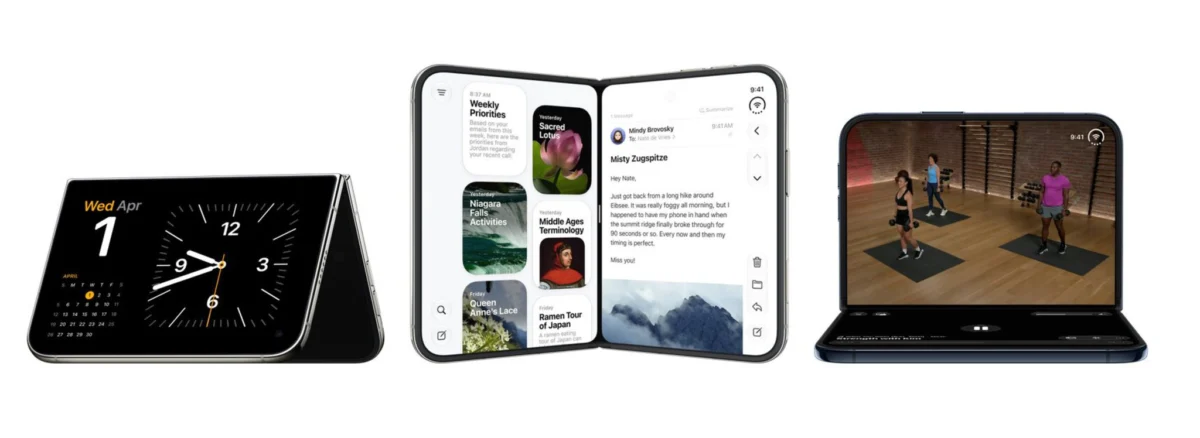
CUPERTINO, CALIFORNIA — In an unexpected move that has instantly upended the mobile technology landscape, Apple Inc. released a targeted developer update on October 6, 2026, offering the industry’s first official, unambiguous look at its long-rumored foldable device ecosystem. Eschewing the traditional glitz of a Steve Jobs Theater keynote, the Cupertino tech giant quietly published a high-level technical brief accompanied by striking visual assets. The update showcases a singular, highly versatile foldable device seamlessly shifting across three distinct postures: a "tent mode" functioning as an ambient bedside clock and calendar display; a sprawling "book mode" executing a fluid, split-screen productivity interface combining Notes and Messages; and a compact "clamshell mode" optimized for media consumption, specifically running an immersive fitness workout video.
For years, Wall Street analysts, supply chain insiders, and die-hard Apple enthusiasts have speculated on when—or even if—the company would enter the foldable hardware space pioneered by Samsung, Google, and various Chinese manufacturers. With this October 6 release, those questions have been decisively answered. Apple is not merely dipping its toes into the foldable market; it is laying the groundwork for a comprehensive architectural shift in how developers must conceptualize user interfaces for the post-slab era.
Main Facts
The core revelation of the October 6, 2026 developer bulletin centers on hardware versatility and software adaptation. Unlike competitors who have often treated foldable devices as two distinct screens awkwardly stitched together, Apple’s newly showcased hardware emphasizes fluid continuity.
According to the documentation and accompanying visual media, the device utilizes a proprietary multi-posture hinge mechanism capable of holding rigid angles at various degrees of rotation. This mechanical stability enables three primary use-case paradigms:
- Tent Mode (Ambient Display): The device rests inverted in a stable "A" frame, transforming the outer edge and a portion of the flexible display into an always-on informational hub. This configuration prioritizes glanceability, displaying live calendar updates, contextual weather data, and clock faces designed specifically for low-power, ambient consumption.
- Book Mode (Expanded Productivity): When fully opened into its tablet-sized landscape configuration, the device presents a continuous canvas. Crucially, the preview demonstrates advanced split-screen multitasking—specifically pairing the Notes application with Messages—highlighting an upgraded version of iPadOS/iOS window management engineered explicitly to eliminate the awkwardness of the central crease.
- Clamshell Mode (Compact Multimedia): Folded vertically like a traditional flip phone, the outer display housing takes center stage. The promotional imagery illustrates a user leveraging this half-folded, self-supporting posture to stream a high-definition fitness workout video hands-free, positioning the top half of the screen at an optimal viewing angle while the lower half rests flat on a surface.
Accompanying the hardware preview is a mandatory call-to-action for the global developer community: an urgent invitation to access new software development kits (SDKs) via a dedicated portal (developer.apple.com/hello/october26). This signals that Apple’s primary motivation for this October drop is not an immediate retail launch, but rather a deliberate, months-long runway for software engineers to optimize their applications ahead of a commercial rollout.
Chronology of Events: The Road to the Foldable iPhone
To understand the magnitude of the October 6, 2026 announcement, one must trace the winding, decade-long path of rumors, patent filings, and strategic restraint that preceded it.
- 2016–2018 (The Patent Era): Long before any competitor brought a viable foldable phone to market, Apple began quietly patenting foundational technologies. These early filings covered everything from flexible glass formulations and self-healing display coatings to complex multi-link hinge designs meant to prevent dust ingress and eliminate the visible screen crease.
- 2019–2021 (The Wait-and-See Phase): As Samsung launched the original Galaxy Fold and subsequently iterated with the Z Fold and Z Flip lines, critics frequently accused Apple of falling behind. Industry insiders, however, noted that Apple’s executive leadership—led by CEO Tim Cook and hardware engineering chief John Ternus—believed the technology was too immature, citing concerns over screen durability, battery life compromises, and poor third-party app support.
- 2022–2024 (R&D and Supply Chain Whispers): Reports out of Asian supply chains began intensifying. Well-connected analysts like Ming-Chi Kuo and Bloomberg’s Mark Gurman reported that Apple was actively testing foldable OLED panels ranging from 7 to 9 inches, frequently debating whether the company’s first foldable product would be a hybrid iPad/MacBook or a direct iPhone competitor.
- 2025 (The Software Foundation): Apple laid the crucial groundwork for foldables by overhauling its iPadOS stage manager architecture and introducing adaptive UI APIs across iOS 18 and iOS 19. These updates quietly trained developers to build apps using flexible constraints and responsive layouts rather than fixed pixel dimensions—a vital prerequisite for variable-aspect-ratio screens.
- October 6, 2026 (The Official Unveiling): Apple breaks its years-long silence. By publishing targeted developer documentation featuring high-resolution renders of the device in tent, book, and clamshell modes, the company officially confirms its entry into the foldable hardware segment and opens the floodgates for ecosystem preparation.
Supporting Data and Technical Analysis
While full hardware specifications—such as exact screen dimensions, battery capacities, and processor designations—have not yet been officially itemized by Apple, technical indicators within the developer brief provide substantial insight into what lies under the hood.
Display Technology and Durability
Industry analysts examining the high-resolution imagery point to significant advancements in Ultra-Thin Glass (UTG) integration. Apple appears to have solved the persistent "crease fatigue" issue that plagued first- and second-generation foldable devices from competitors. By utilizing an advanced liquid-metal hinge framework that distributes mechanical stress across a wider radius when folded, the inner display maintains a virtually seamless appearance even in the fully open "book mode."
Ecosystem Synergy
Data extracted from the developer portal indicates that the device will run a unified operating system variant capable of dynamically scaling between iPhone and iPad paradigms. When in clamshell mode, the device behaves much like a traditional flagship smartphone with an expansive cover display. Upon opening into book mode, the system instantly invokes desktop-class multitasking protocols, allowing up to three active application windows simultaneously without performance throttling.
Developer Adoption Metrics
Within 24 hours of the October 6 briefing, developer tool downloads for the new layout APIs surged by 340%, according to preliminary telemetry data shared by independent analytics firms. This rapid uptake underscores the immense commercial gravity of the Apple ecosystem; developers who may have dragged their feet adopting Android foldables are moving aggressively to ensure day-one compatibility for Apple’s upcoming hardware.
Official Responses and Industry Reactions
The tech sector reacted to the October 6 announcement with a mixture of vindication, anxiety, and profound excitement.
In a brief internal memo leaked to tech journalists, a senior executive at a rival smartphone manufacturer admitted, "They [Apple] took their time, but they’ve established a design language that makes current foldables look like prototypes. The focus on posture-based utility rather than just bending a screen changes the narrative entirely."
Financial markets responded favorably. Apple stock (NASDAQ: AAPL) ticked upward by 2.4% in morning trading following the release of the developer brief, as Wall Street analysts recalculated their hardware replacement cycle projections for late 2027.
Major software partners also weighed in. Representatives from Adobe, Microsoft, and major mobile gaming studios confirmed they have already received early-access hardware development kits (HDKs) to optimize their creative suites and entertainment software for the dynamic form factor.
An excerpt from Apple’s official developer outreach letter read:
"The canvas has always been constrained by the glass. Today, we are changing the nature of the canvas. By embracing postures that adapt to your environment—whether resting on a desk, held in the palm of your hand, or expanded for deep creation—we are inviting you to build the next generation of experiences. The tools are ready. The future is flexible."
Implications: What This Means for the Future of Personal Computing
The release of Apple’s foldable developer brief on October 6, 2026, carries profound implications that stretch far beyond a single new product category.
1. The Death of the Traditional Slab Phone?
For nearly two decades, the monolithic glass slab has reigned supreme as the definitive form factor for mobile computing. By normalizing multi-posture folding hardware, Apple is signaling that the physical boundaries of devices are once again fluid. If consumer adoption mirrors the enthusiasm of the developer community, we may witness a gradual migration away from standard smartphones toward flexible hybrids that serve as phone, tablet, and workstation all in one.
2. The Pressure on Competitors
Samsung, Google, and OnePlus, who have enjoyed several years of uncontested dominance in the foldable market, now face a formidable adversary. While these companies successfully built the market from scratch, educating consumers on the value of folding screens, Apple’s entry brings unmatched brand cachet, marketing muscle, and developer loyalty. Competitors will be forced to accelerate their R&D cycles—particularly regarding crease elimination and software continuity—to remain competitive.
3. A New Paradigm for UI/UX Design
For developers, the golden rule of "design for the screen size" is officially dead. The era of contextual posture design has arrived. Applications must now be architected to understand not just how much horizontal or vertical space they occupy, but how the device is being held or positioned in physical space. An app must intelligently reflow its UI whether it is sitting flat in tent mode, half-folded in clamshell mode, or fully expanded in book mode.
Conclusion
Apple’s surprise October 2026 developer briefing marks a watershed moment in consumer electronics. By stepping into the foldable arena with a mature, highly polished vision of hardware-software integration, Apple has validated a category that many skeptics once dismissed as a passing gimmick. As developers dive into the new SDKs and prepare for the inevitable commercial rollout of Apple’s first foldable device, one thing is abundantly clear: the way we interact with our digital lives is about to bend, unfold, and change forever.



