










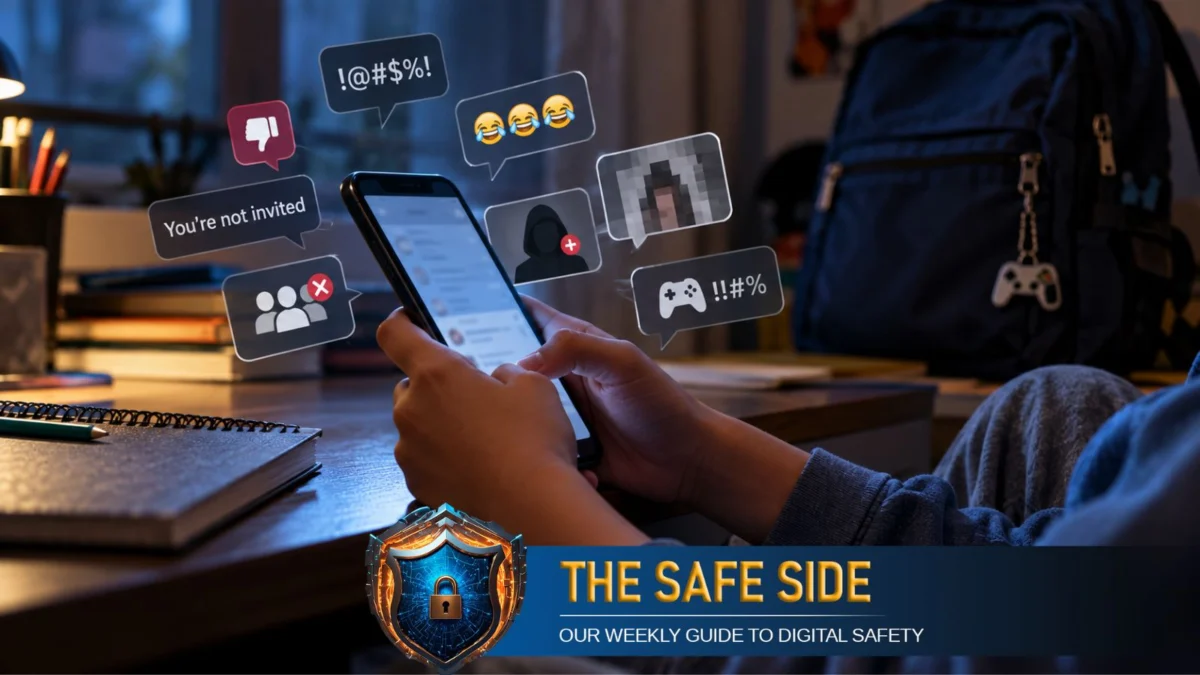
For generations, the school bell served as a definitive boundary. Once children walked out of the school gates, the social pressures, playground politics, and hallway conflicts of the day were left behind. Home was a sanctuary—a place of refuge where the outside world, and its social hierarchies, could no longer reach.
Today, that boundary has dissolved entirely.
For children growing up immersed in smartphones, social media feeds, and multiplayer online games, the school day no longer ends. A classroom disagreement seamlessly transitions into a hostile WhatsApp group chat after hours. A seemingly harmless joke cracked in the cafeteria is rapidly weaponized into a viral meme shared among hundreds of classmates before dinner. A child can be deliberately, systematically excluded from private digital circles, targeted and harassed while gaming, or wake up to find a fake social media profile operating under their name, maliciously spreading misinformation.
Unlike traditional schoolyard bullying, which remains bound by time and geography, modern cyberbullying possesses no obvious end point, no geographical safe zone, and no physical limit to its audience.
I. Main Facts: The Anatomy of Modern Digital Harassment
The landscape of youth interaction has fundamentally shifted from physical spaces to digital ecosystems, bringing with it a profound evolution in how peer aggression manifests.
According to a landmark 2022 study by cybersecurity giant McAfee, a staggering 85 per cent of surveyed Indian children reported experiencing cyberbullying—the highest proportion recorded among all countries evaluated in the report. The study illuminated the dual nature of these threats: 45 per cent of victims reported being targeted by total strangers, while 48 per cent were harassed by individuals they knew in real life. The repertoire of abuse spans a terrifying spectrum, including relentless trolling, targeted personal attacks, sexual harassment, and doxing (the public release of private or identifying information).
"The biggest change is that bullying does not stop at school anymore," explains Bikash Barai, founder of FireCompass, who has spearheaded cyber-education initiatives across more than 100 schools.
Barai notes that unlike adults, who often mentally or physically segment their professional and personal lives, children do not separate their online and offline worlds. Their friendships, shared hobbies, competitive gaming sessions, and emotional lives exist simultaneously across physical classrooms and digital platforms.
Compounding this crisis is the rapid democratization of advanced technology. "Now AI has added another problem," Barai warns. "Creating a fake account was already easy. Now creating a fake photograph, voice, or video is also becoming easy. You don’t need a lot of technical knowledge to do this anymore."
II. Chronology: The Evolution from Playground Taunts to AI-Powered Torment
To understand how modern cyberbullying has achieved its current pervasive scale, it is necessary to examine how youth interaction has evolved over the past two decades:
- The Pre-Smartphone Era (Early 2000s and Prior): Bullying was predominantly face-to-face, localized to physical spaces like schoolyards, hallways, and school buses. Incidents stopped when children returned home, and reach was limited to direct witnesses.
- The Rise of Web 2.0 and Social Networks (Late 2000s–2010s): The proliferation of desktop internet, early social media platforms, and SMS text messaging allowed harassment to occasionally bleed into the home via instant messaging or online message boards. However, access remained tethered to household computers.
- The Mobile Revolution (Mid-2010s): Smartphones placed high-speed internet and social media platforms directly into the pockets of pre-teens and teenagers. Cyberbullying became continuous, instantaneous, and mobile, moving from static computers to 24/7 availability.
- The Hyper-Connected & AI Era (Present Day): The ubiquity of encrypted messaging apps, ephemeral stories, online multiplayer gaming economies, and generative Artificial Intelligence has supercharged harassment. Today, bullies can instantly manufacture deepfake audio, manipulated photographs, and synthetic videos with minimal technical skill, making victimization nearly impossible to escape or disprove.
III. Supporting Data: The Scale of the Crisis
Statistics from global cybersecurity assessments and child protection organizations paint a stark picture of the psychological and social reality facing digitally native youth:
- 85 Per Cent: The proportion of Indian children reporting cyberbullying encounters in the 2022 McAfee study, leading global metrics.
- Nearly Even Split: The perpetrator breakdown shows that nearly half of all attacks originate from known peers (48%), while a significant portion (45%) stem from anonymous online strangers.
- Amplified Audiences: While a classroom incident might be witnessed by 20 to 30 peers, a screenshot or forwarded meme on Instagram or WhatsApp can exponentially scale to reach hundreds, or even thousands, of individuals instantaneously.
- Multifaceted Threat Vectors: Harassment is no longer confined to text-based messaging; it deeply penetrates online gaming communities, where players face systemic insults, targeted sabotage, and personal degradation based on gender, performance, or identity.
IV. Official Responses and Expert Perspectives
As the psychological toll of digital harassment mounts, industry leaders, cybersecurity experts, and child protection advocates are calling for a fundamental reassessment of how society approaches online safety.
Recognizing the Disguises of Modern Bullying
For parents, one of the most formidable hurdles is identification. Explicit threats or overtly abusive messages are easily flagged, but modern bullying is frequently camouflaged as everyday digital socialization.
Harish Kumar, CEO of Quick Heal Technologies, points out that bullying often hides in plain sight: "A child may face repeated insults, targeted attacks, or humiliation based on their performance, gender, or other personal characteristics while playing online. Parents frequently overlook gaming-related harassment."
Furthermore, peer dynamics can be weaponized subtly. A child might be systematically excluded from a specific WhatsApp group, while a duplicate shadow group is intentionally created for the sole purpose of mocking them behind their back.
"Even a meme can become bullying," Barai notes. "Somebody takes a photograph of a child, edits it, and it starts circulating in the class. Everybody else may think it is funny. The child at the centre of it may not find it funny at all." Kumar adds that parents must remain vigilant for repeated public shaming, unconsented screenshot sharing, and malicious rumors.
The Inescapable Nature of the Digital Realm
The psychological burden of cyberbullying is heavily magnified by its permanence and reach. In traditional bullying, a child finds relief at home. In the digital age, a malicious message can ping a phone at 2:30 AM, or a humiliating photograph can be forwarded across multiple closed networks with a single tap.
"What happens inside a classroom—maybe 20 or 30 people see it. Put the same thing in a WhatsApp or Instagram group, and it can reach hundreds of people," Barai explains. Once digital content is replicated and distributed, the victim loses all agency over its trajectory.
Shifting Focus: From Checklists to Behavioral Changes
Experts emphasize that parents should not search for a rigid checklist of symptoms, as children react to trauma in vastly different ways. Instead, attention must be paid to sudden deviations from baseline behavior.
A child who formerly engaged in a daily online video game may abruptly abandon it. A once-gregarious participant in a group chat may display visible anxiety or outright refusal to open messaging apps. Conversely, hyper-vigilant phone checking—driven by fear of what has been posted—can also be a warning sign.
Sandeep Kumar, founder of the COP (Child Online Protection) app, notes that shifts in a child’s relationship with their device often tell a clearer story than raw screen-time metrics. Withdrawal, acute anxiety, disrupted sleep cycles, falling academic concentration, and sudden secrecy regarding device usage all warrant gentle, proactive attention.
Fostering an Environment of Trust
Perhaps the most critical vulnerability in the fight against cyberbullying occurs at the moment of disclosure. Harish Kumar stresses that children frequently hide their torment out of fear. They worry that parents will confiscate their smartphones, strip away internet privileges, or initiate dramatic confrontations with the bullies or their families. They may also harbor deep shame regarding their own online mistakes.
"Don’t start with, ‘Why did you send this?’" Barai advises.
The initial parental response dictates whether a child will seek help in the future. Experts agree that parents must first listen without judgment, resist the immediate urge to punish by taking away devices, and validate the child’s courage in speaking up.
V. Implications: A Collective Responsibility
The burden of safeguarding children in an increasingly complex digital world cannot rest solely on the shoulders of parents navigating these uncharted waters alone.
Amit Relan, co-founder and CEO of mFilterIt, argues for a multi-layered defensive ecosystem. Schools, technology conglomerates, gaming platform developers, and governmental policymakers must actively collaborate to engineer safer digital environments by design. Relan stresses that digital literacy and cyber-safety cannot remain relegated to isolated, one-time school awareness seminars; they must be integrated as continuous, evolving pillars of modern education—particularly as generative AI lowers the barrier for malicious actors to fabricate convincing synthetic identities and fraudulent media.
Ultimately, however, the foundational line of defense begins at home with approachability.
Children must fundamentally believe that reporting an uncomfortable, threatening, or abusive online interaction will not result in arbitrary digital exile, victim-blaming, or public humiliation. By building enduring trust, parents and educators can ensure that when the invisible classroom turns hostile, children view trusted adults not as wardens to hide their problems from, but as allies ready to help them reclaim their peace of mind.



