











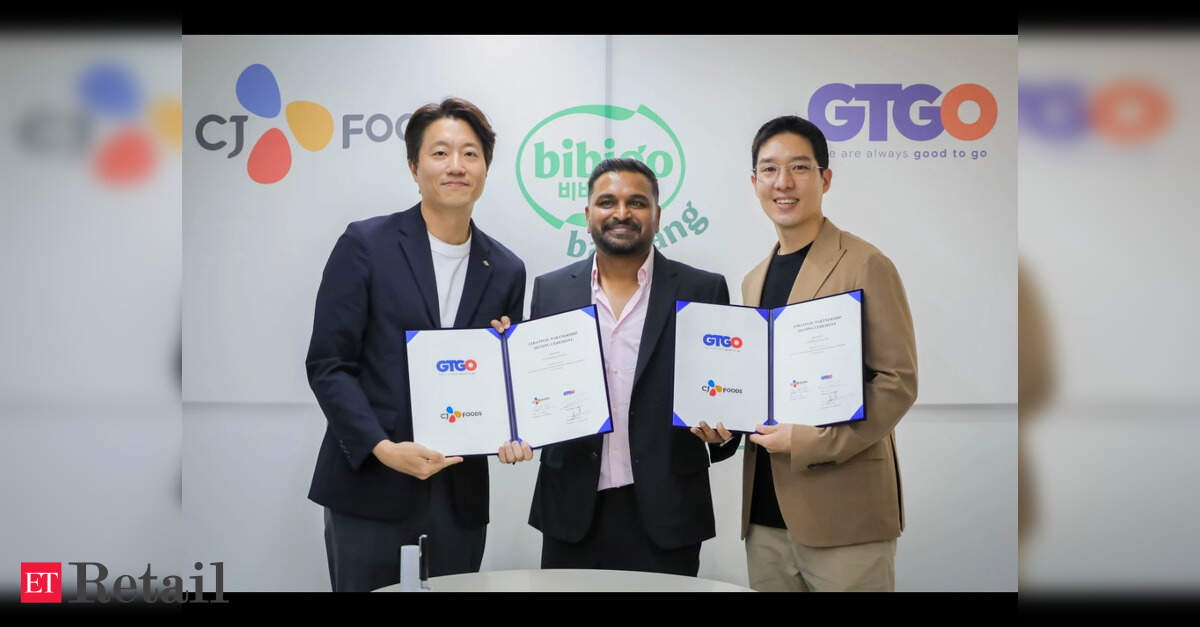
The landscape of India’s Quick Service Restaurant (QSR) industry is undergoing a seismic shift as global culinary giants eye the nation’s rapidly evolving palate. In a landmark development, CJ Foods—the South Korean food conglomerate behind the internationally acclaimed brand Bibigo—has officially entered the Indian market. Through a high-stakes strategic partnership with GTGO, a multi-brand Korean food platform, the company is launching Bibigo Bapsang, its inaugural restaurant-format foray into the country.
This partnership is not merely a brand launch; it is a calculated effort to institutionalize Korean cuisine within the Indian dining ecosystem, leveraging the operational expertise of GTGO to bridge the gap between traditional Korean flavors and the fast-paced, value-conscious Indian consumer.
The Genesis of the Partnership: A Strategic Alignment
The arrival of Bibigo Bapsang in India follows a year of meticulous planning and market analysis. Jae Won (Jay) Lim, Founder and CEO of GTGO, confirmed that the project has been in the pipeline for twelve months, with the first outlet opening its doors in Bengaluru just last weekend.
For GTGO, this collaboration marks a pivotal transition. Previously known for its aggressive expansion of the GOPIZZA brand, the company is now rebranding itself as a comprehensive "K-food platform." This evolution allows GTGO to move beyond the niche appeal of single-product QSRs and instead curate a diversified portfolio that includes Gochujang and Dalkomi, alongside its latest addition, Bibigo Bapsang.
The strategic importance of this move cannot be overstated. CJ Foods, a subsidiary of the massive CJ Group, is not only a brand partner but also a significant investor in GTGO. By positioning Bibigo Bapsang as the spearhead, CJ Foods aims to cultivate brand awareness for the Bibigo identity before potentially launching a full-scale retail offensive in the Indian FMCG sector.
Financial Framework and Expansion Roadmap
The financial architecture behind this rollout is built on a model of lean, high-efficiency operations. GTGO has committed an investment of approximately Rs 1 crore per store for the initial phase of Bibigo Bapsang. According to company leadership, these stores are designed for rapid deployment, with a typical setup time of just 45 days.
Scaling for Success
GTGO’s expansion strategy is characterized by a "cluster-based approach." Rather than adopting a scattered, one-off expansion model, the company plans to enter cities with a minimum of 10 to 15 outlets simultaneously, supported by centralized kitchens. This operational density allows for better quality control, supply chain efficiency, and brand visibility.
- Current Footprint: The platform operates roughly 60 outlets across India, including 45 GOPIZZA stores, 10 Gochujang outlets, and 5 Dalkomi stores.
- Near-term Goals: The company aims to add 15 new outlets by December 2024 and reach a milestone of 100 outlets by June 2027.
- Financial Health: For the last financial year, the platform generated Rs 75 crore in revenue, with an ambitious target of Rs 100 crore by the end of 2026.
Mahesh Reddy, Co-Founder and CEO of GTGO, emphasized that the company’s focus remains strictly on fiscal health rather than vanity metrics. "We were not chasing the number of outlets; we were chasing the P&L and EBITDA," Reddy stated. With 20% profitability across its current network and an ROI cycle of just 12 months per outlet, the company has proven that its unit economics are sustainable even in a competitive market.
Supporting Data: The Investment Landscape
The commitment to India is further underscored by a massive capital injection. To date, GTGO has invested over Rs 100 crore into its Indian operations. Looking ahead, the company is preparing for a significant capital raise ranging between Rs 100 crore and Rs 250 crore. Crucially, up to 70% of these proceeds are earmarked for the Indian market, signaling an aggressive investment pipeline of Rs 50 crore to Rs 175 crore over the next 18 months.
The IPO Horizon
The ultimate objective for the leadership team is an Initial Public Offering (IPO) in roughly three years. CEO Jae Won Lim notes that India’s performance is the linchpin of this valuation strategy. "We aim to IPO in three years’ time, and until then, our India performance will be very crucial to create a bigger valuation for our investors," Lim explained.
The company’s investor roster—which includes Korean venture capital heavyweights like CJ Investment, GS Ventures, DSC Investment, and Capstone Partners—suggests that the market is watching this experiment closely as a litmus test for Korean food brands in South Asia.
The Culinary Offering: Bringing Korea to the Indian Table
Bibigo Bapsang is designed to cater to the Indian consumer’s preference for "bowl meals"—a format that aligns well with the existing QSR landscape in India. The menu features:

- Bibimbap: The iconic Korean mixed-rice dish.
- Korean Fried Chicken: A global sensation that has seen massive popularity in Indian urban centers.
- Authentic Sides: A range of Korean staples designed to introduce the local palate to the depth of Korean flavors.
The formats are versatile, ranging from 100 sq ft airport kiosks to 600 sq ft standalone restaurants. This flexibility allows GTGO to penetrate high-footfall areas like transport hubs and malls, where the "grab-and-go" culture is most prevalent.
Implications: A Catalyst for the K-Food Ecosystem
The entry of CJ Foods is expected to serve as a catalyst for a larger influx of Korean capital into India. As Lim noted, the company has "put a foot in the door" for others to follow. There is a palpable expectation that as Bibigo Bapsang scales, it will pave the way for other Korean startups and food conglomerates to view India as a primary destination for expansion.
The Shift to Tier-II and Tier-III Markets
While the initial focus is on major metros like Bengaluru, Hyderabad, Chennai, and Anantapur, the company’s roadmap explicitly includes expansion into Tier-II and Tier-III cities. By leveraging the central kitchen model, GTGO intends to maintain price parity and quality consistency, ensuring that the "Korean Wave" (Hallyu) is not restricted to the cosmopolitan elite.
Strengthening the Bilateral Economic Bond
This venture is a testament to the strengthening trade and cultural ties between India and South Korea. As Indian consumers become more globally oriented, the demand for authentic international cuisines has surged. By providing a platform that is backed by both local operational expertise (GTGO) and global culinary standards (CJ Foods), the venture is positioned to capture a significant share of the growing "fast-casual" dining segment.
Conclusion: The Road Ahead
As GTGO and CJ Foods embark on this ambitious journey, the success of Bibigo Bapsang will likely be determined by their ability to balance authentic Korean identity with the nuances of the Indian consumer’s preferences. With a robust financial backing, a clear roadmap to 100 outlets, and a disciplined approach to store-level profitability, the partnership is well-equipped to navigate the complexities of the Indian market.
For the Indian consumer, the arrival of Bibigo Bapsang offers more than just a meal; it offers a front-row seat to the globalization of Korean cuisine. For the industry, it signals a new era where specialized international food platforms can achieve scale and profitability by meticulously localizing global brands. As the countdown to 2027 begins, all eyes will be on how this "K-food platform" navigates the challenges of the world’s most promising consumer market.



