










WASHINGTON — In what authorities are hailing as the largest and most comprehensive multi-national operation of its kind, a coalition of international law enforcement agencies and major private-sector technology firms has dealt a historic blow to transnational cybercrime syndicates. Codenamed "Joint Disruption Week," the intensive, coordinated campaign focused squarely on dismantling sophisticated online scam operations originating in West Africa.
The U.S. Department of Justice (DOJ) announced Tuesday that the wide-ranging offensive resulted in 28 criminal arrests, the dramatic rescue of 117 human trafficking victims trapped within forced-labor scam compounds, and the neutralization of more than 3.7 million fraudulent digital accounts. Furthermore, investigators identified over $11 million in illicitly obtained cryptocurrency and fiat funds eligible for freezing, alongside the seizure of hundreds of electronic devices utilized by criminal actors.
The offensive highlights a paradigm shift in how global authorities confront modern digital fraud—moving away from isolated, reactive investigations toward proactive, synchronized public-private partnerships capable of striking cybercrime ecosystems across multiple borders simultaneously.
Main Facts and Scope of the Operation
Joint Disruption Week targeted a sprawling network of cyber-fraud enterprises specializing in high-yield, emotionally devastating financial crimes. The illicit operations dismantled during the sweep included:
- Pig Butchering (Sha Zhu Pan): Complex, long-term romance and investment scams where victims are groomed over months before being defrauded of their life savings through fraudulent cryptocurrency platforms.
- Law Enforcement Impersonation: Scams where fraudsters pose as police officers, tax authorities, or regulatory officials to terrify victims into transferring funds.
- Digital Arrest Extortion Schemes: Coordinated psychological operations where targets are falsely accused of severe crimes and forced to isolate themselves while paying ransom or transferring assets.
According to participating officials, the operation marks the first time law enforcement and private industry have executed a joint, region-specific disruption campaign of this magnitude targeting West African cyber syndicates.
“For so long, the problem of international scams seemed impossible to tackle,” said Kelly Milliron, acting chief of staff and counselor to the Assistant Attorney General leading the DOJ’s Criminal Division. “But now, because of collaborations like Joint Disruption Week, we have a plan, a consolidated approach, bringing together people that can bring solutions and, most of all, safety for our citizens.”
The coalition of participating agencies was unprecedented. Alongside the DOJ, the operation involved the Scam Center Strike Force under the U.S. Attorney’s Office for the District of Columbia, the FBI, the U.S. Secret Service, the Treasury Department, Homeland Security Investigations (HSI), and the Homeland Security Task Force. International partners included the United Kingdom’s National Crime Agency (NCA), the Nigerian Joint Case Team on Cybercrimes, the Nigeria Police Force’s National Cybercrime Center, the Ghanaian Cyber Security Authority, and INTERPOL, alongside specialized agencies from Australia, Canada, India, and New Zealand.
Significantly, the success of the mission relied heavily on private industry. Tech giants and blockchain analytics firms—including Adobe, Binance, Coinbase, Cyjax, Elliptic, Chainalysis, Flashpoint, Google, Meta, Microsoft, OpenAI, Silent Push, Starlink, and TRM Labs—collaborated in real-time to track, report, and eliminate infrastructure used by the scammers. Meta reported independently that it removed more than 3.7 million fraudulent accounts, groups, and pages from Facebook and Instagram that were rooted in West Africa and primarily targeting users in the United States and the United Kingdom.
Chronology of the Crackdown
While Joint Disruption Week culminated in a flurry of synchronized announcements and enforcement actions in late October, the operation was months in the making and executed in calculated phases.
Phase 1: Intelligence Sharing and Cross-Border Alignment
The groundwork for the operation was laid earlier in the year, bolstered by a newly formalized counter-fraud partnership between the United States and the United Kingdom. Jeanine Pirro, U.S. Attorney for the District of Columbia, noted that the initiative was designed to foster parallel prosecutions and joint targeting.
"The aim is to bring cases in parallel and also to combat fraud together through joint targeting," Pirro explained. "This was the perfect time to continue that partnership."
Phase 2: On-the-Ground Raids in West Africa (September)
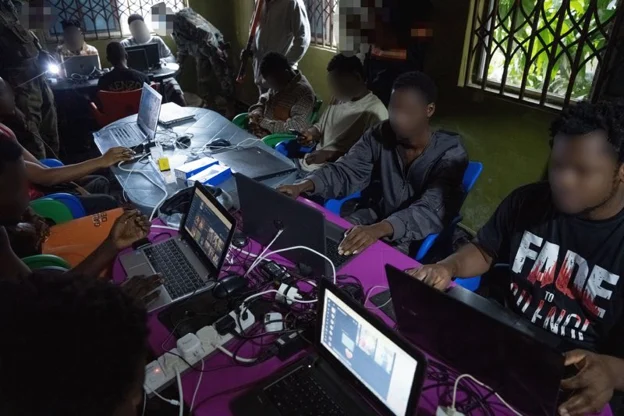
The kinetic phase of the operation quietly kicked off in September, weeks before the official public rollout of Disruption Week. Armed with intelligence compiled by both domestic and international agencies, law enforcement launched a series of high-impact raids targeting physical scam compounds in Ghana. These raids proved critical not only for gathering digital evidence and hardware but also for locating and liberating human trafficking victims who had been lured to the region under the false pretense of legitimate employment, only to be forced into executing online scams under threat of violence.
Phase 3: The Digital Takedown and Global Sweep (October)
With physical compounds disrupted in Ghana and intelligence flowing freely across borders, the operation expanded into cyberspace. Tech platforms moved aggressively to purge millions of fraudulent profiles, while financial intelligence units tracked illicit capital flows. By the time the Justice Department announced the results on Tuesday, participants had shared more than 30 actionable leads regarding active scam centers, laying the groundwork for subsequent operational phases.
Supporting Data and Financial Metrics
The quantifiable impact of Joint Disruption Week underscores both the profitability of modern cybercrime and the complex hurdles law enforcement faces in recovering stolen assets.
- 28 Arrests: Key facilitators, ringleaders, and digital infrastructure operators were taken into custody across multiple jurisdictions.
- 117 Victims Rescued: Individuals subjected to forced labor within scam compounds were safely extracted, highlighting the intersecting horrors of human trafficking and cyber-enabled financial crime.
- 3.7+ Million Accounts Neutralized: Massive purges by Meta and other platforms severed the primary communication pipelines scammers use to groom and contact victims.
- $11 Million in Freezable Assets: Investigators successfully mapped and identified over $11 million in cryptocurrency and bank accounts tied directly to criminal operations.
However, translating "identifiable" assets into recovered funds remains a laborious legal process. Matthew Floyd, deputy assistant director of the FBI’s Criminal Investigative Division, explained the distinction between identifying illicit funds and actually seizing them.
"Identifying the assets is the easy part, and tracing them, going after and developing probable cause within our investigations so that we can legally seize them does require a little bit of work," Floyd told reporters. "So at this point, that’s why it’s much easier in these efforts to identify assets initially, and then they’ll fold into our investigations as we move forward."
Official Responses and Strategic Context
The operation aligns closely with broader governmental priorities. The current administration has repeatedly emphasized that disrupting cyber adversaries, ransomware gangs, and transnational fraud networks is a cornerstone of its national security and economic strategy. By treating cyber-scams not merely as isolated consumer protection issues, but as matters of national security and transnational organized crime, Washington has sought to elevate the profile of these investigations.
Despite the widespread praise for Joint Disruption Week, the operation also arrives amid ongoing scrutiny from lawmakers. Some members of Congress have previously raised concerns during Capitol Hill hearings regarding whether U.S. agencies are sufficiently coordinated in their approaches to tackling transnational scam networks. Proponents of the recent operation point to the multi-agency Strike Force model as a direct answer to these criticisms, demonstrating that federal, state, and international entities can effectively streamline operations when paired with private-sector intelligence.
The private sector similarly lauded the cooperation. Representatives from blockchain analysis and artificial intelligence firms noted that the integration of AI tools, threat-intelligence sharing, and decentralized finance (DeFi) tracking played an indispensable role in mapping out networks that would have otherwise remained opaque to traditional policing methods.
Implications for the Future of Cybercrime and Defense
Joint Disruption Week represents a watershed moment in the global fight against digital fraud, offering several critical takeaways for the future of international cybersecurity:
- The Human Trafficking Nexus: The rescue of 117 trafficking victims reinforces a grim reality: many cyber-scam operations are run like industrial-scale prisons. Future anti-scam strategies must inherently incorporate rescue and humanitarian operations alongside traditional law enforcement actions.
- The Necessity of Private-Public Synergy: Law enforcement alone cannot police the internet at scale. The removal of millions of fraudulent accounts by tech platforms demonstrates that real-time information sharing between corporations and governments is the most effective way to blunt the operational capacity of cybercriminals.
- Institutionalized Collaboration: FBI officials confirmed that Disruption Week was not a one-off event, but rather the culmination of an ongoing framework for regular, synchronized crackdowns. While the exact intervals of future joint operations remain classified, the infrastructure for continuous, cross-border disruption has been permanently cemented.
- Asset Recovery Challenges: While millions in funds have been flagged, the friction inherent in international legal cooperation, cryptocurrency obfuscation (such as the use of privacy mixers), and multi-jurisdictional asset forfeiture means that recovering funds for victims will remain an uphill battle.
As cybercriminals continue to evolve their tactics—incorporating generative AI, deepfakes, and more decentralized communication channels—operations like Joint Disruption Week signal that the global law enforcement community is finally learning to match the agility, scale, and cross-border nature of modern digital crime.



