










NEW YORK — As the crisp winds of mid-September sweep through Manhattan, signaling the return of peak operational velocity across industries, the enterprise technology sector is experiencing a corresponding surge in momentum. Amidst the seasonal transition of autumn lattes and dropping temperatures, the AWS launch calendar has shifted into high gear. This week, that energetic pace is anchored by a landmark release that bridges the worlds of hyperscale cloud infrastructure and frontier artificial intelligence: the official arrival of OpenAI’s GPT-6 Astra on Amazon Bedrock.
For enterprise architects, developers, and corporate leaders, this integration marks a significant maturation point in how large language models (LLMs) are deployed, governed, and utilized at scale. Bringing OpenAI’s most advanced reasoning engine into the secure, scalable ecosystem of Amazon Bedrock is more than just a software update—it represents a structural upgrade to the enterprise tech stack.
1. Main Facts: The Integration of GPT-6 Astra on Amazon Bedrock
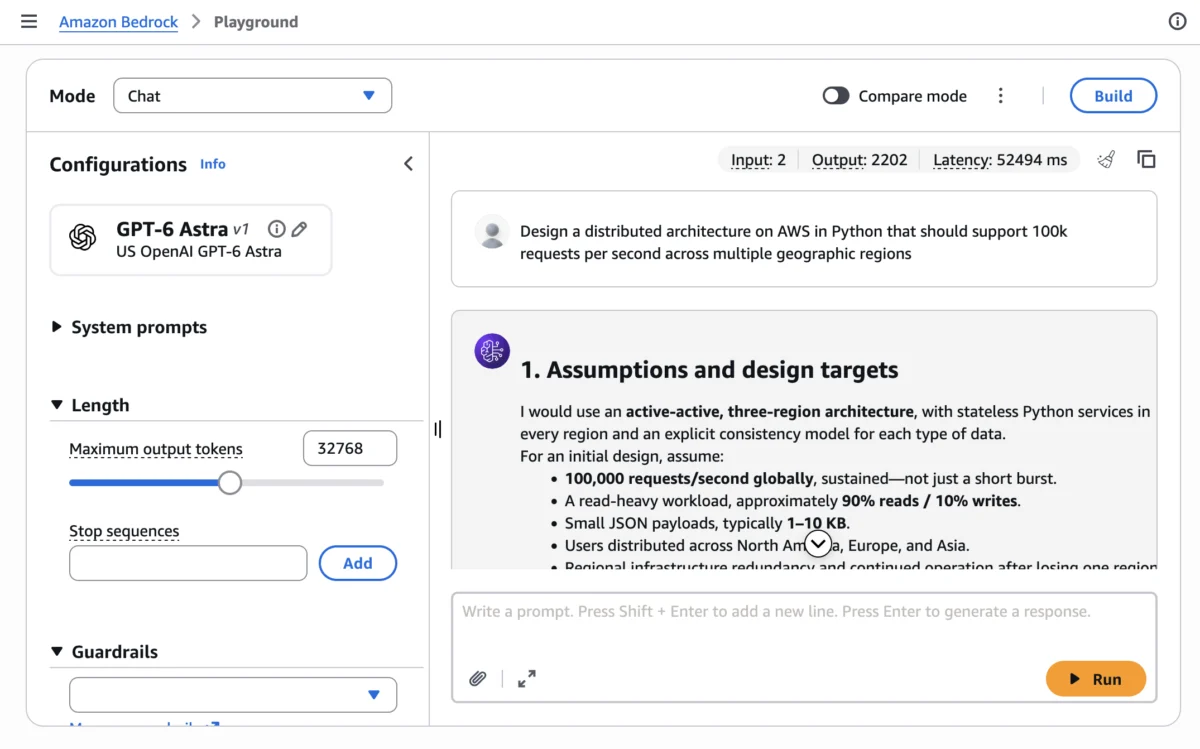
The centerpiece of this week’s announcements is the general availability of OpenAI GPT-6 Astra on Amazon Bedrock. Representing OpenAI’s most capable foundation model to date, GPT-6 Astra is engineered to tackle complex, demanding business workflows that require advanced cognitive functions far beyond simple text generation.
Key Capabilities and Specifications
- Advanced Reasoning and Judgment: GPT-6 Astra introduces significantly enhanced logic processing, making it uniquely suited for multi-step problem solving, strategic planning, and nuanced decision-making in corporate environments.
- Professional-Quality Output: The model demonstrates exceptional proficiency in professional-grade writing, software design, and creative ideation, closing the gap between human execution and AI assistance.
- Massive Context Window: Supporting up to 1 million input tokens, the model can ingest and process colossal volumes of data simultaneously. Enterprise users can now upload entire codebases, multi-hundred-page legal contracts, or extensive archives of corporate documentation in a single prompt. The model can then analyze, synthesize, and reconcile competing inputs across these massive datasets.
- Autonomous Computer and Browser Use: Moving beyond static text prompts, GPT-6 Astra features native capabilities for interacting with digital tools, navigating browsers, and executing tasks across common business applications.
Accessibility and Deployment
Organizations can invoke GPT-6 Astra seamlessly through standard, supported Amazon Bedrock APIs. Additionally, administrators can configure ChatGPT Work and Codex to leverage the model directly through the Bedrock infrastructure.
Simultaneously, OpenAI is rolling out new enterprise plugins for ChatGPT Work. These plugins are specifically designed to extend Astra’s browser-use capabilities across ubiquitous business applications—streamlining workflows from customer relationship management (CRM) to enterprise resource planning (ERP) platforms.
2. Chronology: The Road to GPT-6 Astra and Cloud Convergence
To understand the weight of this week’s launch, it is helpful to contextualize the timeline of enterprise generative AI adoption over recent years:
- Late 2022 – 2023 (The Spark): The generative AI boom ignites with the widespread availability of early LLMs. Businesses scramble to experiment with basic chat interfaces, quickly running into roadblocks regarding data privacy, latency, and integration complexity.
- 2024 (The Infrastructure Era): Cloud providers step in to solve enterprise bottlenecks. Platforms like Amazon Bedrock emerge to offer managed access to multiple foundation models through a single API, emphasizing security, zero-data-retention training policies, and private cloud deployment.
- 2025 (Multi-Model Maturity): Enterprises move away from single-vendor lock-in. Organizations demand reasoning models capable of handling complex domain-specific tasks, massive context windows, and multi-modal inputs.
- Mid-September 2026 (The Current Milestone): OpenAI and Amazon Web Services (AWS) reach a pivotal convergence point. The launch of GPT-6 Astra on Amazon Bedrock marries OpenAI’s bleeding-edge frontier intelligence with AWS’s unmatched enterprise-grade security, governance, and auditing frameworks.
3. Supporting Data and Technical Architecture
Enterprise adoption of artificial intelligence hinges not just on raw model intelligence, but on security, compliance, and infrastructure reliability. The integration of GPT-6 Astra on Amazon Bedrock inherits the robust security posture that AWS has refined over decades.
Security and Governance
When deploying GPT-6 Astra via Amazon Bedrock, organizations retain absolute control over their operational data:
- Zero Data Training Policy: Inference data—the prompts and inputs submitted by corporate users—is strictly sequestered and never used to train or fine-tune OpenAI’s underlying models.
- Data Sovereignty and Encryption: Workloads are secured using established AWS security controls, ensuring end-to-end encryption both in transit and at rest.
- Access Control and Auditing: Enterprise administrators can leverage AWS Identity and Access Management (IAM) to govern precisely who within an organization can invoke the model. Furthermore, AWS CloudTrail provides comprehensive audit logging for all model invocation activity, satisfying rigorous compliance frameworks (such as SOC, HIPAA, and GDPR).
Context Window Economics
The introduction of a 1-million-token context window fundamentally changes how software engineers and legal teams interact with AI. Historically, querying large documents required complex retrieval-augmented generation (RAG) pipelines that could occasionally miss cross-document nuances. With GPT-6 Astra, an entire repository of legacy code or a multi-volume regulatory filing can reside entirely within the model’s active working memory. This drastically reduces hallucinations and ensures holistic, context-aware outputs.
4. Official Responses and Industry Perspectives
While official statements accompanying the launch emphasize technical capabilities, industry analysts and cloud leaders have been vocal about the broader strategic implications.
"The deployment of models like GPT-6 Astra on flexible, secure cloud backbones like Amazon Bedrock signifies that the conversation has shifted away from mere experimentation," notes a leading enterprise cloud strategist. "We are no longer asking what AI can do in a vacuum. We are asking how deep reasoning engines can be safely embedded into the day-to-day nervous system of the Fortune 500 without compromising data privacy or operational compliance."
AWS representatives reiterate that the collaboration is driven by customer demand. Enterprise builders have consistently requested access to the absolute highest-tier intelligence models without sacrificing the enterprise-grade management tools they rely on for their core cloud infrastructure. By integrating OpenAI’s latest flagship model into Bedrock, AWS continues to execute on its vision of giving developers choice without compromise.

5. Implications: Working Differently, Not Just Working Harder
As Micah noted in this week’s AWS Weekly Roundup, a profound realization is taking root across the developer ecosystem: the builders seeing the biggest productivity gains from AI agents aren’t simply using better tools—they are fundamentally working differently.
Paradigm Shift in Software Development
For years, the promise of developer tools was incremental efficiency—faster autocomplete, automated unit tests, and syntax error checking. With the advent of GPT-6 Astra’s advanced reasoning and autonomous browser use, the paradigm is shifting toward agentic collaboration.
- Delegation over Execution: Developers are transitioning from being sole coders to orchestrators of AI agents. Instead of writing boilerplate code, engineers define system architecture, edge cases, and safety parameters, letting models like Astra handle massive refactoring tasks across millions of lines of code.
- Cross-Disciplinary Workflows: Because Astra bridges the gap between text, code, and digital tool navigation, non-technical business units can collaborate directly with technical systems. Legal, compliance, and product management teams can leverage the model to execute complex research, reconcile conflicting regulatory guidelines, and instantly translate those insights into actionable software tickets or operational strategies.
Looking Ahead
As we move deeper into the autumn season, the pace of technological evolution shows no signs of slowing down. For builders looking to stay at the cutting edge, engagement within the community remains critical. Developers are encouraged to join the AWS Builder Center to connect with peers, share innovative solutions, and access ongoing educational resources. Additionally, checking the official What’s New with AWS and AWS Blogs pages will be essential for tracking subsequent rollouts as the Q4 conference season approaches.
The integration of GPT-6 Astra on Amazon Bedrock is a defining moment for 2026. It proves that the future of enterprise AI belongs to platforms that can successfully marry bleeding-edge cognitive capability with uncompromising security, scale, and governance.



