










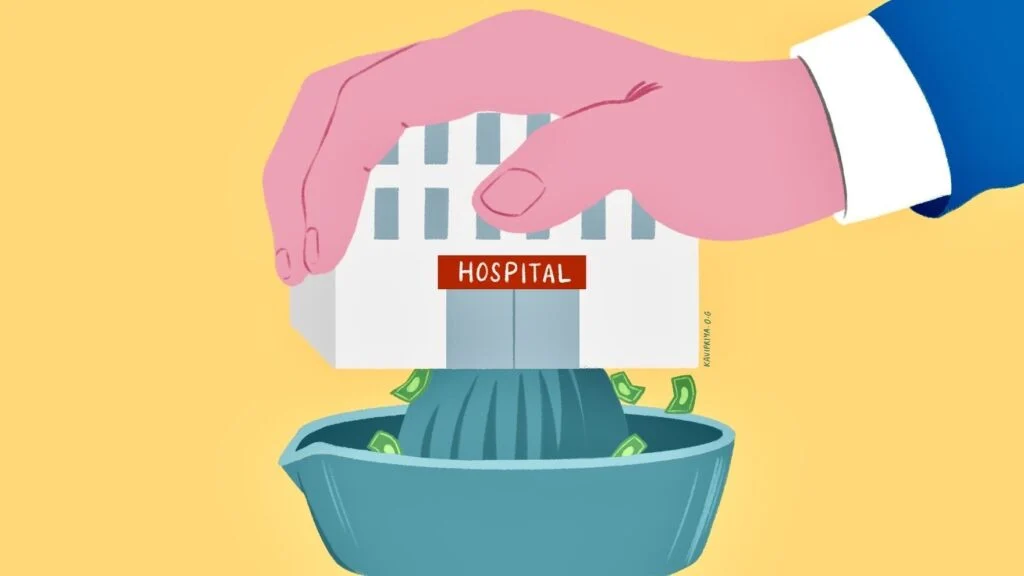
Introduction: The High-Stakes Tango of Private Equity and Indian Hospitals
Even if you stand at a stolid degree of remove from anything subjective, the pull of the private equity (PE) and private healthcare tango in India today is palpable. Not a quarter goes by without a sizable deal altering the landscape of the nation’s medical infrastructure.
“It’s a potent combination; insurance is the least insidious player now—to give the devil its due—but it won’t be for long,” said the co-founder of a 150-bed hospital in one of southern India’s major metropolitan hubs. Despite building a standalone medical facility that was widely regarded as both financially and reputationally successful, these founders ultimately had to sell out. Managing escalating wage bills became fundamentally untenable as PE-backed hospital chains entered the market armed with virtually "blank cheques" to poach premier medical talent.
Today, across India’s burgeoning metropolitan corridors, it doesn’t matter what the poaching costs are; well-funded hospitals are paying whatever it takes to secure top-tier physicians and surgeons.
“You can’t say it’s one and not the other; all major hospitals are PE-backed and there’s more capital than ever to attract the person they want… And you can’t really blame the doctors when they get offers they can’t refuse,” said the chief executive of a mid-sized hospital in Bengaluru, who ultimately bowed out of the business when a budding healthcare chain acquired his establishment.
India’s hospital industry is, depending on your vantage point, either the most mouth-watering investment story in Asia or the most stomach-churning experiment in healthcare commercialization. The country’s medical sector has quite simply never witnessed capital inflows of this magnitude.
Main Facts: Massive Capital Inflows and Record Valuations
The financial velocity within India’s healthcare sector has reached unprecedented heights, characterized by aggressive expansions, massive corporate investments, and staggering company valuations.
On September 18, integrated healthcare-service provider Aster DM Healthcare issued an addendum to its annual general meeting, formally announcing a staggering ₹6,900-crore expansion plan slated over the next two years. This ambitious roadmap involves scaling up bed capacity, upgrading diagnostic infrastructure, and deepening the provider’s footprint across high-growth Tier-1 and Tier-2 cities.
Just a day prior to Aster’s announcement, global private equity heavyweight Advent International executed a landmark transaction, paying ₹3,150 crore to acquire nearly a quarter stake in Yatharth Hospitals. This high-profile deal values the National Capital Region (NCR)-based hospital chain at approximately 33 times its EBITDA (Earnings Before Interest, Taxes, Depreciation, and Amortization)—a key metric used to evaluate a company’s operational performance.
To put this astronomical figure into perspective, the average public-market multiple for listed Indian hospital chains hovers around 27 times EBITDA.

“This is an unrealistic valuation; how do you ever justify that?” reasoned the Bengaluru-based hospital chief executive, echoing growing anxieties among industry veterans regarding asset price inflation.
Furthermore, structural shifts in how hospitals scale are becoming increasingly apparent. Data indicates that of the 14,000 new beds added to India’s listed hospital universe over the last six years, a remarkable 55% were acquired or leased from existing operators rather than built from the ground up. Inorganically driven growth has become the preferred playbook for institutional investors looking to bypass the protracted regulatory hurdles, real estate acquisition challenges, and long gestation periods associated with greenfield projects.
Chronology: The Evolution of Institutional Capital in Indian Medicine
The intersection of institutional finance and Indian healthcare is not entirely new, but its strategic trajectory has shifted dramatically over the past decade.
Phase I: The Early Venture Capital and Growth Equity Wave (2010–2018)
In the early part of the previous decade, private equity interest in Indian healthcare was largely exploratory. Funds primarily targeted single-specialty chains (such as eye care, fertility, and dental clinics) or regional players requiring working capital to expand from a handful of centers to a regional network. Valuations were tethered to traditional healthcare metrics, and founders retained significant operational autonomy.
Phase II: The Consolidation and Platform Play (2018–2023)
As healthcare consumption surged—spurred by a growing middle class, rising lifestyle diseases, and a widening health insurance net—global funds recognized the massive supply-demand deficit in quality beds. Large global alternative asset managers began executing "platform strategies." Instead of buying minority stakes, firms sought controlling majorities, aiming to stitch together fragmented regional hospital networks into cohesive, pan-Indian entities capable of commanding immense pricing power.
Phase III: The Public Market Exit and Mega-Valuation Era (2023–Present)
When The Ken first reported on this phenomenon years ago, the core private equity thesis was relatively straightforward: buy a privately owned hospital company at a low valuation, professionalize its management, scale its operations, and eventually execute a lucrative exit by taking it public through an Initial Public Offering (IPO).
However, as liquidity flooded global markets and dry powder accumulated among alternative investment funds, the strategy evolved. Rather than waiting for public markets to reprice assets, mega-funds are now bidding against one another in private auctions, driving valuations to historic highs. Today, the race is less about waiting for an IPO and more about building consolidated healthcare monopolies that can dictate terms to medical professionals, suppliers, and insurers alike.
Supporting Data: The Anatomy of Market Consolidation
To fully comprehend the seismic changes underway, one must examine the quantitative indicators defining modern Indian healthcare:
- Valuation Multiples: While traditional Indian hospital chains traded at historical public-market multiples of 20x to 25x EBITDA, recent private equity transactions like Advent’s stake acquisition in Yatharth Hospitals are commanding multiples as high as 33x EBITDA.
- CapEx Commitments: Major legacy and PE-backed chains are deploying capital at unprecedented rates. Aster DM Healthcare’s ₹6,900-crore two-year expansion plan is indicative of a broader industry race to lock in prime real estate and catch rising healthcare demand.
- Inorganic Growth Dominance: Out of 14,000 new beds added across India’s listed hospital universe over a six-year window, 55% were acquired or leased. This reliance on acquisition over greenfield creation signals an intense race for market share where speed supersedes organic construction.
- Talent Inflation: Physician acquisition costs have skyrocketed. PE-backed hospitals routinely deploy aggressive financial packages—including guaranteed minimums, equity sharing, and administrative stipends—effectively pricing independent and mid-sized standalone hospitals out of the talent market.
Official Responses and Stakeholder Perspectives
The aggressive financialization of healthcare has elicited sharply contrasting viewpoints from different segments of the medical and financial community.

The Private Equity and Corporate Perspective
Proponents of PE involvement argue that institutional capital is precisely what India’s deeply fragmented and often under-resourced healthcare sector desperately needs. Institutional investors bring rigorous corporate governance, standardized clinical protocols, advanced medical technology investments, and efficient supply chain management. Without billions of dollars in foreign and domestic private equity, proponents argue, India would lack the capital required to bridge its massive deficit of hospital beds per capita.
The Independent Hospital Owner Perspective
Conversely, independent operators view the trend with profound apprehension. Smaller hospital founders argue that the influx of institutional money creates an uneven playing field.
“When a competitor walks in with a blank cheque funded by a multi-billion-dollar global fund, you cannot compete on doctor compensation or high-tech equipment procurement,” notes a retired hospital promoter from western India. Many independent owners feel coerced into selling their life’s work simply because operational costs—particularly medical personnel wages—have been artificially inflated beyond sustainable limits.
The Medical Practitioner Dilemma
For doctors, the PE boom represents a double-edged sword. On one hand, corporate consolidation offers unprecedented financial compensation, institutional backing, and state-of-the-art facilities. On the other hand, clinicians frequently express concern over the creeping influence of corporate key performance indicators (KPIs) on clinical decision-making, where patient care risks being viewed strictly through the lens of quarterly revenue generation and average revenue per occupied bed (ARPOB).
Implications: What Lies Ahead for Patients and the Healthcare Ecosystem
As private equity tightens its grip on Indian hospitals, several profound structural implications emerge for the future of the nation’s health services:
1. The Erosion of Affordable Healthcare
As PE firms acquire hospitals at lofty valuations (such as 33x EBITDA), the underlying imperative shifts to generating outsized returns for limited partners. To service these capital costs and valuation multiples, hospitals inevitably look to enhance margins. This often translates to higher out-of-pocket expenses for patients, increased diagnostic testing overheads, and steeper procedural costs—potentially squeezing out low- and middle-income families who rely on private facilities due to inadequate public infrastructure.
2. Homogenization and Corporate Monopolies
The trend toward inorganic expansion (with 55% of new beds coming from acquisitions) points toward rapid market consolidation. Over the coming decade, independent standalone hospitals may become a rarity, replaced by monolithic regional or national chains dominated by a handful of global private equity funds. This consolidation could drastically reduce consumer choice and weaken the bargaining position of standalone medical practitioners.
3. Regulatory and Ethical Quandaries
As healthcare increasingly mirrors financial asset classes, regulatory bodies will face mounting pressure to monitor clinical governance. Ensuring that patient welfare remains paramount—and preventing aggressive monetization of medical interventions—will require proactive oversight from bodies like the National Medical Commission (NMC) and the Competition Commission of India (CCI), particularly as mega-mergers threaten to form regional healthcare monopolies.
Conclusion
The tango between private equity and Indian healthcare has moved past its exploratory phase and is now driving the definitive structural evolution of the industry. While the influx of capital has undeniably modernized infrastructure and expanded bed capacity, it has simultaneously introduced unprecedented valuation pressures, fierce talent wars, and existential threats to independent operators. As this high-stakes financial experiment unfolds, the ultimate test of its success will not be measured merely in EBITDA multiples or transaction sizes, but in whether quality healthcare remains accessible, ethical, and affordable for the everyday Indian citizen.



