










Every week, the business world is barraged by a new, breathless headline regarding the "Agentic Revolution." Gartner warns that $234 billion in SaaS spending is currently exposed to "agentic arbitrage." Meta has launched a high-stakes paid developer API for its own agentic models, and Google has integrated "information agents" directly into its core Search product. To the casual observer, the adoption of agentic AI—autonomous systems capable of reasoning, planning, and executing complex workflows—appears to be a runaway train.
Yet, there is a profound, uncomfortable silence in the C-suite. When you place these soaring adoption statistics side-by-side with the grim failure data published by those same research firms, a startling dissonance emerges. We are currently witnessing a massive, multi-billion dollar disconnect between what companies are buying and what is actually delivering value. This analysis dissects the chasm between the hype and the reality, offering a roadmap for survival in an era of "AI-first" disillusionment.
The Adoption Story Everyone Already Knows
The narrative of universal adoption is compelling, supported by a flurry of impressive metrics. According to industry data, the integration of autonomous agents into the enterprise tech stack is accelerating at a pace rarely seen in the history of IT.
Key Adoption Indicators
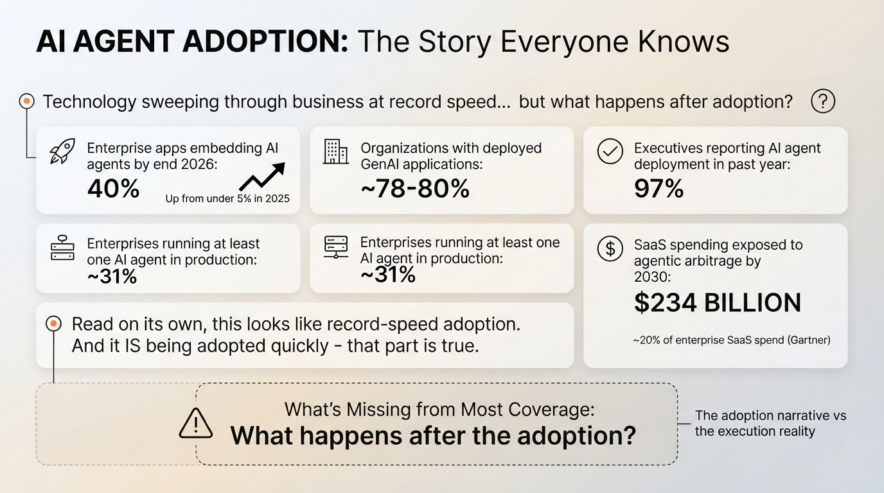
- Rapid Integration: By the end of 2026, it is projected that 40% of enterprise applications will embed AI agents, a staggering increase from less than 5% in 2025.
- Deployment Saturation: Roughly 78–80% of organizations now report having deployed at least one Generative AI application.
- The Executive Consensus: A remarkable 97% of executives claim their companies have deployed AI agents within the past year.
- Production Reality: About 31% of enterprises are currently running at least one AI agent in a live production environment.
- Economic Exposure: Gartner estimates that by 2030, $234 billion—roughly 20% of total enterprise SaaS spending—will be directly exposed to "agentic arbitrage," where software is replaced or fundamentally altered by autonomous agents.
On the surface, this is the story of a technological paradigm shift sweeping through the global economy. However, the narrative ends abruptly at the point of "deployment." It rarely touches upon the outcome of these projects.
The Failure Numbers Nobody Headlines
While the industry celebrates the "go-live" moment, the data on post-deployment performance paints a much harsher reality. The metrics of failure are not merely incidental; they are systemic.
| Failure Metric | Figure | Source |
|---|---|---|
| GenAI pilots failing to deliver P&L impact | ~95% | MIT NANDA Study |
| Overall AI projects that fail | ~80%+ | RAND Corporation |
| Orgs seeing significant ROI from GenAI | ~29% | Industry Survey |
| Orgs seeing significant ROI from AI Agents | ~23% | Industry Survey |
| CEOs reporting both revenue gain and cost reduction | ~12% | Industry Survey |
| Agentic projects predicted to be canceled by 2027 | 40%+ | Gartner |
| Enterprises that scaled beyond pilot stage | <10% | Gartner |
The math is unforgiving: nearly every company claims to have "deployed" an agent, yet fewer than one in four reports a meaningful return on that investment. When Gartner predicts that 40% of these projects will be shuttered within two years, it is not suggesting a temporary setback—it is predicting a massive, expensive, and widespread corporate retreat.
The "Learning Gap": What MIT’s Research Revealed
The most rigorous look at this phenomenon comes from MIT’s Project NANDA. Unlike self-reported surveys, which are often prone to "innovation theater," the NANDA study examined approximately 300 real-world, public AI deployments to measure actual financial outcomes.
The researchers discovered a critical "learning gap." The failure was rarely due to the LLMs themselves being "stupid" or inaccurate. Instead, the failure stemmed from a profound inability of organizations to design workflows that could effectively leverage the strengths of AI while insulating the business from its inherent weaknesses, such as hallucinations, latency, and non-deterministic outputs.
Why Workflows Break Down
- Vague Objectives: Many projects are launched with the instruction to "make it more efficient," without a clear, measurable KPI.
- Lack of Human-in-the-Loop (HITL) Design: Companies often deploy agents as "set it and forget it" solutions, failing to create the necessary oversight structures for high-stakes decision-making.
- Data Silos: Agents are often deployed in environments where they lack access to the necessary real-time data, leading to outdated or irrelevant outputs.
The "Build vs. Buy" Dichotomy
Perhaps the most actionable insight from recent research is the disparity between DIY AI development and vendor-partnered solutions. Many organizations, driven by the desire to own their "AI intellectual property," have opted to build internal frameworks from scratch. The data suggests this is a costly mistake.
According to the MIT findings, the approach to acquisition is the single largest predictor of success:
- Partnership/Vendor-Sourced: These deployments boast a success rate of approximately 67%.
- In-House/DIY Builds: These projects struggle to reach a success rate of just 33%.
This data sends a clear signal: the technology is not the bottleneck; the implementation and integration expertise are. Specialized vendors bring pre-built, hardened workflows and battle-tested guardrails that most internal IT departments, currently overwhelmed by the speed of AI development, cannot replicate.
Chronology of the AI Hype Cycle
To understand why this is happening, one must view the timeline of the last 24 months:
- Q1 2023: The "ChatGPT Moment." Companies rush to integrate LLMs into everything. The focus is on capability—"Can the AI write this email?"
- Q3 2023: The "Agentic Pivot." The market realizes that chat-bots are not enough; agents that can perform actions are the new gold standard.
- Q1 2024: The "Pilot Explosion." Every enterprise initiates a pilot program. Budgets are inflated, and "AI Strategy" becomes a mandatory board-level slide.
- Q3 2024–Present: The "Reality Check." The realization that deploying an agent into a legacy, siloed, and messy enterprise environment is vastly more difficult than running a clean demo on a developer laptop.
Implications for the C-Suite
The current state of affairs poses a direct threat to the credibility of CIOs and CTOs. When 40% of projects are earmarked for cancellation, the "AI-first" mandate risks becoming a career-limiting strategy.
1. The Death of the "Big Bang" Project
Organizations must move away from multi-year, enterprise-wide AI transformations. Success is currently found in small, narrow, and high-frequency use cases—such as automated ticket routing or specific data entry tasks—where a single, clear performance metric can be tracked daily.
2. Prioritizing Vendor Maturity
The "build vs. buy" data is clear. Unless a company has a core competency in machine learning infrastructure, buying or partnering is the path to survival. The risk of vendor lock-in is currently lower than the risk of an expensive, failed internal project.
3. The Need for "Agentic Governance"
As companies move toward autonomous agents, they need to implement strict governance. This includes defining the "blast radius" of an agent—what it can do, what it cannot do, and at what point a human must be alerted to intervene.
Official Industry Responses
While the major AI players (OpenAI, Google, Microsoft) continue to promote the potential of their models, there is a shifting tone in how they communicate. Increasingly, the messaging has moved from "AI can do everything" to "AI is a copilot that requires human partnership." This shift reflects a strategic acknowledgment that the current market is suffering from "deployment fatigue."
Gartner’s analysts, while predicting the $234 billion disruption, have also begun to emphasize the need for "AI-Ready" data foundations. They argue that without clean, governed data, agents are simply "automated error-generation machines."
Conclusion: The Path Forward
The agentic AI story being told in most headlines is only half the story. Adoption is real, rapid, and unstoppable—but success is not guaranteed. The gap between the 97% of executives who have deployed agents and the 23% who see ROI is the most critical space in the modern business landscape.
Businesses that treat AI as a silver bullet will almost certainly end up in the 95% failure category. Conversely, those that understand that the technology is merely a tool, and that success depends on vendor expertise, narrow scoping, and clear, measurable outcomes, will be the ones that actually capture the economic value of this new era. The "Agentic Revolution" is not about replacing the human element; it is about the disciplined integration of autonomous systems into the specific, messy, and highly nuanced workflows that define modern enterprise success.