







In an era dominated by generative AI and automated scheduling, the digital landscape of LinkedIn has become increasingly saturated with "noise." Yet, for those who know how to navigate the platform, the opportunity for organic growth is greater than ever. Statistics reveal that only 1% of LinkedIn’s massive user base actively creates content. This supply-and-demand imbalance creates a unique vacuum for professionals who can deliver high-value, human-centric insights that resonate with their specific audience.
For creators like Kasey Brown, a LinkedIn growth strategist and founder of Digital Kairos, the secret to standing out isn’t about gaming the algorithm—it’s about mastering the psychology of the human reader. In collaboration with Michael Stelzner, Brown has synthesized a robust, three-part strategy known as the "Triple S Framework." This approach aims to move beyond vanity metrics, focusing instead on capturing attention, sustaining engagement, and driving meaningful, high-converting shares.
The Foundational Pillars of Strategy
Before a single word is drafted, success on LinkedIn requires a shift in mindset. Brown emphasizes that consistency is a hollow metric if the content lacks strategic direction. To build an authority-driven presence, creators must first establish three foundational pillars.
1. The Precision of the Ideal Client Profile (ICP)
Many professionals treat their "target audience" as a nebulous concept. Brown argues that an effective ICP must be granular. A vague definition like "small business owners" is insufficient. Instead, a successful profile should be defined by specific pain points and economic indicators—for example, "Speakers and consultants earning $20K+ monthly who require automated content systems to scale." When an ICP is this specific, it informs every aspect of content creation, from the tone of voice to the specific problems addressed.
2. Defining the Transformation
Every piece of content must answer a singular question: "What transformation does the reader walk away with after 30 days of following me?" By framing content around a specific outcome, you transform your profile from a feed of random updates into a coherent roadmap that leads your ideal prospect toward a solution.
3. The Reader-First Mandate
The most common mistake on LinkedIn is ego-centric posting. When creators focus on personal accolades, corporate announcements, or "selling," they alienate their audience. When the focus shifts to the reader’s needs—solving their problems, validating their experiences, and offering actionable insights—the content naturally transitions from a monologue into a bridge for business growth.

The Triple S Framework: A Chronology of Engagement
The Triple S framework serves as the lifecycle of a post, tracking the journey from a passive scroll to an active engagement.
Phase 1: Stop (The Visual and Textual Hook)
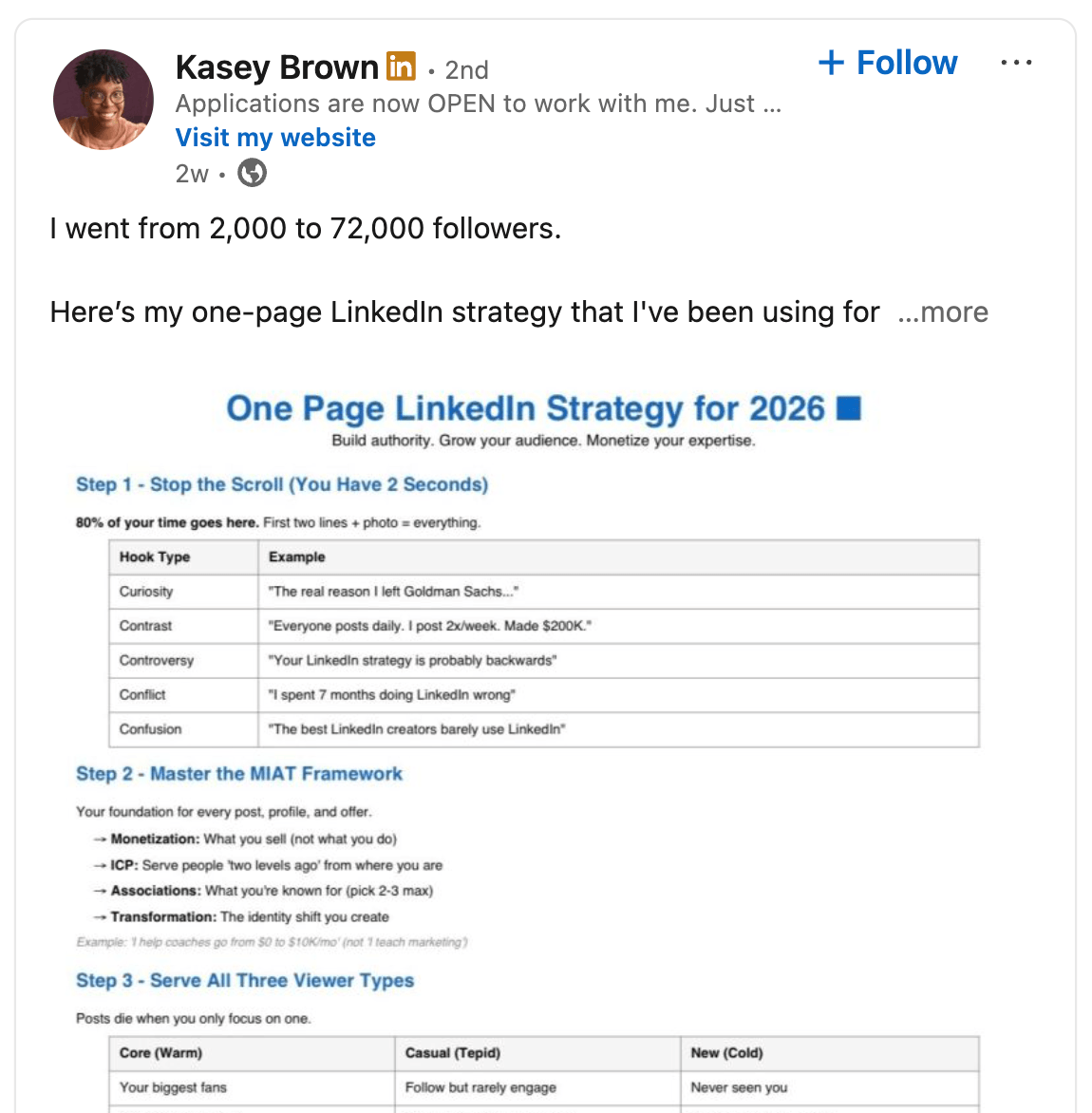
The initial hurdle is simple: you must force the user to pause their scroll. According to Brown, 80% of a post’s impression potential relies on two elements: the image and the first two lines of text.
Visual Disruption:
Most users reach for polished, high-resolution headshots, which have become "background noise" in the LinkedIn feed. Brown’s experiments indicate that raw, unpolished, or "vertical" imagery often outperforms professional photography. A wide-angle, 0.5x zoom selfie from a speaking event, for instance, provides a sense of authenticity and "real-world" context that standard professional photos lack. Furthermore, infographics that contain dense, useful information—formatted to look like working documents rather than polished title cards—act as pattern interrupts that command attention.
The Power of the Five Cs:
To hook the reader textually, Brown employs the "Five Cs" framework: Curiosity, Contrast, Contradiction, Controversy, and Confusion. A successful hook should trigger at least two or three of these elements. For example, contrasting a past failure with a current success (e.g., "I was in a job I hated in 2021" vs. "I spent $30K to be here in 2026") creates immediate cognitive tension, compelling the reader to click "see more."
Phase 2: Stay (Maintaining Narrative Tension)
Once the reader clicks, the goal is to keep them reading. This is where many creators fail, often by resolving their hook too quickly.
The Art of the Re-Hook:
After the "see more" click, the third line of the post must act as a secondary hook. It should deepen the tension rather than provide an immediate resolution. If you tell the reader how you solved a problem immediately, they have no reason to finish the post. By providing context—explaining the stakes, the fear of failure, or the complexity of the situation—you earn the right to the reader’s attention.
Rhythm and Readability:
Structure is the unsung hero of retention. Brown suggests a rhythmic approach: alternating between rapid-fire, one-sentence lines and slightly longer, multi-sentence blocks. This cadence prevents visual fatigue. Furthermore, optimizing for a fourth-to-seventh-grade reading level, verified by tools like the Hemingway App, ensures that the message is accessible to a broad audience. Because 70% of LinkedIn usage occurs on mobile devices, previewing posts in a mobile-native format—using tools like Authored Up—is a non-negotiable step to ensure the layout remains clean and readable.
Phase 3: Share (The Ultimate Validation)
The final "S" is the share. While views and comments are vanity metrics, a share represents a high-level endorsement. A user sharing your content is essentially "lending" their credibility to your message.
A "good" share-to-impression ratio is 0.3, while anything above 0.5 is considered exceptional. Brown recommends that any post achieving a 0.5 ratio should be recycled every 60 to 90 days. The structural key to driving shares is the "Goodie Bag"—a concrete, actionable takeaway at the end of the post. By providing a step-by-step framework or a summary of the transformation, you give the reader a tangible reason to save the post or share it with their own network.
Supporting Data and Strategic Implications
The data surrounding these techniques reveals a clear trend: the "human" factor is the most valuable currency on LinkedIn. In one notable case study provided by Brown, a professionally lit, high-resolution photo generated 200 leads, whereas a casual, 0.5x zoom selfie from the same event generated 3,000 leads. This 1,500% difference underscores the market’s craving for authenticity over corporate polish.
The implications for business owners are profound. By moving away from AI-generated, generic content, companies can foster deeper trust. When content is built around the reader’s transformation, the call-to-action (CTA) ceases to feel like a pitch and begins to feel like a logical next step in a value-added relationship.
Official Perspective and Expert Insight
Kasey Brown maintains that the "content gap" on LinkedIn—where the vast majority of users consume rather than create—is not closing anytime soon. As AI tools become more prevalent, the market will likely become more saturated with low-effort, synthetic content. This paradoxically increases the value of "human-in-the-loop" content.
"We don’t have to be better; we have to be different," Brown notes. By prioritizing the reader’s transformation and focusing on the three dimensions of engagement—Stop, Stay, and Share—professionals can build a defensible, authoritative brand that thrives regardless of algorithm updates.
Conclusion: The Path Forward
Success on LinkedIn is no longer about "hacking" the system. It is about applying intentional, human-centered principles to every post. By defining a clear ICP, creating visual and textual "pattern interrupts," and ensuring that every piece of content leaves the reader with a tangible transformation, you move from being just another voice in the feed to an essential resource in your industry. In an age of artificiality, the most disruptive strategy is to be undeniably, effectively human.