










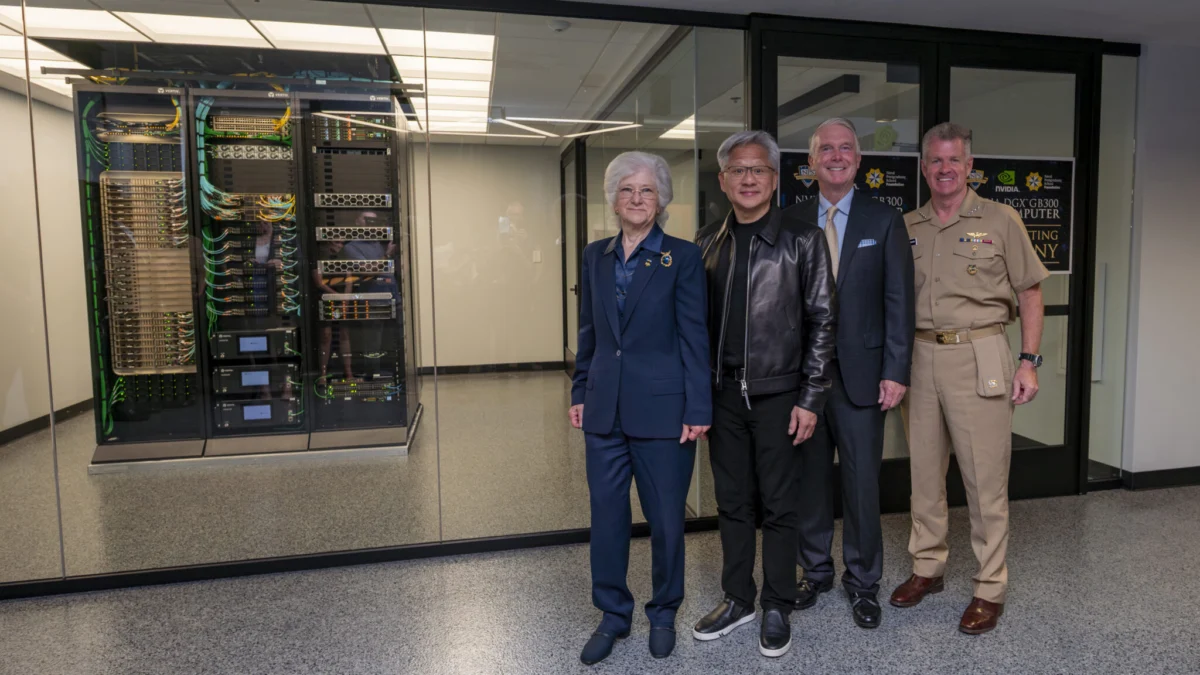
In a landmark development for national security and academic research, the Naval Postgraduate School (NPS) in Monterey, California, has officially commissioned the NVIDIA DGX GB300. This deployment marks the first time the U.S. military has integrated a supercomputing platform of this caliber directly into its graduate-level education and research ecosystem. The move signifies a strategic pivot toward AI-centric defense, positioning the NPS at the bleeding edge of global technological competition.
The Dawn of a New Era in Military Computing
The commissioning ceremony, held during the high-profile "Converge @ NPS" event, saw NVIDIA founder and CEO Jensen Huang personally oversee the launch of the system. For the more than 1,500 in-resident students and 600 faculty members at the flagship graduate university, the arrival of the DGX GB300 represents more than just a hardware upgrade; it is the democratization of high-performance computing (HPC) for the defense sector.
Equipped with cutting-edge NVIDIA Mission Control software, the GB300 allows researchers to train complex foundation models, conduct real-time inference, and run high-fidelity simulations that were previously computationally prohibitive. From predicting volatile weather patterns to fortifying cybersecurity frameworks and planning disaster response logistics, the platform serves as a force multiplier for the military’s intellectual capital.
A Chronology of Strategic Integration
The path to this moment was not instantaneous. It is the culmination of a multi-year effort to modernize the way the U.S. military trains its future leaders.
- Foundation (The AI Technology Center): The journey began with the establishment of the NVIDIA AI Technology Center on the Monterey campus. This hub served as the testbed for integrating AI curricula into traditional graduate programs.
- The Collaboration Roadmap: Through a series of hackathons and applied research projects, NPS faculty and NVIDIA engineers identified the specific computational bottlenecks facing naval operations. These findings informed the requirements for the current deployment.
- The Commissioning (July 2026): During the three-day "Converge @ NPS" conference, the DGX GB300 was officially brought online, marking the transition from theoretical AI research to large-scale, production-ready military application.
- Future Trajectory: With the infrastructure now operational, the next phase involves the widespread rollout of instructor toolkits provided by the NVIDIA Deep Learning Institute, aimed at embedding AI literacy across all departments, from space operations to oceanography.
Supporting Data and Technical Architecture
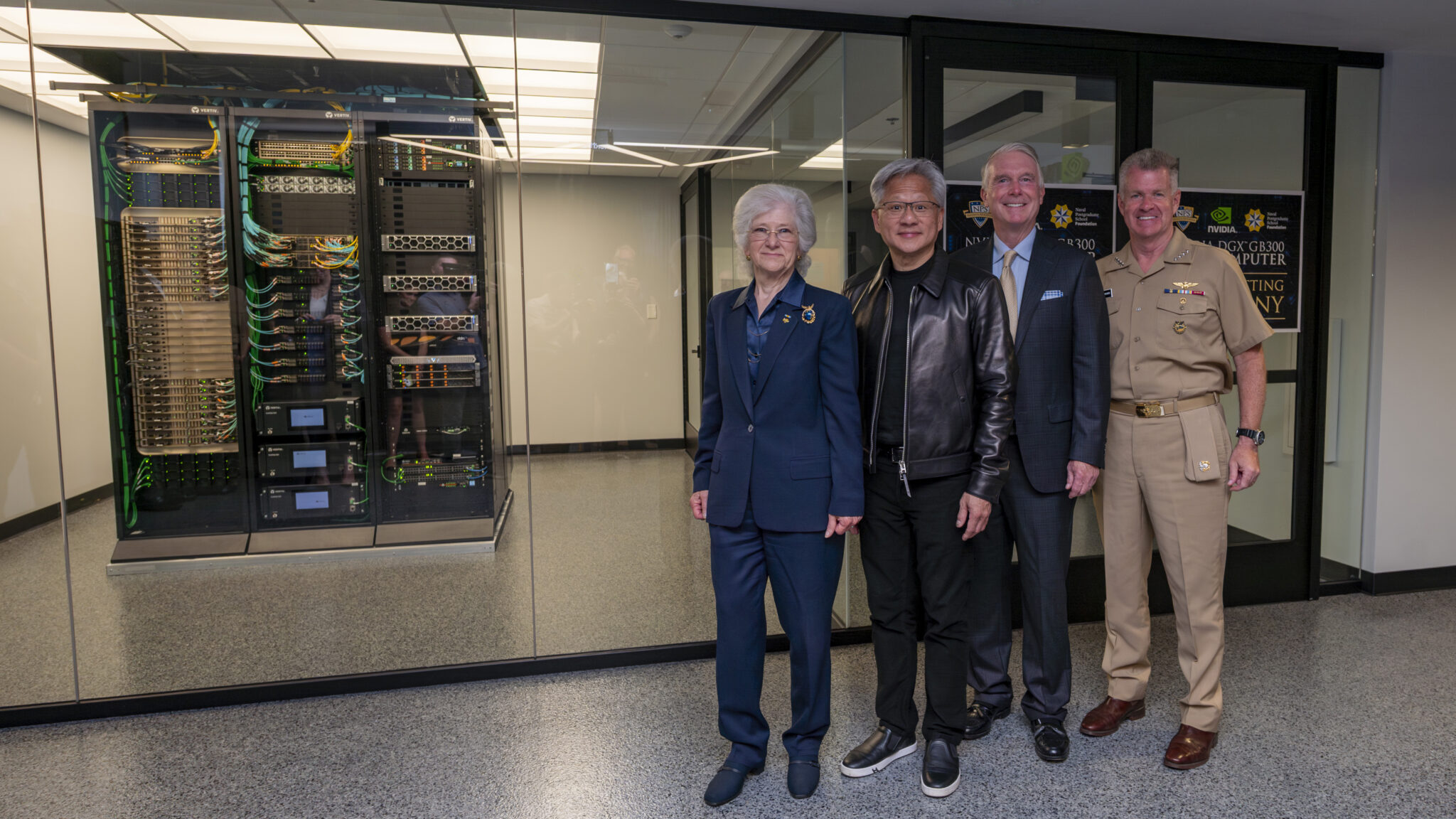
The DGX GB300 is not a standalone marvel; its efficacy is derived from a sophisticated ecosystem of partners. Bringing a machine of this power to the Monterey campus required a Herculean effort in infrastructure design, power management, and data handling.
The Partner Ecosystem
- DDN: Provided the high-performance data infrastructure, ensuring that the massive datasets required for AI model training can be ingested, managed, and protected with minimal latency.
- VAST Data: Deployed a unified data platform designed to bridge the gap between edge, core, and cloud environments, allowing for seamless data flow regardless of where the information originates.
- Vertiv: Acted as the backbone for the physical installation. Vertiv provided the specialized racks, cooling systems, and power distribution units, ensuring the system remains operational under the intense thermal loads generated by advanced AI processing.
The result is a closed-loop environment where students can move from raw data collection—such as ocean floor sensor readings—to the creation of "digital twins" that simulate complex naval maneuvers, all within a single, secure environment.
Official Perspectives: Bridging Leadership and Technology
The significance of this installation was echoed by both industry leaders and senior military commanders.
Jensen Huang, speaking at the event, emphasized that the ultimate value of AI in the military is the speed of insight. "Our nation depends on our men and women who fight on the front lines," Huang noted. "Nothing is more valuable to you than information and insight, and information and insight in a timely way, and to understand its impact and consequence. I can’t imagine anything more important."
Huang’s message to the officer corps was clear: do not fear the complexity of the technology. He urged students to "engage" with the tools, arguing that as these systems evolve, they become more intuitive, effectively lowering the barrier to entry for non-computer science specialists to leverage advanced AI in their respective fields.
Admiral Samuel Paparo, commander of the U.S. Pacific Command, offered a high-level strategic perspective on why this matters for the future of warfare. "As we modernize our technology, we must also modernize how we educate our leaders," Paparo stated. He emphasized that the battlefield of the future will be defined by AI-enabled environments where decision-making cycles are compressed into seconds.
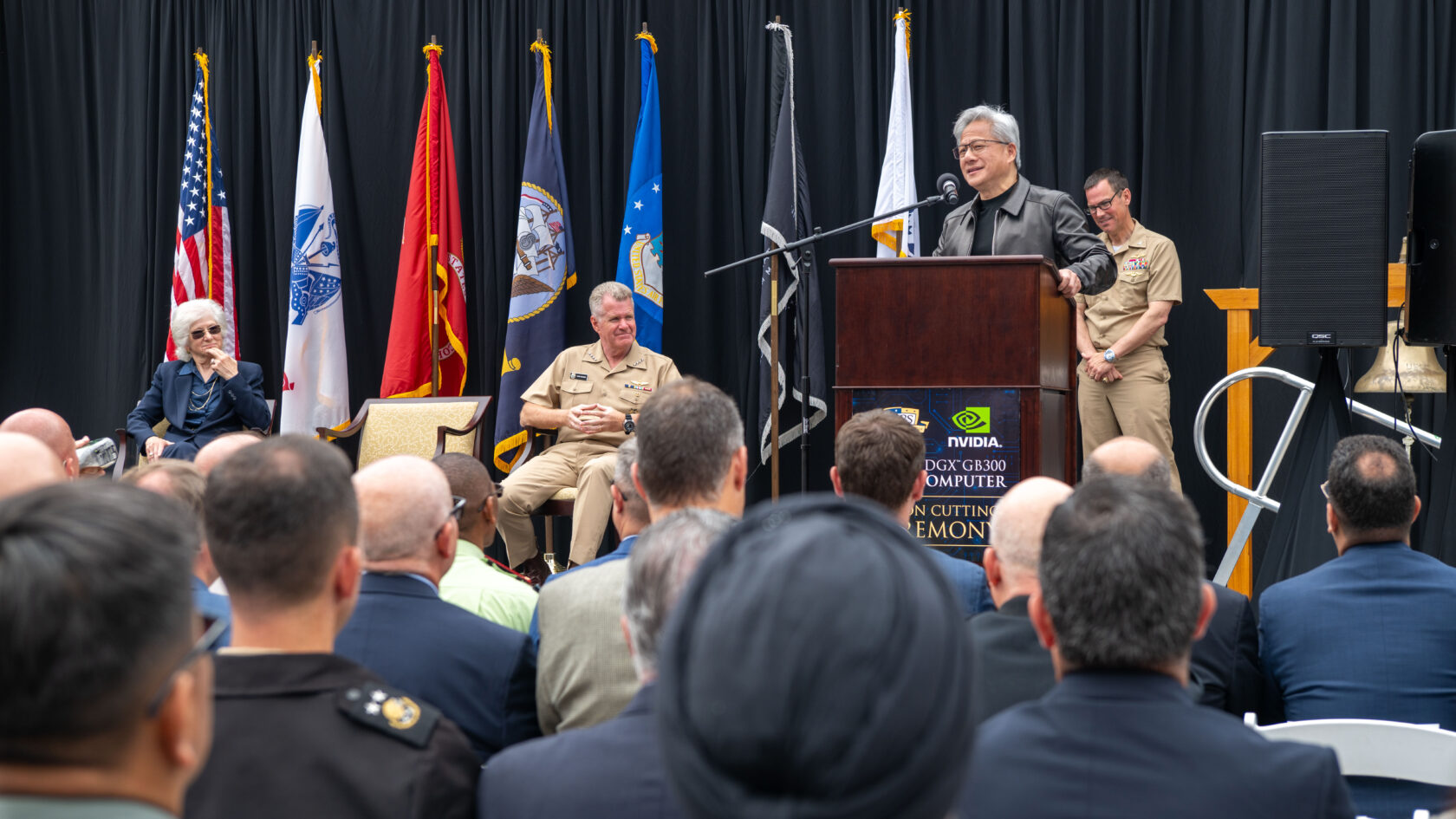
"Our advantage will come from leaders who can use the technology to see, understand, decide, and act faster while exercising the judgment, experience, and leadership that machines cannot provide," Paparo added.
Implications for National Security and Education
The integration of the DGX GB300 into the NPS curriculum carries profound implications for the U.S. defense apparatus.
1. The Rise of the AI-Literate Officer
The traditional graduate curriculum at NPS is undergoing a transformation. By utilizing the NVIDIA Deep Learning Institute toolkits, the school is ensuring that every officer—regardless of their primary military specialty—develops a working knowledge of AI’s potential and its limitations. This creates a generation of commanders who are not merely consumers of AI tools, but informed designers and critics of them.
2. Digital Twins and Predictive Modeling
One of the most immediate applications is the use of NVIDIA Omniverse to build digital twins. By creating high-fidelity virtual replicas of complex environments—such as contested maritime zones or humanitarian disaster sites—NPS researchers can simulate thousands of possible outcomes under uncertain conditions. This "war-gaming" capability allows commanders to test strategies in a zero-risk virtual environment, dramatically enhancing the quality of decision-making in the field.
3. Accelerated Research Cycles
Previously, the time taken to train a custom AI model could span weeks or months due to compute constraints. The DGX GB300 reduces this timeframe to days or even hours. This acceleration is critical for fields like ocean science and weather prediction, where the relevance of data is highly time-sensitive.

4. Ethical and Responsible AI
Beyond the technical capabilities, the presence of such a powerful system at an academic institution provides a unique venue for discussing the ethics of autonomous systems. By housing this technology at a university rather than a restricted private lab, the military fosters an environment where the "responsibilities" associated with AI—including data bias, transparency, and human-in-the-loop requirements—are central to the learning process.
Conclusion: A New Standard for Defense Research
The commissioning of the NVIDIA DGX GB300 at the Naval Postgraduate School marks a turning point in the modernization of the U.S. military. By providing the intellectual elite of the armed forces with the most advanced tools available, the Department of Defense is betting on the idea that the next conflict will be won by those who can best harness information.
As Admiral Paparo remarked, technology is ultimately a tool in service of the mission. By grounding this mission in the rigorous academic environment of the NPS, the military is ensuring that this tool is wielded by leaders who are prepared to navigate the complexities of an AI-driven world with wisdom, speed, and precision. The Monterey campus has effectively become the laboratory where the future of naval warfare is being written in code, simulations, and the strategic foresight of the next generation of commanders.