








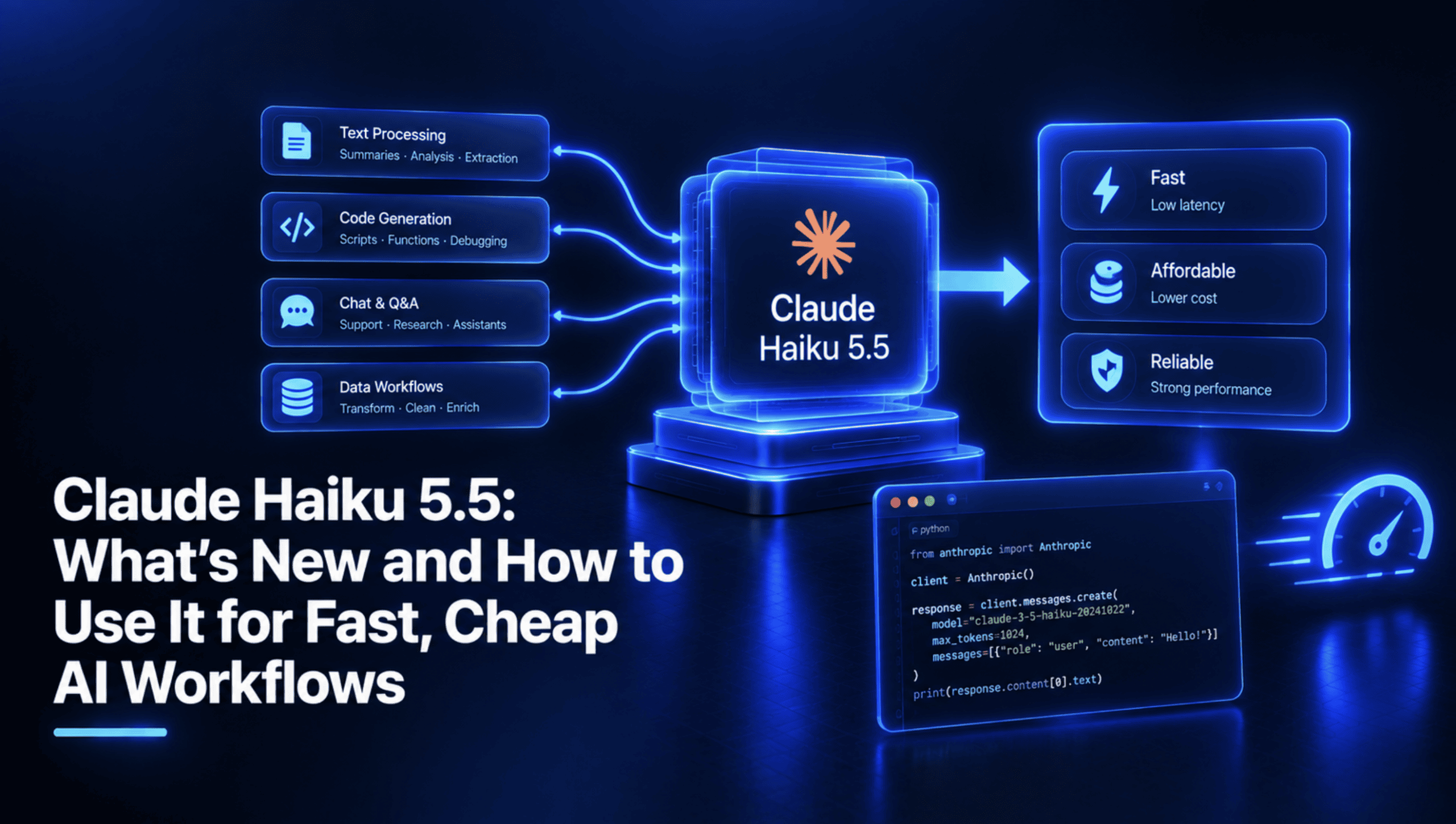
On October 7, 2026, Anthropic fundamentally altered the landscape of cost-effective artificial intelligence by releasing Claude Haiku 5.5. Positioned as the company’s most capable, rapid, and economical small language model to date, Haiku 5.5 is designed to serve as the engine for high-volume enterprise operations. With a robust API—accessible via claude-haiku-5-5—Anthropic has aggressively priced the model at $0.10 per million input tokens and $0.50 per million output tokens for standard prompts up to 100,000 tokens, setting a new benchmark for accessible AI.
This release is not merely an incremental update; it represents a strategic pivot toward agentic, high-throughput workflows. Whether tasked with automated database querying, real-time data extraction, or acting as a specialized sub-agent in complex multi-model architectures, Haiku 5.5 offers a compelling balance of intelligence and efficiency that challenges the current status quo of LLM deployment.
The Chronology of Evolution: From 4.5 to 5.5
The transition from Haiku 4.5 to 5.5 mirrors the rapid pace of the broader AI industry. While Haiku 4.5 established a reliable baseline for lightweight tasks, the 5.5 iteration introduces structural changes that address the limitations of its predecessor.
Key Technical Upgrades
The most significant shift lies in the model’s architecture. Haiku 5.5 boasts a 1,000,000-token context window—a fivefold increase from the 200,000 tokens available in version 4.5. This massive expansion allows for the ingestion of entire technical manuals, large codebases, or extensive legal transcripts in a single context window, dramatically reducing the need for complex retrieval-augmented generation (RAG) pipelines in specific use cases.
Furthermore, the introduction of Adaptive Thinking—a first for the Haiku line—allows the model to allocate computational effort dynamically based on the complexity of the query. Unlike the rigid manual budgeting of previous versions, Haiku 5.5 manages its own reasoning process, which can be tuned via an "effort" setting.
Comparative Benchmarking
Anthropic’s internal testing reveals a dramatic leap in performance across core competencies:
- Knowledge Work (GDPval-AA): Increased from 735 to 1620.
- Computer Use (OSWorld 2.1): Performance jumped from 15.7% to 72.4%.
- Agentic Coding (Terminal-Bench 4.0): Performance moved from 0% to 39.2%.
These benchmarks highlight that while Haiku 5.5 is still a "small" model, its reasoning capabilities have matured enough to handle tasks that were previously reserved for mid-tier or even flagship models.
Supporting Data and Economic Implications
The economics of AI deployment are often obscured by complex tokenization schemes. Anthropic has taken steps to simplify this with Haiku 5.5, though users should be aware of the "real-world" cost. While the list prices suggest a massive reduction, the model utilizes a new, more dense tokenizer. As a result, the same text consumes approximately 30% more tokens than under the previous model. Even accounting for this, Anthropic estimates an average net savings of 75% for most enterprise workflows.
The Cost-Efficiency Matrix
To visualize the impact, consider a standard classification workflow:
- Haiku 5.5: ~$0.045 per 1,000 calls.
- Sonnet 5.5: ~$0.90 per 1,000 calls.
- Opus 5.5: ~$1.80 per 1,000 calls.
The disparity is clear. By offloading repetitive tasks like invoice extraction or sentiment analysis to Haiku 5.5, organizations can reduce their AI operational expenditure by orders of magnitude without sacrificing the structural integrity of their output.
Official Responses and Strategic Positioning
Anthropic has explicitly positioned Haiku 5.5 as the "sidekick" in a multi-model ecosystem. According to early adopters, such as the developers behind the Devin Fusion platform, the model thrives when paired with a more powerful "lead" model, like Claude Opus 5.5. In this configuration, the lead model acts as the strategist, while Haiku 5.5 performs the "grunt work"—summarizing documents, classifying tickets, and executing routine code snippets in parallel.
Safety and Compliance
Anthropic’s commitment to safety remains a pillar of their release strategy. The 5.5 system card documents a significant hardening of safety protocols. Cybersecurity safeguards have been tightened to prevent misuse, particularly regarding penetration testing. Furthermore, developers must now implement robust error handling to manage the stop_reason: "refusal" flag, as the model’s safety classifiers are more aggressive than those in Haiku 4.5. This reflects a growing industry trend: as models become more capable, their propensity for unintended output must be constrained by stricter, built-in guardrails.
Implications for Developers: Migrating to 5.5
Migrating existing codebases to the new model is not a drop-in replacement. Developers must be prepared for three primary "breaking" changes:
- Removal of Sampling Parameters: Parameters like
temperature,top_p, andtop_kare no longer supported. The model is tuned for high-precision, deterministic output. - Assistant Prefill Errors: Sending messages that end with an assistant prefill will now trigger an error.
- Manual Thinking Budget: The previous
budget_tokensparameter is deprecated. Developers must instead utilize theeffortparameter within theoutput_configobject.
Building Resilient Workflows
For those looking to integrate Haiku 5.5, the move toward JSON-mode extraction is highly recommended. By utilizing output_config="format": "type": "json_schema", "schema": schema, developers can enforce strict data structures, ensuring that the AI’s output is immediately ready for downstream database ingestion.
It is important to note that these structured output features are currently unavailable on Amazon Bedrock. For deployments on AWS, developers must continue to rely on robust prompt engineering and post-generation validation.
When to Use Haiku vs. Flagship Models
A common pitfall in AI architecture is the "over-engineering" of simple tasks. Using a flagship model like Opus 5.5 for a simple sentiment analysis task is a waste of capital and latency. Conversely, attempting to use Haiku 5.5 for high-level architectural design or complex, multi-step agentic coding will lead to failure.
The Hierarchy of Utility
- Reach for Haiku 5.5 when: You have high-volume, low-latency requirements (e.g., classifying 10,000 customer emails an hour, extracting data from thousands of invoices, or summarizing repetitive internal logs).
- Stay with Sonnet or Opus 5.5 when: The task requires deep reasoning, creative writing, or complex software development that requires maintaining a long chain of logic over many turns.
The "Haiku-first" approach is becoming the industry standard. By testing a high-volume task on Haiku 5.5 first, companies can determine if the model’s performance is sufficient. Only when the model consistently falls short of the required reasoning threshold should developers consider moving to the more expensive, higher-tier models.
Conclusion: The Future of High-Volume AI
As of October 2026, we are witnessing a maturation of the LLM market. We have moved past the "gold rush" phase where bigger was always better, and into an era of specialization. Claude Haiku 5.5 is the manifestation of this maturity. By providing an exceptionally fast, cheap, and capable model, Anthropic is enabling a new class of applications—those that require intelligence at scale.
The inclusion of a one-year lifecycle (with a retirement date of October 7, 2027) provides the stability that enterprises need for long-term project planning. For software engineers, the message is clear: the future of AI is not just about having a single, massive model, but about orchestrating a fleet of specialized, efficient, and cost-effective agents. Haiku 5.5 is, for now, the most powerful tool in that fleet.
Shittu Olumide is a software engineer and technical writer focused on the intersection of scalable AI and infrastructure. His work aims to distill the complexities of machine learning deployment into actionable, efficient workflows.