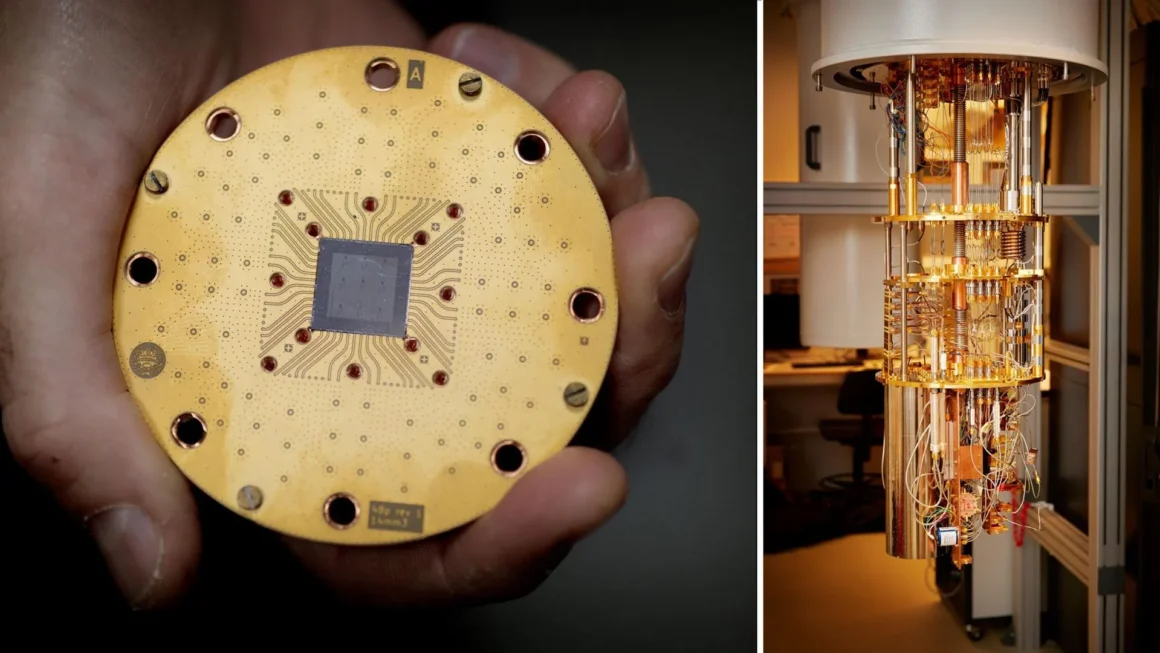








TOKYO — In what may prove to be a foundational milestone for the commercialization of quantum computing, an international team of researchers has demonstrated unprecedented parallel control of silicon spin qubits. Published in the prestigious journal Nature Physics, the breakthrough addresses one of the most stubborn bottlenecks in the development of silicon-based quantum processors: the loss of operational accuracy that occurs when multiple quantum bits are manipulated simultaneously.
Led by researchers at the RIKEN Center for Emergent Matter Science (CEMS) in Japan, in collaboration with global partners, the team successfully controlled an array of five silicon spin qubits linked to a shared microwave control line. By identifying a primary driver of multi-qubit crosstalk and engineering a scalable calibration technique, the team achieved single-qubit gate fidelities surpassing 99.99% during simultaneous operation.
The advance bridges the gap between theoretical quantum mechanics and industrial semiconductor manufacturing, offering a viable pathway toward large-scale, fault-tolerant quantum computers that can be built using existing microchip fabrication infrastructure.
Chronology of the Discovery: From Lab Bench to Breakthrough
The road to simultaneous multi-qubit control has been paved by decades of incremental advancements in semiconductor physics. However, the path taken by the RIKEN team represents a focused, methodical attack on operational interference.
Phase 1: Identifying the Interferences
For years, laboratories worldwide demonstrated high-fidelity control over isolated silicon spin qubits. These foundational experiments proved that electrons confined in silicon quantum dots could reliably store and process quantum information using their spin states. However, as researchers attempted to scale up these systems—moving from single-qubit architectures to multi-qubit arrays—performance degraded rapidly.
When microwave signals were applied to manipulate multiple qubits at once, the operations became imprecise. The RIKEN team set out to isolate the exact physical mechanism responsible for this degradation. Through meticulous experimentation using a five-qubit linear array, they traced the root of the error to the AC Stark shift—a phenomenon wherein continuous or pulsed microwave control fields inadvertently alter the effective energy levels of neighboring qubits, inducing unwanted phase shifts in their quantum states.
Phase 2: Engineering the Pairwise Calibration Solution
Recognizing that calibrating every conceivable permutation of multi-qubit interactions would quickly become computationally intractable as processors grew larger, the team developed a more elegant solution. Instead of mapping out every global configuration, they devised a pairwise calibration method.
By evaluating and compensating for interactions exclusively between pairs of qubits, the system could mathematically predict and correct the phase shifts affecting the broader array. This drastically reduced the computational and experimental overhead required for calibration, making it a viable strategy for larger systems.
Phase 3: Validation and High-Fidelity Execution
With the calibration protocol established, the researchers integrated the technique into an optimized device architecture, pairing it with meticulously shaped microwave control pulses.
When tested individually, each of the five qubits achieved gate fidelities well above 99.99%, with the highest-performing qubit reaching 99.999%. More importantly, when the team engaged multiple qubits concurrently—testing systems with up to three and eventually all five qubits operating simultaneously—the fidelity remained resiliently high, staying above 99.99% for three active qubits and hovering around 99.9% for the full five-qubit array.
Supporting Data and Technical Breakdown
To contextualize the significance of these figures, it is necessary to examine how quantum fidelity is measured and why silicon spin qubits hold such immense promise for industrial manufacturing.
Understanding Qubit Fidelity
In quantum computing, fidelity measures how closely an executed quantum operation matches the theoretical ideal. A fidelity of 99.99% means that out of 10,000 operations, only one results in an error. For fault-tolerant quantum computing—where error-correction codes must actively detect and reverse mistakes faster than they occur—physicists generally agree that physical gate fidelities must consistently exceed the threshold of 99% to 99.9%, depending on the architecture and overhead of the error-correction scheme.
| Operational State | Active Qubits | Measured Fidelity | Performance Evaluation |
|---|---|---|---|
| Isolated Operation | 1 Qubit | > 99.99% (Peak: ~99.999%) | State-of-the-art baseline precision |
| Partial Parallel Operation | 3 Qubits | > 99.99% | Highly resilient against multi-qubit crosstalk |
| Full Parallel Operation | 5 Qubits | ~ 99.9% | Meets baseline thresholds for fault tolerance |
The Remaining Hurdle: Drive-Induced Decoherence
While the newly developed calibration method successfully neutralized AC Stark phase shifts, the researchers observed a secondary source of error that prevented perfection: drive-induced decoherence.
As more qubits are operated simultaneously, the system requires higher total microwave power to drive the control lines. This elevated power environment introduces noise that disturbs the fragile quantum coherence of the electrons. Unlike the systematic phase shifts corrected by pairwise calibration, decoherence represents a fundamental loss of quantum information. The RIKEN team notes that mitigating this remaining obstacle will require further iterations in device geometry and electromagnetic shielding.
Why Silicon?
Silicon spin qubits possess a distinct advantage over competing technologies, such as superconducting circuits or trapped ions: compatibility with the multi-trillion-dollar semiconductor manufacturing ecosystem.
Because silicon qubits are manufactured using standard complementary metal-oxide-semiconductor (CMOS) fabrication techniques—the same methods used to mass-produce smartphone processors and computer chips—they benefit from decades of industrial optimization, extreme miniaturization capabilities, and low-cost scalability.
Official Responses and Expert Perspectives
The breakthrough has drawn praise from the international quantum physics community, signaling a shift in how researchers approach the scaling of semiconductor-based quantum hardware.
Leon Camenzind, a RIKEN research scientist and co-first author who supervised the experiments, emphasized the practical leap forward represented by the study:
"This shows that high-fidelity control can be maintained even when several qubits are operated at the same time and represents an important step toward scaling up silicon-based quantum processors."
Camenzind also addressed the mechanical realities of scaling control infrastructure:
"By addressing a key source of control errors through pairwise calibration, our study supports the use of shared control lines as a practical approach to scaling up quantum processors. Combined with silicon’s compatibility with established semiconductor manufacturing, we believe that this advance could help pave the way toward larger quantum processors capable of performing increasingly complex computations."
Yi-Hsien Wu, the study’s first author, who conducted the experiments as part of his doctoral research, elaborated on the elegance of the calibration model:
"Rather than requiring an entirely separate calibration procedure for every possible combination of qubits, our method uses calibrations between pairs of qubits to compensate for the unwanted phase shifts."
Looking toward the broader horizon of the technology, Seigo Tarucha, project manager of the silicon quantum computing project under Japan Science and Technology Agency’s (JST) Moonshot Goal 6, outlined the ultimate objective of the research:
"Our long-term goal is to build a fault-tolerant quantum computer based on silicon spin qubits, and reliable parallel control is an essential step toward that goal."
Implications for the Future of Quantum Computing
The successful parallel control of silicon spin qubits carries profound implications for both the architecture of quantum processors and the commercial trajectory of the industry.
1. The Wiring Dilemma and Shared Control Lines
As quantum processors scale from a handful of qubits to millions, routing individual physical control wires to every single qubit becomes physically impossible—a dilemma known in the industry as the "wiring bottleneck."
By demonstrating that high-fidelity operations can be maintained using shared microwave control lines, the RIKEN team has validated a much more efficient architectural design. Shared lines allow multiple qubits to be addressed simultaneously through multiplexing techniques, drastically simplifying the cryostat wiring harness required to operate large-scale quantum computers at millikelvin temperatures.
2. Accelerating Commercial Viability
While exotic quantum architectures often require bespoke, ultra-clean fabrication facilities built from scratch, silicon quantum computing leverages existing foundry infrastructure. The ability to achieve 99.9%+ fidelity under simultaneous multi-qubit operation proves that silicon architectures do not need to sacrifice precision for manufacturability. This convergence of industrial scalability and high operational fidelity shortens the theoretical timeline for commercial silicon quantum processors.
3. Toward Fault-Tolerant Supercomputing
Current quantum systems operate in the "Noisy Intermediate-Scale Quantum" (NISQ) era, where calculations are frequently corrupted by environmental noise and operational errors. The ultimate transition to fault-tolerant quantum computing relies on quantum error correction (QEC), which groups physical qubits together to form resilient "logical qubits."
For QEC to function effectively, the error rate of physical operations must fall below a specific error threshold, and errors must be uncorrelated. By proving that parallel operations can maintain fidelities near the 99.9% mark, the RIKEN group has provided the precise empirical foundation required to begin designing fault-tolerant silicon quantum error-correction circuits.
Next Steps in Research
With the pairwise calibration method validated on a five-qubit array, the RIKEN Center for Emergent Matter Science plans to scale the architecture to larger linear and two-dimensional arrays. Concurrently, engineers will focus on optimizing device design to suppress drive-induced decoherence, ensuring that as qubit counts climb into the tens and hundreds, operational fidelity remains uncompromised.
As these engineering hurdles are cleared, the vision of a silicon-based, fault-tolerant quantum supercomputer moves steadily from theoretical physics into achievable reality.