







Introduction: The Next Leap in In-Car AI Assistants
The landscape of in-car infotainment and driver assistance is undergoing a seismic shift. For years, drivers have relied on basic voice commands to play music, dial phone numbers, or pull up rudimentary navigation routes. While these features made driving safer by reducing manual phone interaction, they often lacked context, personalization, and deep integration with a driver’s digital life.
Enter Google. In a major announcement, the tech giant revealed that its advanced Gemini Personal Intelligence framework is officially rolling out to Android Auto and vehicles equipped with Google built-in. This expansion marks a pivotal moment in the evolution of automotive technology, moving away from static voice assistants toward dynamic, context-aware artificial intelligence designed to act as a true co-pilot on the road.
By bridging the gap between a driver’s smartphone ecosystem and their vehicle’s dashboard, Google is promising a safer, smarter, and far more intuitive driving experience. Whether it is scanning a driver’s Gmail inbox for flight details, cross-referencing dietary restrictions with restaurant recommendations along a route, or seamlessly picking up a search query initiated hours earlier on a mobile device, Gemini Personal Intelligence aims to transform the vehicle into an extension of the user’s personal digital workspace.
Main Facts: What is Gemini Personal Intelligence in Vehicles?
At its core, Gemini Personal Intelligence is designed to mirror the comprehensive AI experience users already encounter on modern Android smartphones, but tailored specifically for the driving environment where safety and minimal distraction are paramount.
Key Capabilities and Integrations
- Ecosystem Connectivity: With explicit user permission, Gemini links directly into a suite of Google services, including Gmail, Google Photos, Google Maps, Google Search, and Workspace applications.
- Context-Aware Voice Queries: Instead of requiring rigid, robotic command phrases, drivers can speak to Gemini naturally. The AI uses the user’s personal data as an active knowledge base to tailor responses in real time.
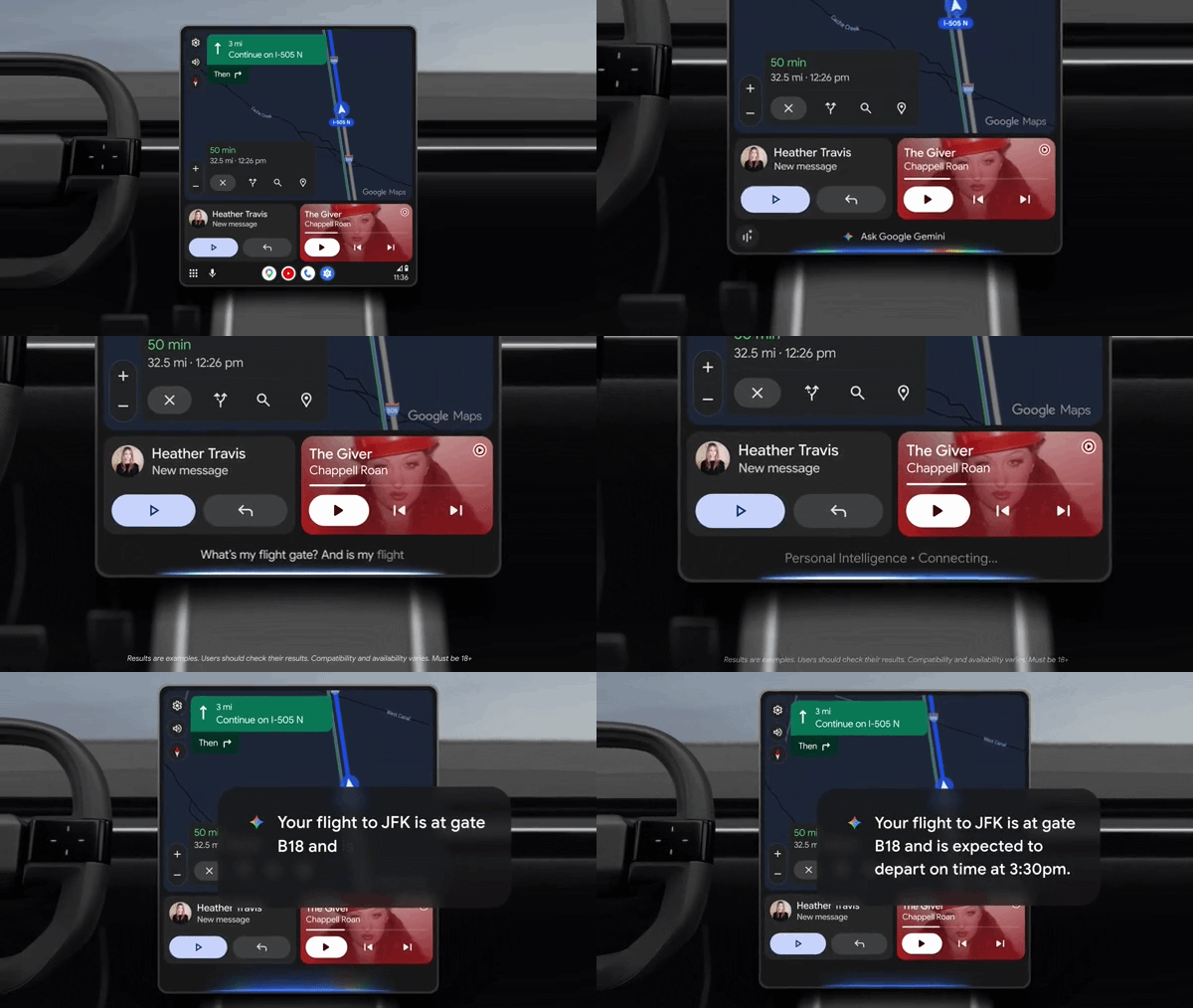
- Proactive Information Retrieval: For instance, a driver heading to the airport can ask, "Is my flight on time and what is my gate number?" Gemini will dive into incoming emails, extract the flight confirmation data, and read out the precise details while the driver keeps their hands on the wheel and eyes on the road.
- Intelligent Route Planning and Dining: If a driver asks for dinner suggestions, Gemini goes beyond generic local search results. By factoring in user preferences—such as dietary restrictions (e.g., vegetarianism)—it curates hyper-specific restaurant stops along the active navigation route.
- Cross-Device Continuity: Drivers can "pick up where they left off." If a user researched a specific coffee shop or point of interest on their phone earlier in the day, that context travels to the car. Upon entering the vehicle, the user can casually bring it up, and Gemini will instantly pull up the details and generate a Google Maps route.
- Multimodal Search via Photos: In a display of advanced multimodal capability, Google highlighted that drivers can even ask Gemini to track down information about their vehicle—such as looking up specific tire models or maintenance notes by searching through their Google Photos library.
Chronology: The Road to In-Car Personal Intelligence
Google’s rollout of Gemini Personal Intelligence to the automotive sector is the culmination of a rapid, multi-phased deployment strategy that began earlier in the year. Understanding the timeline of this rollout highlights how aggressively Google is weaving its generative AI ecosystem across all device categories.
- January: Google initially introduces the foundational concepts of Gemini’s Personal Intelligence, setting the stage for a deeply integrated, AI-first ecosystem that leverages user data securely across apps.
- Spring and Summer: The tech giant begins expanding Personal Intelligence to new form factors, introducing it to AI Mode and standard Gemini mobile app interfaces across the United States. Users begin experiencing context-driven responses tailored to individual profiles, preferences, and personal app ecosystems.
- October 20: Google officially announces the expansion of Gemini Personal Intelligence to Android Auto and vehicles featuring Google built-in. The announcement highlights privacy-first permission controls and showcases early demonstrations of flight tracking, dynamic route curation, and seamless cross-device history synchronization.
- The Coming Months (Late 2025 and Beyond): Google confirms that the feature will roll out progressively to vehicles with Google built-in and Android Auto-compatible systems. Users who already have Personal Intelligence configured on their mobile devices will find the transition virtually seamless once the update hits their vehicle’s dashboard.
Supporting Data & Technical Architecture
While the consumer-facing features of Gemini Personal Intelligence are undeniably impressive, the underlying architecture requires a delicate balance between high-powered cloud computing, vast data synthesis, and rigorous privacy protocols.
How the Data Flows
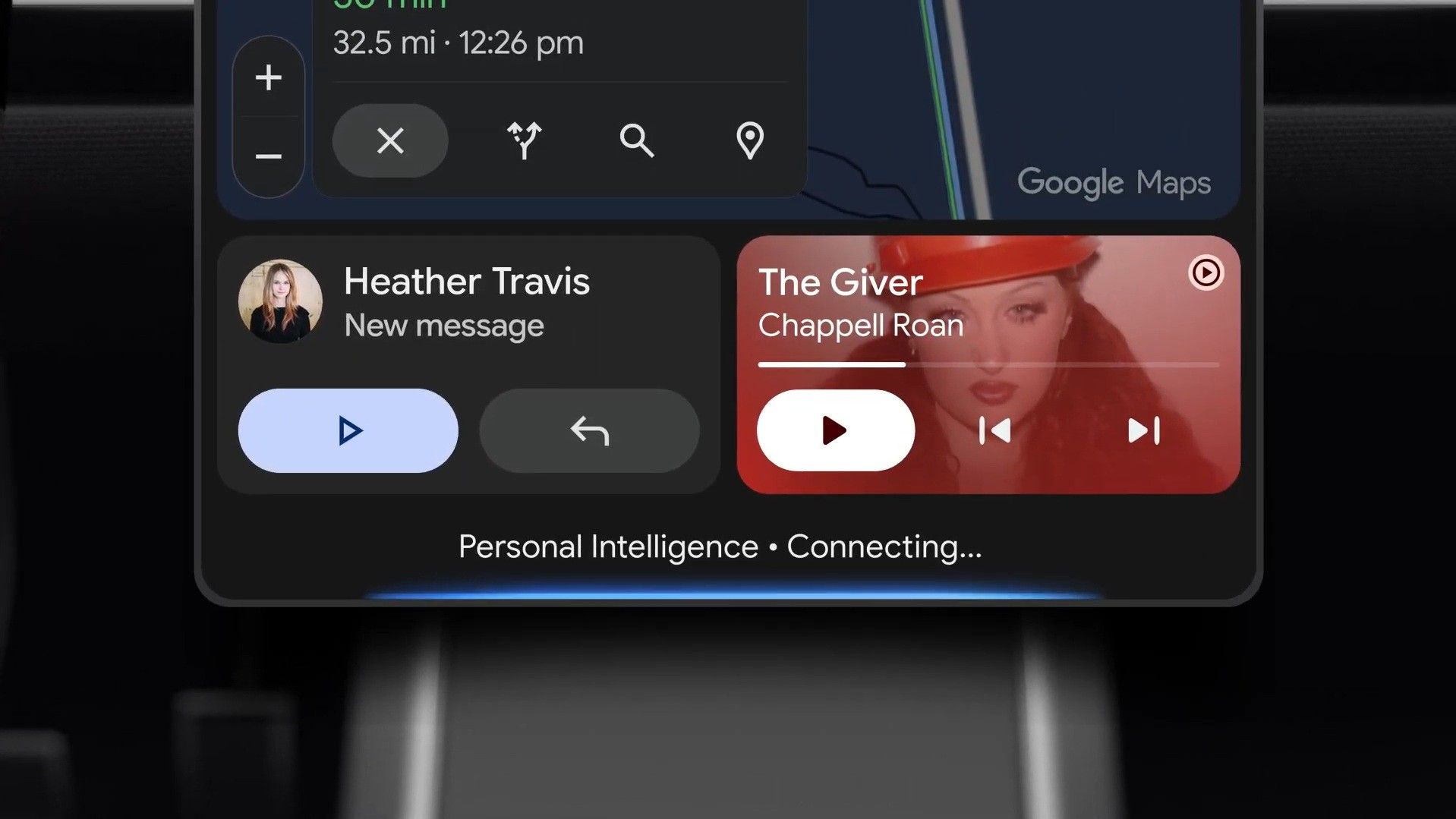
To deliver real-time answers, Gemini does not merely scan the web; it acts as an intelligent orchestrator across the user’s personal application graph:
- The Trigger: A voice query is captured by the vehicle’s microphone array and processed via Android Auto or the native Google built-in system.
- The Contextual Query: Gemini analyzes the intent of the prompt. If the prompt requires personal data (e.g., flight status or past searches), it securely queries the authorized Google Workspace APIs (Gmail, Photos, etc.).
- The Synthesis: The Large Language Model (LLM) synthesizes the retrieved personal data with real-time geospatial data from Google Maps and live web data from Google Search.
- The Output: A concise, conversational response is delivered audibly to the driver, minimizing cognitive load and visual distraction.
Privacy and User Control
Because Personal Intelligence taps into sensitive personal repositories like private emails and photo galleries, privacy is a paramount concern. Google has structured the feature around strict opt-in frameworks:
- Explicit Permission Required: Personal Intelligence remains completely dormant and disconnected from personal apps until the user grants explicit, granular permission.
- Granular Management: Users can manage, restrict, or revoke permissions directly within Gemini’s settings menu on their mobile device or car display.
- Data Isolation: Google maintains that personal app data used to power Gemini responses is handled in accordance with stringent enterprise-grade privacy standards, ensuring that private communications are not indiscriminately exposed or used for unauthorized third-party advertising tracking.
Official Responses and Industry Context
The rollout of Gemini Personal Intelligence to automobiles signals a heating-up race in the in-car software ecosystem. For years, tech giants and legacy automakers have battled for dominance over the dashboard.
Google’s subtle nod in its announcement—"Sorry, Microsoft: Apparently Gemini is your new copilot"—highlights the intense rivalry between Google’s Gemini ecosystem and Microsoft’s aggressive push into AI integrations across operating systems and enterprise software. While Microsoft has largely anchored its copilot strategy around Windows, Office, and select automotive partnerships, Google is leveraging its unmatched ubiquity in mobile operating systems (Android), mapping (Google Maps), search, and cloud communication (Gmail).
Automotive industry analysts note that modern consumers increasingly judge a car not just by its horsepower, suspension, or fuel economy, but by the seamlessness of its digital ecosystem. By integrating deep AI personalization directly into Android Auto—which is utilized by hundreds of millions of vehicles globally—and native Google built-in systems (found in vehicles from brands like Volvo, Polestar, Renault, and General Motors), Google is cementing its role as the definitive digital layer of the modern driving experience.
Implications: What This Means for Drivers and the Future of Transportation
The arrival of Gemini Personal Intelligence in vehicles carries profound implications for safety, convenience, and the future relationship between humans and their automobiles.
1. Reimagining Driver Safety Through Reduced Cognitive Friction
Paradoxically, while adding advanced AI features might sound like a recipe for increased distraction, the goal of conversational agents like Gemini is actually to reduce visual and manual distraction. In the past, if a driver needed to find their flight gate while driving to the airport, they might have been tempted to glance at their phone or fumble through multiple menus on a touch screen. With Gemini, a simple spoken sentence prompts the AI to dig through emails and speak the answer aloud. By streamlining complex multi-step information retrieval into a natural dialogue, the driver’s eyes remain focused squarely on the road.
2. The Evolution of Hyper-Personalized Travel
Standard GPS navigation tells drivers how to get somewhere. Gemini-powered navigation tells drivers where they might want to go based on who they are. By combining real-time traffic data, user preferences, past search histories, and personal calendars, the car evolves from a dumb transport machine into an active assistant that understands dietary needs, scheduling conflicts, and personal habits.
3. The Battleground for Dashboard Supremacy
As vehicles become computers on wheels, the battle for the operating system of the car intensifies. Apple continues to iterate on its next-generation CarPlay, while independent automakers strive to build proprietary software-defined vehicle (SDV) platforms. Google’s aggressive deployment of Gemini gives Android Auto and Google built-in a formidable competitive advantage. Drivers accustomed to having Gemini manage their digital lives on their phones will naturally gravitate toward vehicles that offer that exact same intelligence seamlessly integrated into the dashboard.
Conclusion
Google’s introduction of Gemini Personal Intelligence to Android Auto and Google built-in represents a major milestone in automotive tech. By transforming the car into a context-aware, hyper-personalized companion, Google is setting a new standard for what drivers can expect from their vehicles. As the rollout progresses over the coming months, the modern commute is poised to become significantly smarter, smoother, and deeply attuned to the individual needs of every driver behind the wheel.