










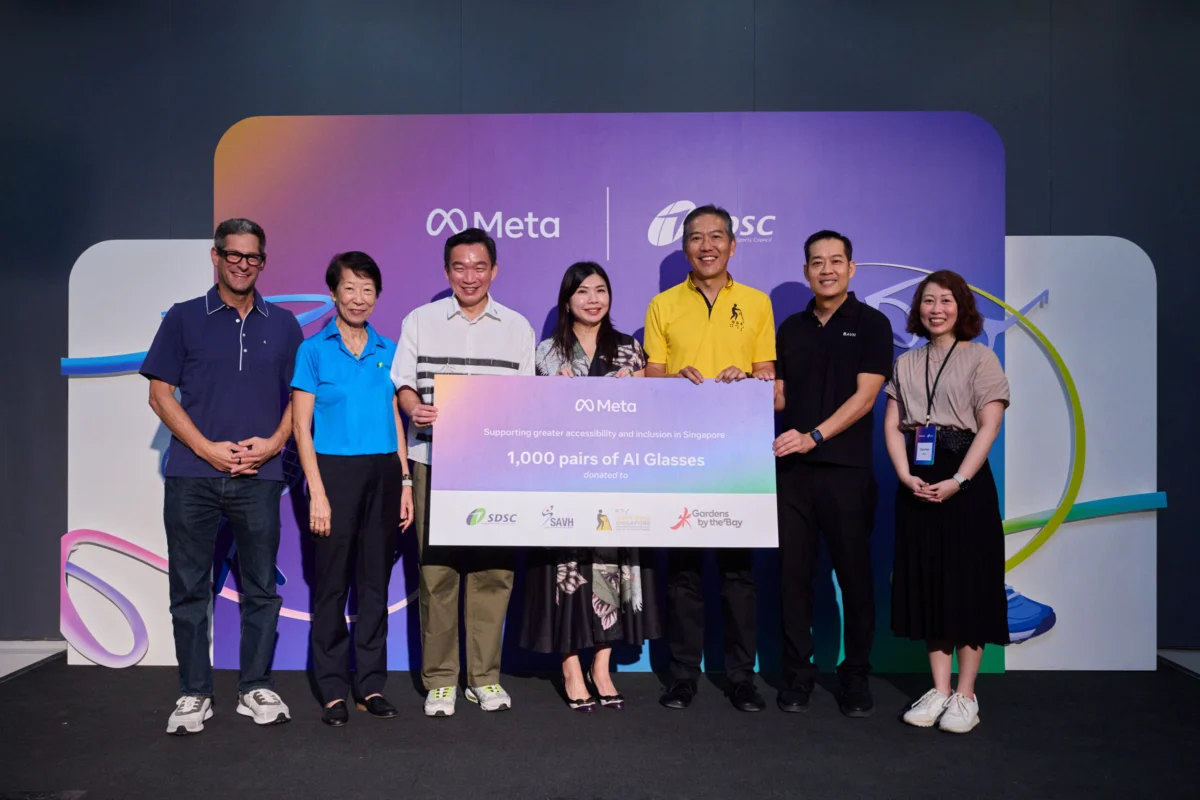
SINGAPORE — In a major milestone for digital inclusion and assistive technology, Meta’s Chief Global Affairs Officer, Joel Kaplan, announced a significant philanthropic initiative in Singapore today. Meta is donating 1,000 pairs of Ray-Ban Meta AI glasses to four prominent local organizations: the Singapore Association of the Visually Handicapped (SAVH), Guide Dogs Singapore (GDS), the Singapore Disability Sports Council (SDSC), and Gardens by the Bay.
Alongside the hardware donation, Meta is committing a US$30,000 investment to fund specialized accessibility training programs. This financial injection will primarily support SAVH in developing comprehensive curricula to ensure users can safely, effectively, and confidently integrate the wearable artificial intelligence into their daily routines.
The announcement was unveiled at a high-profile AI glasses accessibility showcase co-hosted by Meta and the SDSC. The event brought together key stakeholders from Singapore’s disability community, government officials, athletes, and advocacy leaders to demonstrate how cutting-edge consumer technology can be repurposed to dismantle barriers for persons with disabilities.
Main Facts
The core of Meta’s initiative centers on the distribution of 1,000 advanced Ray-Ban Meta AI glasses to individuals with visual impairments, physical disabilities, and developmental needs across Singapore.
- The Hardware: The Ray-Ban Meta glasses are equipped with built-in artificial intelligence, high-definition cameras, open-ear speakers, and multi-microphone arrays. While widely commercialized for lifestyle applications—such as streaming, listening to music, taking hands-free calls, and recording point-of-view video—their multimodal AI capabilities offer life-changing utility for individuals with low vision or total blindness.
- Core Accessibility Functions: Powered by AI, the glasses can perform real-time text reading, object identification, and descriptive audio narration of the user’s immediate surroundings. This empowers wearers to navigate unfamiliar environments, read menus or mail independently, and interact more seamlessly with the physical world.
- The Beneficiaries:
- Singapore Association of the Visually Handicapped (SAVH): Will receive hardware for clients and funding to build a robust educational curriculum.
- Guide Dogs Singapore (GDS): Will integrate the technology into mobility and independence programs for visually impaired individuals.
- Singapore Disability Sports Council (SDSC): Will distribute units to local athletes and advocates to aid in daily living and potentially review sports training performance.
- Gardens by the Bay: Will explore utilizing the technology to enhance sensory tours and inclusive visitor experiences across its sprawling nature park.
- The Financial Commitment: The US$30,000 grant dedicated to SAVH will finance structured training workshops, teaching participants how to utilize voice commands, manage privacy settings, and maximize the AI features for everyday problem-solving.
Chronology of Events
The path toward today’s landmark announcement reflects a growing convergence between big tech innovators, local social service agencies, and Singaporean government bodies striving to make the "Smart Nation" initiative radically inclusive.
Morning Showcase and Official Unveiling
The rollout kicked off with an immersive accessibility showcase in Singapore, co-hosted by Meta and the SDSC. Attendees included prominent para-athletes, digital inclusion advocates, and institutional leaders.
The Guest-of-Honour for the event was Eric Chua, Senior Parliamentary Secretary for the Ministry of Law and the Ministry of Social and Family Development. Mr. Chua toured the exhibition booths, observing firsthand demonstrations of how visually impaired users leverage the voice-activated AI features to interpret surroundings and interact dynamically with exhibits.
The Joint Announcement
During the central presentation, Meta’s Chief Global Affairs Officer, Joel Kaplan, formally announced the distribution of the 1,000 AI glasses and the accompanying US$30,000 training grant. Representatives from SAVH, GDS, SDSC, and Gardens by the Bay accepted the partnerships on behalf of their respective communities.
Afternoon Breakout Sessions and Training Frameworks
Following the plenary announcements, rehabilitation specialists from SAVH and GDS met with Meta engineering representatives to map out the framework for the upcoming accessibility curriculum. These workshops established baseline safety protocols, device customization guidelines, and peer-to-peer mentoring structures designed to ensure smooth adoption by elderly and younger demographics alike within the visually impaired community.
Supporting Data and Technological Impact
To understand the weight of Meta’s donation, one must examine the intersection of wearable consumer tech and assistive technology (AT). Historically, dedicated assistive devices—such as specialized electronic travel aids, text-to-speech reading machines, and electronic magnifiers—have suffered from high costs, steep learning curves, and social stigma due to their clinical appearance.
By contrast, the Ray-Ban Meta glasses offer a sleek, socially integrated form factor. Weighing nearly the same as standard high-end eyewear, they allow users to blend into public spaces without drawing unwanted attention.
- Multimodal AI Integration: The glasses utilize Meta AI to process visual data captured through the built-in camera lenses. When a user asks, "Meta, what am I looking at?" or requests help reading a street sign, the system translates visual inputs into synthesized audio delivered directly via discreet open-ear speakers. This leaves the user’s ears open to ambient environmental sounds—a critical safety feature for pedestrians with visual impairments navigating Singapore’s bustling urban landscape.
- The US$30,000 Grant Allocation: While hardware distribution is critical, lack of formal training remains a primary bottleneck in technology adoption. Meta’s financial backing ensures that SAVH can hire specialized instructors, produce accessible training materials (including screen-reader-friendly guides and braille documentation), and conduct one-on-one coaching sessions. This structured approach directly addresses the digital divide, ensuring that marginalized populations are not left behind in the rapid race toward artificial intelligence integration.
Official Responses and Perspectives
Leadership figures from across government, corporate, and social service sectors weighed in on the significance of the partnership, emphasizing a shared vision of radical inclusion.
Meta’s Vision for Inclusive Technology
Joel Kaplan, Chief Global Affairs Officer at Meta, underscored the company’s foundational philosophy during his keynote address:
"The athletes and advocates I met today show what’s possible when technology is designed with independence in mind. I’ve seen firsthand how meaningful this technology is for people with disabilities. We believe the future is for everyone. That’s why, through our partnerships with the Singapore Association of the Visually Handicapped, Guide Dogs Singapore, the Singapore Disability Sports Council and Gardens by the Bay, we’re putting these glasses into the hands of the people who stand to benefit most."
Government Endorsement
Highlighting Singapore’s broader national strategy for disability inclusion, Senior Parliamentary Secretary Eric Chua praised the collaborative effort:
"When designed with persons with disabilities, AI and emerging technologies can improve quality of life and enable fuller participation in everyday life. Our goal is a Singapore where inclusion is not exceptional, but simply ordinary."
Empowering Para-Sports and Community Leadership
Dr. Teo-Koh Sock Miang, President of the Singapore Disability Sports Council, noted the multifaceted utility of the donation, pointing out potential applications within the sports arena:
"This partnership is especially meaningful because Meta’s donation is more than a gift for today — it is an investment in a future where technology can expand possibilities for persons with disabilities. Whether fostering greater independence in daily life or enabling new ways to review training and enhance performance, its potential is significant. We are excited to see our community make this technology their own and discover innovative uses we have yet to imagine."
Echoing these sentiments, Paralympian and National Para Shooter Theresa Goh shared her personal experience with the wearable devices:
"Using the glasses hands-free has changed how I capture moments and stay connected through my day. Technology in the right hands has enormous potential for good, especially for the disabled community. We are grateful to Meta for helping our athletes and member organisations gain greater independence in their daily lives."
Social Service and Cultural Partners
Frontline rehabilitation experts expressed optimism regarding how the tools will transform daily casework. Cheryl Yeo, Head of Rehabilitation Services at SAVH, stated:
"We are deeply grateful to Meta for sponsoring Meta AI glasses to SAVH and providing a grant to support accessibility training. This generous support empowers our visually impaired clients with greater independence and access to technology that enhances daily living. At the same time, SAVH plays a vital role in guiding responsible use, ensuring these devices are integrated safely and meaningfully into their lives. Together, we are building pathways toward inclusion, dignity, and self-reliance."
Damon Goh, Chief Executive Officer of Guide Dogs Singapore Ltd, added:
"AI glasses could change how persons with visual impairment learn to navigate and engage with the world around them. By bringing this technology into our work, we hope to open up more possibilities for independent living and participation in work, sports and community life."
Furthermore, cultural institutions are stepping up to bridge accessibility gaps in public spaces. Linda Tay, Senior Director of Programming at Gardens by the Bay, explained how the new initiative aligns with their ongoing inclusivity projects:
"At Gardens by the Bay, we are committed to making the Gardens an inclusive place where everyone feels welcome. Technology is a key enabler in creating innovative ways for visitors of diverse backgrounds and abilities to experience and enjoy the Gardens. Our sensory tours for the visually impaired community, and more recently our pilot of the robotic guide dog, reflect our ongoing efforts to make the Gardens more accessible. We look forward to exploring how Meta’s AI-enabled eyewear can build on these efforts and open up new possibilities to further enhance the visitor experience."
Implications for the Future of Accessibility
The distribution of 1,000 Ray-Ban Meta AI glasses in Singapore serves as a potential case study for how global technology firms can collaborate with municipal organizations and non-profits to address real-world challenges.
1. Shifting from Consumer Gadgets to Assistive Tools
Historically, consumer electronics companies have designed products for the mass market, occasionally adding accessibility features as secondary afterthoughts. This initiative signals a strategic evolution where mainstream hardware inherently possesses advanced assistive capabilities. By putting consumer-grade AI directly into the hands of visually impaired users, Meta is helping normalize assistive tech, replacing clinical medical devices with stylish, universally recognized eyewear.
2. Setting a Benchmark for Corporate Philanthropy in Southeast Asia
Singapore’s status as a technological hub makes it an ideal testing ground for smart-city accessibility initiatives. The combination of hardware donations, localized training grants, and cross-sector partnerships provides a scalable blueprint that other nations and tech conglomerates can replicate to bridge the digital divide.
3. Addressing Privacy, Safety, and Ethical Considerations
While the potential benefits are immense, the integration of AI cameras and voice-activated recording devices in public spaces introduces complex privacy and ethical questions. This underscores the critical importance of SAVH and GDS’s involvement. By embedding responsible-use training into the curriculum, the partnership ensures that recipients are not only technologically empowered but also educated on respectful data practices, consent in public recordings, and situational awareness.
Conclusion
As the first waves of recipients begin receiving their devices and undertaking training sessions through SAVH, the eyes of the global tech and disability advocacy communities will be on Singapore. If successful, this initiative could fundamentally redefine how society views artificial intelligence—moving past the hype of productivity gains to fulfill technology’s highest calling: enhancing human dignity, fostering autonomy, and ensuring that the future is truly for everyone.
To learn more about Meta’s accessibility services and the features built into the Ray-Ban Meta glasses, visit the official Meta Accessibility Portal.



