GLOBAL — In an era where digital literacy dictates economic mobility, access to practical, high-value technical education remains starkly uneven. While coding bootcamps and specialized tech certifications often carry prohibitive price tags, a sweeping global movement is quietly democratizing the web.
Driven by volunteer organizers, dedicated educators, and ambitious students, the WordPress community’s educational initiatives—specifically WordPress Campus Connect and WordPress Credits—are bridging the digital divide. From constructing over 100 websites in a matter of weeks in Bangladesh to adapting software curricula in rural Uganda without access to electricity, these programs are proving that open-source technology can serve as a powerful engine for global educational equity.
According to the July 2026 data released by the WordPress community education framework, thousands of learners across multiple continents have built professional digital portfolios, contributed directly to core open-source software, and earned academic credits—all completely free of charge.
1. Main Facts: Bridging the Digital Divide Through Open Source
The core objective of the WordPress global education framework is simple yet transformative: to equip students—many of whom have never written a line of code or built a website—with practical, real-world digital skills.
The initiative operates primarily through two distinct pipelines:
- WordPress Campus Connect: A program that brings free, hands-on, instructor-led WordPress workshops directly to high schools, vocational institutes, and universities. Operating from a shared, standardized curriculum, local volunteers guide students through the fundamentals of site-building, content management, and digital design. Upon completion, every student receives a certificate of achievement.
- WordPress Credits: A more advanced initiative that integrates into formal higher education structures. It places students into mentored internships where they contribute directly to the development and maintenance of WordPress—which powers over 40 percent of the global web—while earning official academic credit toward their degrees.
In July alone, these initiatives achieved staggering milestones: students in Kishoreganj, Bangladesh, constructed 108 websites across two campuses in two weeks; the WordPress Credits program surpassed 226 total graduates (up from 199 in June); and active partnerships expanded to 38 educational institutions across 16 countries.

Crucially, these programs incur zero financial cost to the participating students or host schools, making advanced web development accessible to demographics that are traditionally underrepresented in the technology sector.
2. Chronology of Events: A Global Wave of Workshops in July
The month of July 2026 marked an unprecedented period of growth and resilience for the initiative, characterized by several notable international events:
Early July: The Kishoreganj Surge in Bangladesh
The momentum began in earnest in the Kishoreganj district of Bangladesh. Organized by community leader Muhibul Haque, Campus Connect rolled out across two major educational institutions separated by a span of two weeks.
- Session One: At Kishoreganj University, participating students successfully built 38 functional websites during their initial hands-on workshop.
- Session Two: At the Kishoreganj Polytechnic Institute, the scale expanded dramatically. Guest speaker Shipon Karmakar traveled over 80 kilometers to support the event, helping students construct nearly 70 additional websites. To date, the regional series has engaged over 150 students, with two additional institutional workshops slated for the near future.
Mid-July: Innovation and Practical AI in Spain
Shifting from basic site-building to advanced problem-solving, Josep Morán led a specialized vocational workshop in Mataró, Spain. Over two four-hour sessions at Escola Pia Sta. Anna, 100 vocational students utilized WordPress Playground and artificial intelligence assistance to develop a working plugin designed to calculate optimal shore-fishing times for the local municipality.
Late July: Overcoming Adversity at Bulamogi College in Uganda
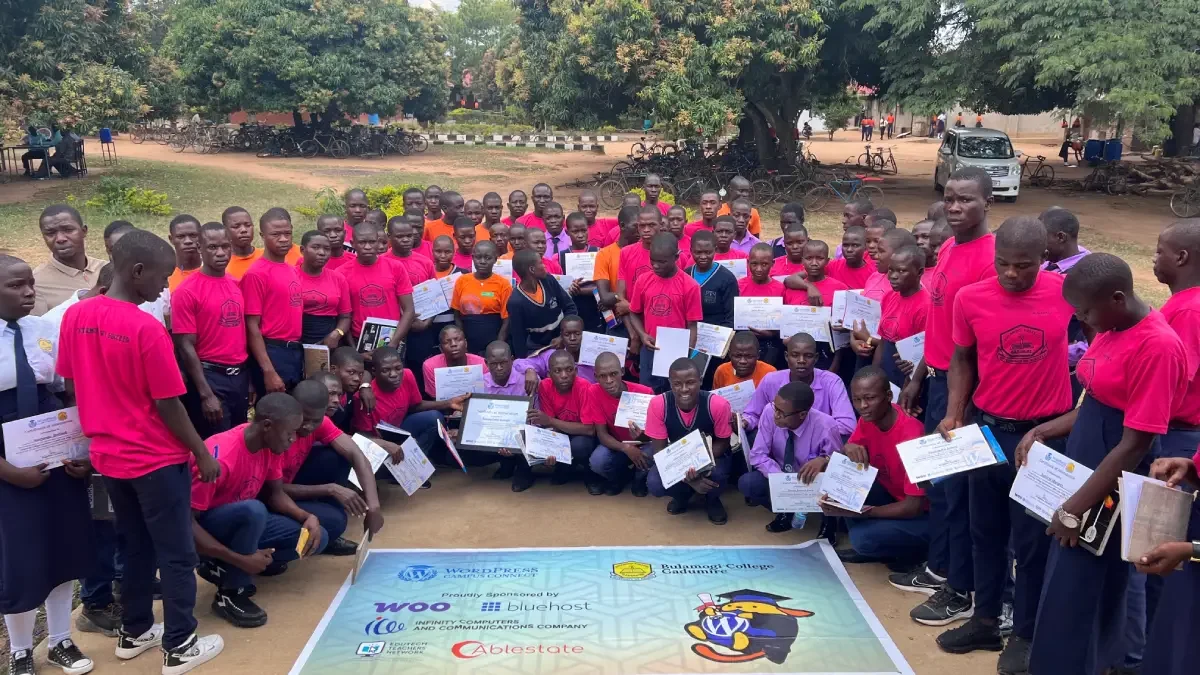
Perhaps the most remarkable logistical hurdle of the month occurred on July 29 in eastern Uganda. Thanks to the grassroots advocacy of alumna Mariam Nairuba—who first encountered the program at a workshop in Kaliro the previous December—Campus Connect arrived at Bulamogi College Gadumire.
Upon arrival, organizers discovered a major crisis: the school lacked electricity entirely. Despite having laptops, projectors, and extension cables rendered temporarily useless, the volunteer team refused to cancel the event. Instead, they engaged over 100 eager learners in an interactive, Socratic Q&A session, writing questions and answers directly onto a classroom blackboard.

Late July to August: Peer-to-Peer Mentorship in Costa Rica
Closing out the month, Rita Robles Loaiza spearheaded dual pilot programs in Costa Rica. In the first instance, three students from the Universidad Fidélitas WordPress Credits cohort designed and delivered a specialized workshop for 40 high school girls at an MIT-backed engineering camp (Patrones Hermosos). In the second pilot, 13 students at Liceo Experimental Bilíngüe José Figueres Ferrer began translating WordPress into regional Spanish (es_CR) as part of their community service requirements.
3. Supporting Data and Program Metrics
The rapid scaling of WordPress educational initiatives is best understood through its quantitative impact across diverse socioeconomic landscapes:
- 108 Websites: Built within a strict two-week window across two campuses in Kishoreganj, Bangladesh, demonstrating rapid competency acquisition among absolute beginners.
- 226+ Graduates: The WordPress Credits program officially crossed the 226-graduate threshold in July, showing a steady month-over-month expansion from June’s 199 graduates.
- 38 Partner Institutions: Formal collaborations now span 16 distinct countries, integrating open-source contributions directly into school curricula.
- 100% Satisfaction Rates: Workshops—such as the high school STEM outreach event in Costa Rica—reported flawless feedback from participants, proving that the standardized curriculum scales effectively across different cultural and linguistic contexts.
- Global Reach: From Kyoto University of Advanced Science in Japan to newly formed student clubs in Dhaka, Bangladesh, the program’s open-source framework allows local leaders to adapt lessons to their unique regional needs.
4. Official Responses and Community Perspectives
The success of these programs has drawn widespread praise from educators, student participants, and open-source community leaders alike.
Organizers emphasize that the true value of the initiative extends far beyond technical proficiency; it fosters agency, confidence, and civic engagement. When reflecting on the unexpected power outage at Bulamogi College in Uganda, the volunteer team noted the palpable enthusiasm in the room:
"The room exploded. Students asked whether WordPress was free, how secure WordPress sites really are, and whether they could become developers themselves."
For the students, the tangible outcomes are immediately clear. In Spain, vocational learners highlighted two primary takeaways from their AI-assisted plugin workshop: the formal certificate of completion, and the realization that their newly acquired skills map directly onto existing jobs within their local economy.

University administrators in partner countries have similarly praised the WordPress Credits model for bridging the gap between theoretical computer science education and practical, collaborative software engineering. By contributing code to a platform that underpins nearly half of the internet, students transition from passive consumers of technology to active creators and maintainers of global digital infrastructure.
5. Implications: Shaping the Future of Global Tech Education
The long-term implications of the WordPress Campus Connect and Credits programs point toward a more inclusive, decentralized model of technical education.
Economic Mobility in Developing Regions
In regions like eastern Uganda and rural Bangladesh, formal technical training is often prohibitively expensive or entirely unavailable. By providing a portable, offline-adaptable curriculum, volunteers are laying the groundwork for digital entrepreneurship. Students who previously viewed the internet purely as a consumption medium are now empowered to build e-commerce platforms for local businesses, establish digital portfolios, and freelance globally.
Sustainable Peer-to-Peer Ecosystems
The Costa Rican pilot models pioneered by Rita Robles Loaiza offer a blueprint for sustainable educational scaling. By training high school and university students to become educators themselves, the initiative bypasses the bottleneck of relying solely on professional developer volunteers. Today’s student learner becomes tomorrow’s workshop instructor.
The Power of Open-Source Contribution
Ultimately, these initiatives challenge the traditional ivory-tower approach to software engineering. By integrating young adults directly into the open-source contribution pipeline, WordPress is cultivating a diverse, global generation of developers who understand the value of collaborative public goods.
As the Monthly Education Buzz Report for July 2026 illustrates, momentum is only accelerating. With student clubs in Dhaka organizing autonomous campus events and international universities embedding open-source contributions into their semesters, WordPress education is proving that with the right community framework, the tools to build the digital world can belong to everyone.