











By Josh Gallant
Updated July 21, 2026
For most growing companies, sales and marketing misalignment rarely announces itself with a loud emergency siren. It doesn’t break out as a sudden corporate catastrophe or a boardroom shouting match. Instead, it creeps in through quiet, corrosive symptoms: "qualified" leads delivered by marketing that sales openly refuses to call; multi-channel campaign messaging that sales reps have never seen and cannot explain; and a revenue pipeline that looks deceptively healthy on a quarterly slide deck until closed revenue abruptly grinds to a halt.
To uncover what is truly happening behind closed doors inside small and medium-sized business (SMB) go-to-market (GTM) teams, Unbounce surveyed over 500 SMB GTM professionals for its comprehensive 2026 report, The Anatomy of Aligned Go-to-Market Teams.
The headline statistic tells a startling story: 87% of teams expect better sales and marketing alignment to directly lift performance, yet only 56% describe themselves as highly aligned.
This expansive deep-dive explores where go-to-market alignment breaks down, the hidden financial cost of operational friction, and the specific strategies top-performing companies use to close the gap.
Main Facts: The Anatomy of the GTM Alignment Gap
At first glance, a 56% high-alignment rate might sound encouraging. However, industry veterans know that saying "we are aligned" often masks a superficial truce. Too many organizations mistake a recurring meeting cadence for an operational strategy.

According to Unbounce’s data, true operational alignment requires shared data pools, strict handoff protocols, and unified key performance indicators (KPIs). Yet, when organizations attempt to bridge the gap, they frequently stop at the calendar layer—scheduling weekly syncs while leaving their underlying data architecture, lead definitions, and incentive structures completely siloed.
The Perception Gap from the Top Down
One of the most revealing discoveries in the 2026 study is the stark perception gap between leadership and execution-level employees:
- 69% of executives report strong sales and marketing alignment.
- Only 47% of non-executives agree.
- 62% of sales professionals feel highly aligned, compared to just 53% of marketers.
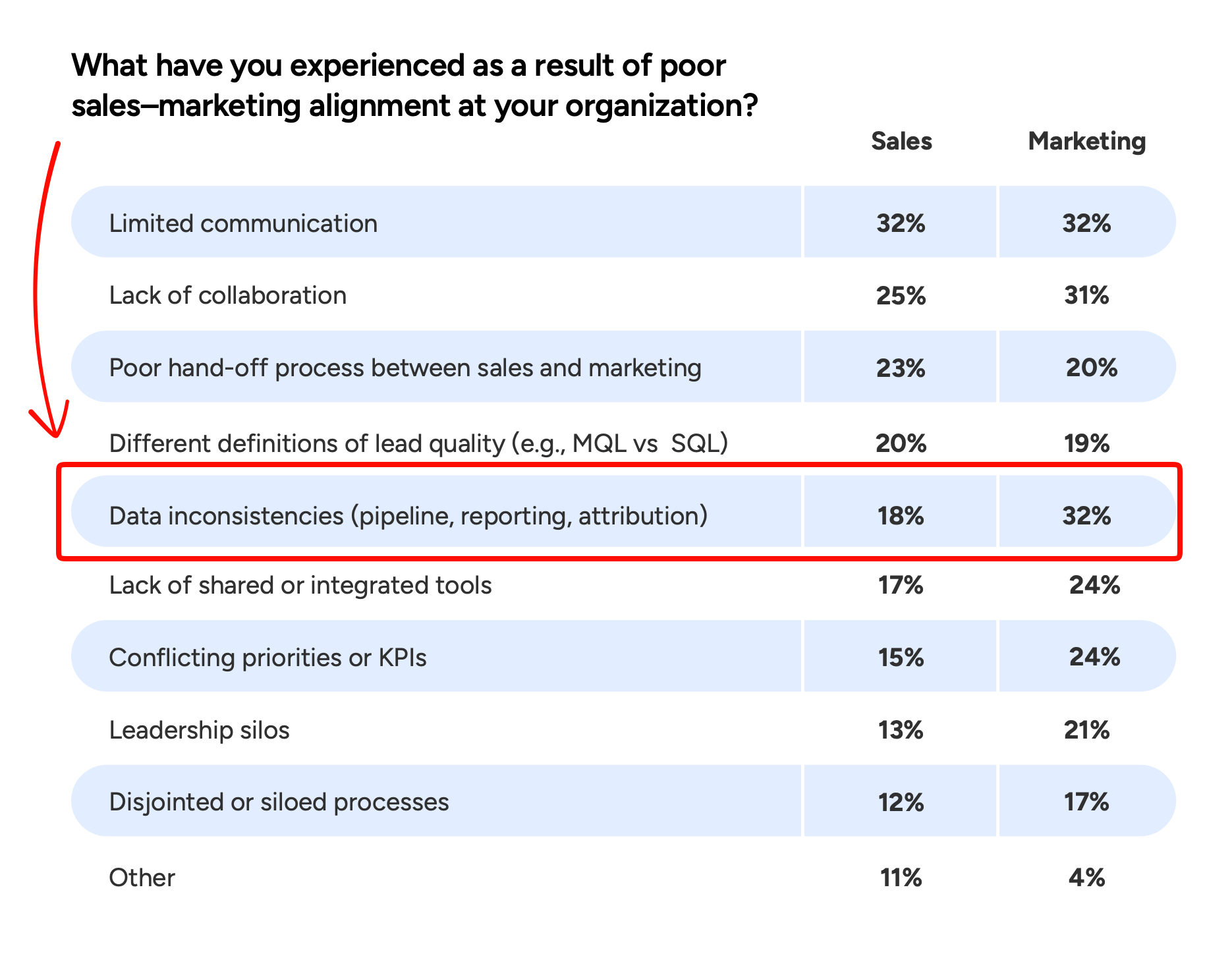
Why does the view from the executive suite look so vastly different from the ground floor? The answer lies in informational lag. Executives view alignment through the pristine lens of strategy decks and projected forecasts. Non-executives, conversely, experience the friction firsthand: data inconsistencies (reported by 28% of non-execs vs. 22% of execs), limited cross-departmental communication (33% vs. 28%), and rigid leadership silos (19% vs. 14%).
Ultimately, alignment lives or dies with the people farthest from the executive table—those who feel it breaking down daily but rarely get a voice in fixing it.
Chronology: How Misalignment Compounds Into Pipeline Failure
The path to a broken revenue pipeline is rarely instantaneous. It is an incremental accumulation of small communication breakdowns that compound over time.
Phase 1: The Upstream Definition Mismatch
It begins at the top of the funnel. Marketing optimizes for lead volume, often utilizing broad parameters to satisfy top-level growth metrics. Meanwhile, sales operates under the pressure of closed-won quotas, requiring hyper-qualified prospects with immediate purchasing intent. Because marketing and sales fail to agree on what constitutes a Marketing Qualified Lead (MQL) versus a Sales Qualified Lead (SQL), marketing sends volume that sales dismisses as noise.

Phase 2: The Breakdown of the Handoff
As leads accumulate, the handoff process falters. Without a strict Service Level Agreement (SLA)—specifying what data must be transferred, how quickly follow-up must occur, and who owns accountability—leads slip through the cracks. According to the report, 23% of sales professionals cite a poor handoff process as a primary operational barrier.
Phase 3: The Attribution Blame Game
When the quarterly numbers flatten, the finger-pointing begins. Marketing blames sales for sluggish follow-up times and poor closing rates; sales blames marketing for piping in low-intent, unqualified leads. Because both departments track success using disconnected metrics, the organization is left with a fragmented diagnosis of why growth has stalled.
Supporting Data: The Hidden Costs of Poor GTM Alignment
Misalignment is frequently dismissed as an internal cultural quirk. In reality, it manifests as a direct drain on operational budgets and employee morale.
The Employee Toll
When asked what poor alignment produces first, 29% of GTM teams point directly to employee frustration. Marketers, in particular, feel the brunt of this disconnect:
- 32% of marketers flag delayed or inconsistent lead follow-up by sales (compared to 22% of sales professionals).
- 29% cite unclear target customer profiles as a constant hurdle (compared to just 16% of sales).
The Tool Bloat Trap
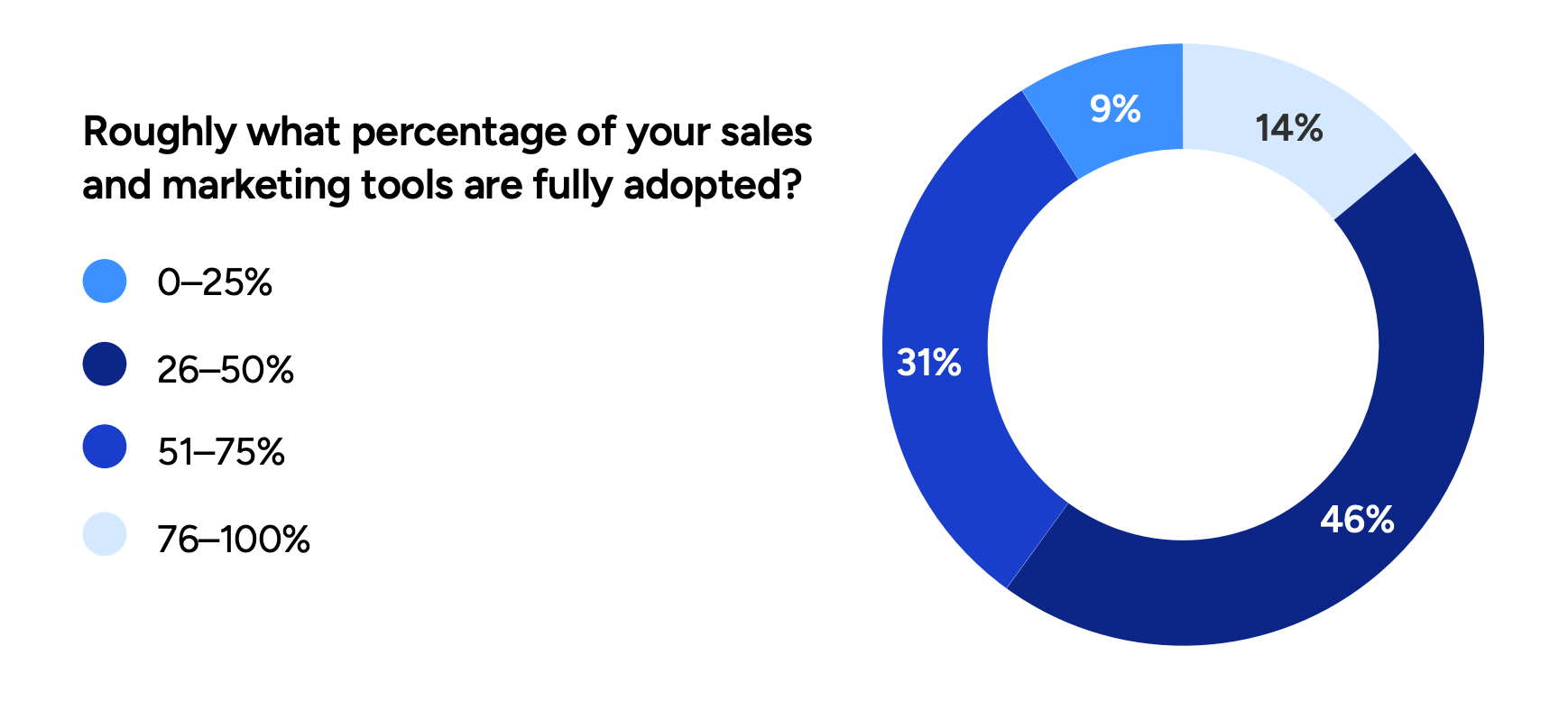
When revenue targets are missed, the knee-jerk reaction for many organizations is to purchase more software. However, the data reveals a paradox: 56% of GTM professionals admit to tool bloat, yet 60% use less than half of their existing tech stack.
- 14% of teams utilize 0% to 25% of their purchased tools.
- 46% utilize only 26% to 50% of their stack.
Far from solving alignment problems, unused software merely generates maintenance overhead, licensing waste, and isolated data silos. Conversely, leaner stacks with high adoption rates consistently outperform sprawling, complex software collections. In fact, organizations that significantly consolidated their tech stack are twice as likely to rate lead quality as "excellent" (55% vs. 20%).
Official Responses and Root Causes
Unbounce’s research categorizes the root causes of sales and marketing misalignment into four distinct operational buckets: Operational (53%), Goal and Incentive (43%), Cultural (40%), and Structural (34%).
1. Siloed Data and Inconsistent Information Sharing
While 40% of GTM teams claim to have excellent cross-functional data sharing, 68% still encounter regular data inconsistencies. Marketing relies heavily on attribution models and CRM analytics, whereas sales tracks performance through rep-owned pipeline signals. When marketing pulls lead reports from an automation platform while sales works off local spreadsheets, unified customer data ceases to exist.
2. Misaligned Goals and Incentives
Charlie Munger’s famous maxim—"Show me the incentive, and I’ll show you the outcome"—rings profoundly true in modern GTM organizations. When marketing is incentivized purely on lead volume and sales is incentivized purely on closed-won revenue, creating a shared metric is nothing more than a superficial philosophical exercise. True behavioral change requires tying compensation and recognition to shared business outcomes like Customer Acquisition Cost (CAC) and blended pipeline conversion rates.
Implications: What Highly Aligned Teams Do Differently
What sets the top 56% of high-performing, highly aligned teams apart from the rest of the pack? The data highlights three critical operational pillars:
1. Unifying Data Infrastructure
Aligned teams are 3.5 times more likely to report strong cross-functional data sharing (59% vs. 16%). They do not rely on ad-hoc meetings to debate whose numbers are correct; instead, they build automated data pipelines where marketing and sales feed from a single source of truth.
2. Crafting Consistent Buyer Journeys
Message drift occurs when a marketing campaign promises one value proposition, but the sales discovery call delivers an entirely different pitch. Aligned teams mitigate this by co-creating buyer personas. Marketers routinely review sales call recordings, and sales reps review campaign copy before it goes live, ensuring the messaging mirrors the actual language and objections expressed by real prospects.
3. Prioritizing Lead Qualification and SLAs
Rather than chasing vanity metrics like raw lead volume, high-performing teams establish rigorous, agreed-upon criteria for what makes a prospect ready for sales engagement. This operational discipline drastically reduces friction during the handoff phase, shortens sales cycles, and stabilizes pipeline conversion rates.
Conclusion: The Path Forward for Lean Teams
Sales and marketing alignment problems cannot be solved with generic pep talks or an increase in the frequency of status meetings. As the Unbounce data proves, alignment is an architectural challenge embedded within the operational model.
For SMB leaders looking to optimize their go-to-market engine, the roadmap is clear: audit your tech stack to eliminate bloat, tie team incentives to shared revenue metrics, and co-create crystal-clear lead qualification definitions. By shifting focus from communication frequency to structural integration, lean teams can transform friction into predictable, scalable revenue growth.



