










In the modern digital landscape, the mantra "data-driven" has become the North Star for marketing and product teams. Companies are collecting more granular customer information than ever before, funneling it into sophisticated Customer Data Platforms (CDPs) with the singular goal of delivering "the right message to the right person at the right time." Yet, when these teams sit across the table from a CFO, they often struggle to reconcile their list of "winning" experiments with actual revenue growth.
The disconnect is rarely a reporting error. It is a fundamental misunderstanding of what constitutes actionable data. True value is only generated when data changes a decision that would have otherwise gone differently—and when the outcome of that decision outweighs the operational cost of implementing it. Many organizations are failing to pass this test, resulting in "personalization bloat" that drains resources without driving meaningful ROI.
The Mirage of Personalization: Main Facts and Fallacies
The drive toward hyper-personalization is often fueled by high-level industry statistics. McKinsey, for example, has noted that faster-growing companies generate roughly 40% more of their revenue from personalization than their slower-growing counterparts.
However, there is a dangerous trap in how this data is interpreted. Correlation is frequently mistaken for causation. Fast-growing companies often possess more capital, cleaner data pipelines, and more robust engineering resources. Personalization is often a byproduct of their success, not necessarily the sole engine behind it.
This confusion leads to expensive inefficiencies. A classic study by researchers at Yahoo demonstrated this disparity perfectly: when observing the impact of display ads on brand search behavior, observational data suggested a "lift" of 870% to 1,200%. However, when the same experiment was subjected to a rigorous randomized holdout, the actual lift was a mere 5.4%. As experts Ron Kohavi and Stefan Thomke highlighted in the Harvard Business Review, the gap between what data suggests and what actions actually cause is the graveyard of many optimization programs.
The Anatomy of the "Crossover Interaction"
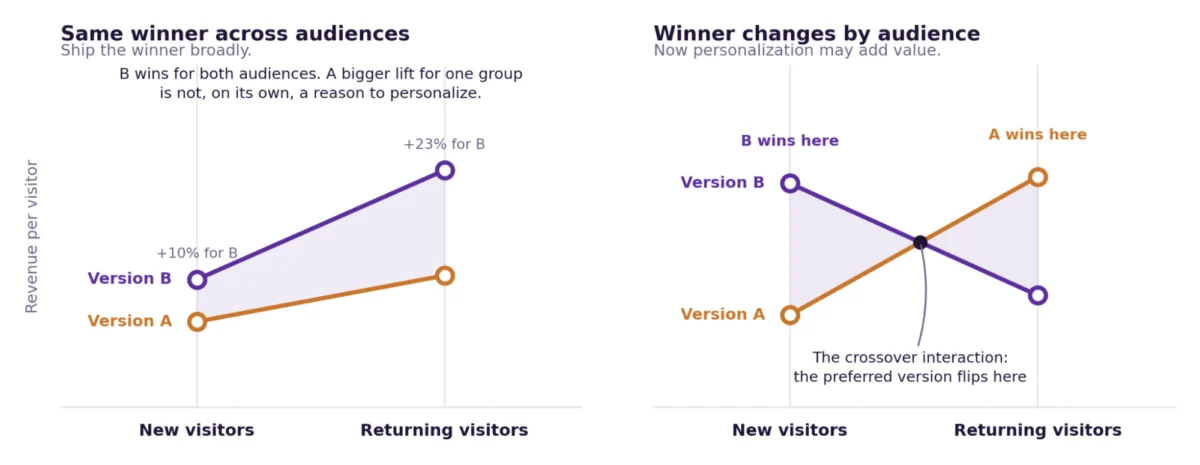
To understand why so many personalization efforts fail, one must look at the "Crossover Interaction." The common assumption is that different customer segments automatically require different experiences. This is a fallacy.

Consider a standard A/B test on a product page. Version B outperforms Version A overall. When segmented, B shows a 3% lift for general visitors and a 9% lift for returning customers. Many teams would instinctively build a personalized experience to target returning users with Version B.
But if Version B is the superior choice for both groups, why incur the cost of managing two separate experiences? The case for true personalization only begins when the "winner" actually changes—for instance, if Version A wins for new users while Version B wins for returning users. If the same version wins for everyone, the additional rules, QA cycles, and maintenance required for personalization are simply a net loss to the bottom line.
Supporting Evidence: The Wharton Field Studies
Recent research from Wharton, led by Anya Shchetkina and Ron Berman, quantified this phenomenon. They conducted two large-scale field studies using five common personalization methods. Despite both studies having similar setups and roughly 20 variations, the outcomes were vastly different: in one, personalization outperformed a single-rollout strategy by 18%; in the other, by only 4%.
The differentiator was not the technology, but the quality of the data in identifying groups that responded differently to the stimuli. This confirms a counter-intuitive truth: collecting more data is useless if it does not highlight meaningful differences in customer response.
Diagnostic Framework: The Four-Question Test
Before a team invests in a new personalization rule, they should subject the initiative to a four-question diagnostic. If the answer to any of these is "no," the most fiscally responsible decision is to deploy the best-performing experience broadly.
- Does the winner change, or is it just a magnitude shift? You are looking for a "flip" in preferences. A higher lift in a specific segment is a reason to launch faster, not a reason to build a specialized experience.
- Was the segment defined a priori? If you slice the data after the fact, you are engaging in "data dredging." Any pattern found should be treated as a new hypothesis for a future test, not as a conclusive win.
- Is the signal actionable in time? If you cannot identify the customer segment until after the checkout process, the personalization is technically impossible to deliver during the decision-making phase.
- Does the ROI exceed the total cost of ownership? Personalization is not free. It involves ongoing maintenance, content production, platform fees, and reporting.
The Math of Profitability: Official Economic Perspectives
Finance departments often look at marketing ROI differently than growth teams. Growth teams look at lift; Finance looks at incremental profit minus incremental cost.

Consider a scenario where a personalization rule generates a 3% lift. If that lift represents $11,500 in incremental annual profit, but the operational cost of maintaining that rule (QA, content updates, platform overhead) is $18,000, the "win" is actually a $6,500 loss.
Minimum Lift Formula:
Annualized Incremental Cost ÷ Annual Profit from Eligible Group = Required Lift
In a documented case within the travel and hospitality industry, a team identified a personalization opportunity for repeat visitors that resulted in a 6% lift. While the lift seemed impressive, the total incremental profit ($13,500) was eclipsed by the $15,000 annual cost to support the rule across seasonal changes and technical maintenance. The team wisely abandoned the project, reallocating those resources toward a broader, high-impact site navigation improvement.
Implications for Modern Optimization Strategy
The implication for leadership is clear: stop measuring "wins" and start measuring "program contribution."
1. The Persistent Holdout
To truly understand the value of an optimization program, teams should implement a persistent holdout group—a small, randomized cohort of users who are never exposed to any personalization. By comparing this group against the rest of the site, leadership can see the true, cumulative impact of the program, stripped of the "noise" of individual test results.
2. Moving from Data Collection to Data Utility
If your test history reveals very few "crossover" opportunities, it is not a sign of failure. It is a signal that your current data strategy is not capturing the right behavioral signals. Instead of running more tests on the same segments, teams should focus on building unified customer profiles. Utilizing platforms like the Wingify Data Platform can help aggregate behavioral and CRM data to form better, more testable hypotheses.
3. The Shift in Focus
Personalization should be treated as an exception, not the rule. The most successful organizations are those that use experimentation to find universal truths about their customers, and then use personalization as a scalpel to address specific, validated differences in customer response.
Conclusion: The Path Forward
The era of "personalize everything" is waning, replaced by a more rigorous, economically driven approach. The goal is no longer to demonstrate the ability to segment, but to demonstrate the wisdom to choose where segmenting actually pays off.
By auditing past tests for genuine crossover interactions, calculating the break-even point before development begins, and maintaining a persistent holdout to measure real program impact, businesses can move away from vanity metrics. In doing so, they not only save on unnecessary operational costs but also ensure that when they do invest in personalization, the results are significant, defensible, and ultimately profitable.
The next time a team presents a "winning" personalization, the question shouldn’t be "How much lift did we get?" but rather, "How much profit did we create, and could we have gotten the same result without the extra work?" The answer to that question is the true measure of a mature, data-driven culture.



