










In the high-velocity world of Direct-to-Consumer (D2C) fashion, the journey from a niche startup to a mainstream brand is rarely linear. Bewakoof, the iconic lifestyle brand that defined urban youth fashion for a generation of millennials and Gen Z, finds itself at a critical crossroads. After a promising fiscal year in 2025 where the brand demonstrated a clear path toward fiscal discipline, its FY26 performance reveals a complex, dual-sided narrative: robust top-line expansion coupled with a widening bottom-line deficit.
As the brand navigates a transition in leadership and integrates further into the Aditya Birla Fashion and Retail (ABFRL) ecosystem, its latest financial results offer a case study in the challenges of scaling operations while managing mounting overheads in an increasingly crowded market.
The Financial Snapshot: A Tale of Two Metrics
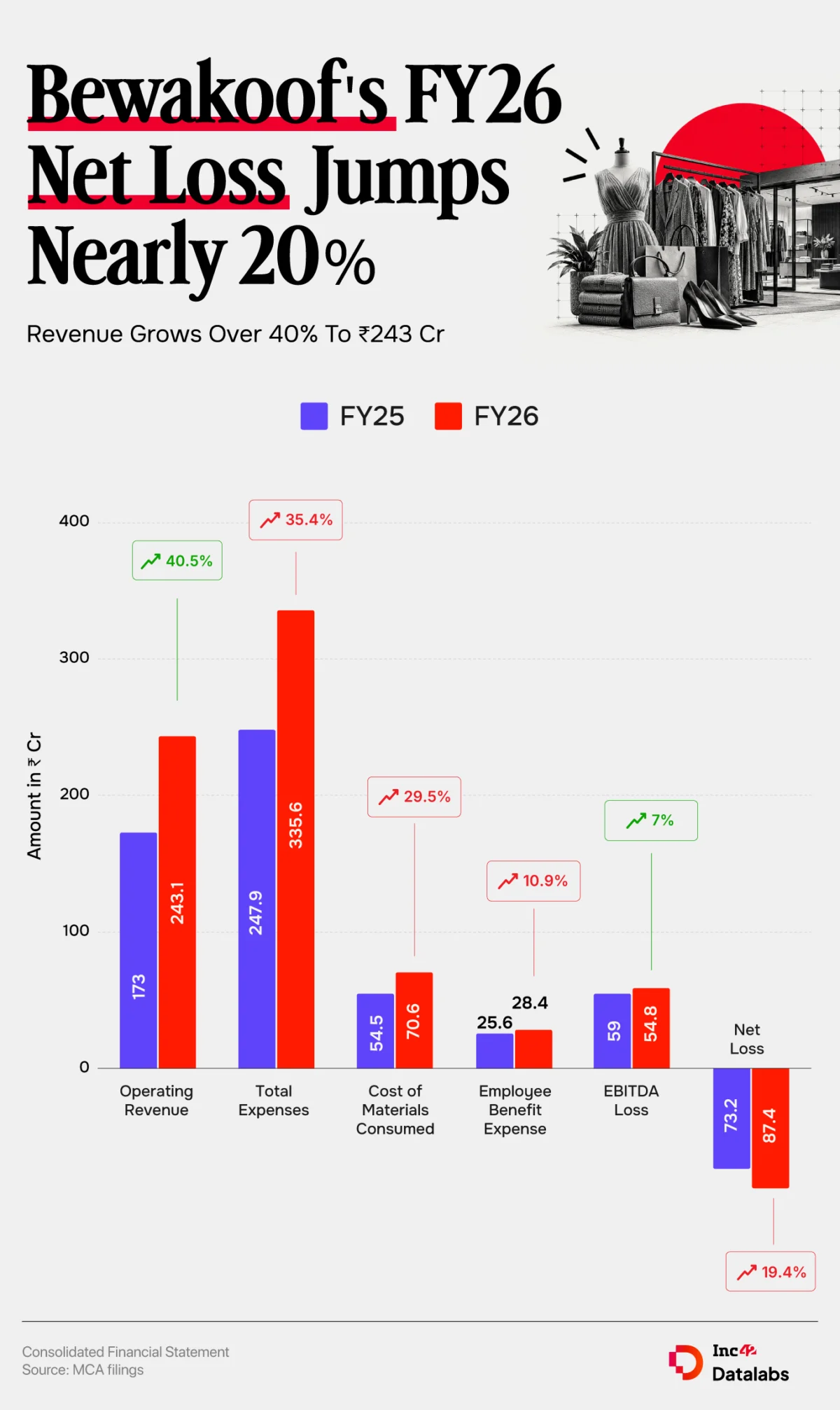
The fiscal year ending March 2026 was marked by aggressive growth for Bewakoof. The company reported a significant surge in its operating revenue, which climbed to ₹243.1 Cr—a healthy 40.6% increase over the ₹173 Cr generated in FY25. When accounting for an additional ₹5 Cr in "other income," the brand’s total income for the year reached ₹248.2 Cr.
However, this top-line success was overshadowed by a regression in net profitability. Bewakoof’s net loss widened by 19.4%, rising to ₹87.4 Cr from the ₹73.2 Cr loss reported in the previous fiscal year. This reversal is particularly notable because it breaks a positive momentum streak; in FY25, the brand had successfully improved its bottom line by 29% year-on-year, signaling to investors that it had mastered the art of unit economics.
Despite the rise in net losses, there is a silver lining buried in the operating margins. The company’s EBITDA loss narrowed by 7.2%, dropping to ₹54.8 Cr from ₹59 Cr in FY25. This suggests that while non-operating costs and depreciation pressures are weighing on the final balance sheet, the core business operations are becoming incrementally more efficient.
A Chronology of Evolution: From Startup to ABFRL Subsidiary
To understand the current fiscal state, one must look at the trajectory of the company since its inception. Founded in 2012 by Prabhkiran Singh, Bewakoof carved a unique identity by offering quirky, pop-culture-infused apparel, accessories, and lifestyle products. It was one of the first brands in India to truly tap into the "Gen Z" aesthetic at scale, eventually becoming a household name among urban youth.
Key Milestones:
- 2012: Bewakoof is launched, focusing on a lean D2C model.
- 2022 (Late): Aditya Birla Fashion and Retail (ABFRL), through its digital-first subsidiary TMRW, announces a strategic move to acquire a majority stake in the brand for ₹200 Cr.
- February 2023: The acquisition process is officially finalized, marking a new chapter for the startup under the corporate umbrella of ABFRL.
- 2025: The company reports a 29% improvement in its bottom-line performance, showcasing the impact of the new ownership’s focus on sustainable growth.
- March 2026: Founder Prabhkiran Singh announces his decision to step down from his leadership role to pursue personal ventures, coinciding with a fiscal year of mixed results.
The transition from an independent, founder-led startup to a subsidiary of a retail conglomerate is a delicate process. The current financial data reflects the growing pains associated with this integration, as the company scales its logistics and inventory management to match the expectations of a large-scale retail partner.
Dissecting the Expenditure: Where Did the Money Go?
The primary driver behind the widening net loss was a substantial increase in total expenses, which ballooned by 35.4% to reach ₹335.6 Cr. To understand why Bewakoof struggled to bridge the gap despite a 40% revenue jump, it is necessary to examine the individual cost centers.
1. The Rising Cost of Production and Inventory
Bewakoof saw a marked increase in its supply chain costs. The "Cost of Materials Consumed" rose by 29.6% to ₹70.6 Cr, up from ₹54.5 Cr in the previous year. Even more significant was the "Purchases of Stock-in-Trade," which jumped by a staggering 67.4% to ₹63.6 Cr. This indicates that the company significantly ramped up its inventory procurement, likely in anticipation of higher demand or as part of a strategy to diversify its product catalog across more categories.
2. Personnel and Operations
Employee benefit expenses grew by 10.6% to ₹28.4 Cr. While this is a relatively modest increase given the scale of revenue growth, it reflects the company’s investment in human capital as it scales its operations.

3. Depreciation: The Non-Cash Weight
Perhaps the most notable spike was in depreciation, depletion, and amortization expenses, which more than doubled from ₹6.1 Cr in FY25 to ₹16.6 Cr in FY26. This surge suggests significant capital expenditure, likely in technology infrastructure, warehouse automation, or the physical assets necessary to facilitate the company’s expansion.
4. Marketing and Overheads
"Other Expenses," which include marketing, promotion, office costs, and logistics, rose by 20.9% to ₹146.6 Cr. In the fiercely competitive Indian D2C landscape—where players like The Souled Store, Snitch, and MyDesignation are vying for the same demographic—customer acquisition costs remain high. The brand clearly chose to spend aggressively to maintain its market share against these emerging rivals.
Implications for the Future: Navigating Leadership and Strategy
The upcoming period for Bewakoof is fraught with uncertainty and opportunity. The most pressing matter is the departure of founder Prabhkiran Singh. In the world of D2C, founders are often the "soul" of the brand; their exit can impact everything from company culture to brand identity.
Leadership Transition
As of the close of FY26, Bewakoof has yet to fully clarify its long-term leadership structure. Whether the brand will be integrated further into the TMRW ecosystem or if a new CEO will be brought in to inject fresh strategy remains the subject of intense speculation. A stable, decisive transition will be critical to reassure investors and stakeholders that the brand’s identity will remain intact.
Competitive Pressure
The D2C fashion space is no longer the "blue ocean" it was when Bewakoof began. Today, the market is saturated with high-quality, agile competitors. The increase in inventory purchases suggests that Bewakoof is betting on a broader product range to maintain its competitive edge. However, the rise in costs highlights the razor-thin margins of the apparel industry, where even a slight miscalculation in inventory turnover can lead to significant financial drag.
Path to Profitability
While the EBITDA loss has narrowed, the widening net loss indicates that the company is currently prioritizing growth over immediate bottom-line stability. For a brand backed by a major conglomerate like ABFRL, this strategy is likely intentional—investing heavily now to capture market share and achieve the scale required for long-term dominance.
However, investors and industry analysts will be watching the next fiscal year closely. The pressure will be on to demonstrate that the increased spending in FY26 was an investment in capacity rather than a sign of operational bloat.
Conclusion: The Road Ahead
Bewakoof stands at a pivotal juncture. Its ability to grow revenue by 40% in a challenging macroeconomic environment is a testament to the enduring strength of its brand and its resonance with the youth demographic. Yet, the 19.4% jump in net losses serves as a sobering reminder of the volatility inherent in the D2C model.
As the company enters the next phase of its lifecycle—post-founder, post-integration—the focus must shift from growth-at-any-cost to disciplined, sustainable expansion. Whether it can leverage its backing from TMRW to optimize its supply chain and reduce its reliance on aggressive, high-cost marketing will ultimately determine if it remains a market leader or faces further erosion of its fiscal health.
For the millions of customers who identify with the "Bewakoof" brand, the hope remains that the company can reconcile its creative, youthful spirit with the rigorous demands of modern corporate finance. The coming year will not just be about revenue figures; it will be about proving that the brand has the agility to survive in an increasingly sophisticated Indian retail landscape.



