










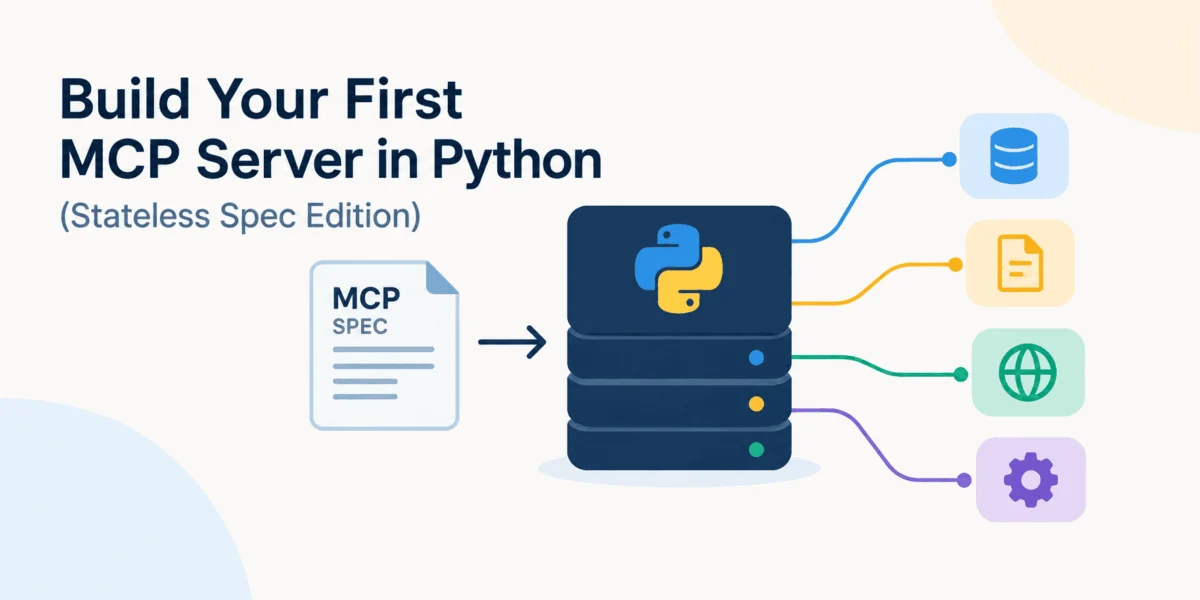
In the rapidly evolving ecosystem of Large Language Models (LLMs), the Model Context Protocol (MCP) has emerged as the definitive standard for bridging the gap between AI reasoning engines and the vast, fragmented world of external data and tools. This summer, the MCP specification underwent a transformative update—the move to a stateless core—marking a pivotal shift in how developers architect AI-integrated systems.
This article explores the mechanics of the 2026-07-28 MCP specification, examines the streamlined development experience offered by the new Python SDK v2, and provides a comprehensive guide to building scalable, production-ready MCP servers.
The Core Shift: Why Statelessness Matters
For most of the protocol’s early life, MCP functioned under a stateful assumption. Clients were required to establish a formal protocol session with a server, often relying on session identifiers (Mcp-Session-Id) to maintain context across multiple interactions. While functional for simple local deployments, this architecture introduced significant overhead for cloud-native, distributed, and high-concurrency environments.
The July 2026 update fundamentally re-engineered this relationship. Modern MCP clients no longer need to perform a multi-step handshake to establish a session before transmitting requests. By decoupling the protocol from persistent session state, the MCP architecture now aligns with the principles of modern, stateless HTTP infrastructure.
The Implications for Scalability
This transition is not merely a cosmetic cleanup; it is a architectural leap. Under the old stateful model, scaling an MCP server required "sticky" routing—ensuring that subsequent requests from a client were routed to the exact server instance that held the session state.
With the current stateless specification, every request is self-contained. A load balancer can distribute incoming MCP traffic across a fleet of workers (e.g., via uvicorn workers or Kubernetes pods) without worrying about session affinity. If "Request A" hits Worker 1 and "Request B" hits Worker 2, the server remains fully capable of processing the instruction, as all necessary context is provided within the request payload itself.
The Developer Experience: Python SDK v2
Alongside the protocol changes, the official Python SDK has matured into its v2 stable release. The highlight of this release is the MCPServer API, a high-level abstraction that allows developers to define tools, resources, and prompts using standard, idiomatic Python.
Gone are the days of manually constructing complex JSON schemas or maintaining bloated manifest files. By leveraging Python’s type-hinting system, the SDK automatically infers input schemas, making the development process feel less like building a communication protocol and more like writing standard library code.
Step-by-Step: Building a Knowledge-Base Server
To illustrate this, let’s build a "Developer Support Knowledge-Base" (KB) server. This server will provide three core primitives: a Tool for searching documentation, a Resource for listing available articles, and a Prompt for drafting support replies.
1. Project Initialization
First, ensure you have Python 3.10 or newer. We recommend using uv for modern project management:
mkdir first-mcp-server
cd first-mcp-server
uv init
uv add "mcp[cli]"
2. Defining the Server
The MCPServer class serves as the central orchestrator. It allows you to inject metadata and instructions that guide the LLM’s behavior:
from mcp.server import MCPServer

mcp = MCPServer(
    "Developer Support KB",
    instructions="Use the knowledge-base tools to answer support questions."
)
3. Exposing Functionality via Decorators
The beauty of the v2 SDK lies in its decorator-driven design. By using @mcp.tool(), @mcp.resource(), and @mcp.prompt(), we expose logic directly to the host application.
The Tool Interface:
When we define a function like search_kb, the SDK inspects the arguments and type hints.
@mcp.tool()
def search_kb(query: str, limit: int = 3) -> list[dict]:
    """Search the support knowledge base."""
    # Logic to filter articles based on query
    ...
The LLM will automatically receive a tool definition that includes the required query parameter and the optional limit parameter, complete with its default value.
Chronology of the Specification Change
The transition to a stateless model was a deliberate, multi-phase effort by the MCP maintainers to ensure that the protocol could move beyond local testing and into enterprise-grade production environments.
- Pre-2026: MCP relied on a bidirectional, stateful model where clients and servers negotiated sessions, mimicking persistent socket connections.
- Early 2026: Engineering challenges with load balancing and horizontal scaling in cloud environments prompted a review of the session management overhead.
- July 28, 2026: The official release of the stateless MCP specification. The requirement for
Mcp-Session-Idwas deprecated for standard operations, and the protocol was optimized for request/response cycles. - Post-Release: The Python SDK v2 was introduced to wrap these low-level protocol changes in a developer-friendly API, ensuring that the transition to statelessness required minimal code refactoring for existing projects.
Architectural Patterns: Handling State Without "Sessions"
A common misconception is that a "stateless protocol" forbids an application from maintaining state. This is incorrect. The shift simply dictates that the protocol itself should not manage the application’s state.
For instance, if you are building an e-commerce integration, you should not rely on an MCP session to remember the user’s shopping cart. Instead, the application should handle state explicitly using handles or identifiers:
- Client initiates a stateful action: The server returns a
basket_id. - Client stores the handle: The LLM client keeps the
basket_idin its conversation context. - Client passes the handle: In subsequent calls (e.g.,
add_item(basket_id, product_id)), the LLM explicitly passes thebasket_idback to the server.
This "explicit-handle" pattern is robust and distributed-system friendly. It ensures that any server instance can resume the interaction, provided it has access to the underlying persistent database or cache.
Implementation Strategies for Production
Integrating with FastAPI/Starlette
For developers working within larger web applications, the MCPServer can be converted into a standard ASGI application. By using mcp.streamable_http_app(), you can mount your MCP server directly into a FastAPI instance:
from fastapi import FastAPI
app = FastAPI()

# Mount the MCP server
mcp_app = mcp.streamable_http_app()
app.mount("/mcp", mcp_app)
This integration is ideal for companies that wish to expose their internal tools through both a REST API and an MCP-compatible interface for LLM agents.
The Development Loop
The inclusion of the mcp dev command in the CLI is a game-changer for the debugging process. By running uv run mcp dev server.py, developers gain access to an automated Inspector UI. This tool allows for the real-time inspection of available tools, testing of input schemas, and validation of tool responses, effectively eliminating the need to write separate test scripts during the initial development phase.
Implications for the AI Ecosystem
The move to a stateless MCP standard is a significant milestone for the democratization of AI agents. By making it trivial to build and deploy servers that can connect to any MCP-compliant LLM host (such as Claude, Cursor, or custom agents), the protocol effectively lowers the barrier to entry for:
- Enterprise Tooling: IT teams can expose internal company documentation and HR policies through an MCP interface, allowing employees to query internal knowledge using natural language.
- Tool-Augmented Agents: Developers can build highly specialized, domain-specific tools that can be "plugged in" to any agentic workflow without worrying about deployment complexity.
- Standardized Interoperability: With a unified protocol, the ecosystem moves toward a world where tools are reusable across different LLM vendors, reducing vendor lock-in and fostering a marketplace of "AI-ready" software.
Conclusion: The Path Forward
The 2026-07-28 MCP specification update represents the maturation of the protocol from an experimental concept to a production-grade standard. By adopting a stateless core and a high-level SDK, the MCP team has addressed the primary hurdles of scalability and developer experience.
For developers, the message is clear: the architecture of the future is stateless, request-driven, and explicitly managed. Whether you are building a simple developer knowledge base or a complex enterprise integration, the new Python SDK provides the tools required to scale your AI capabilities effectively. As the ecosystem continues to grow, mastering these stateless patterns will be essential for anyone looking to build robust, future-proof AI-integrated systems.
About the Author:
Kanwal Mehreen is a Machine Learning Engineer and technical writer specializing in the intersection of AI and data science. A Google Generation Scholar and advocate for diversity in STEM, she is dedicated to simplifying complex architectural shifts for the next generation of software developers.



