










By James Coker
Published: October 2026
Main Facts
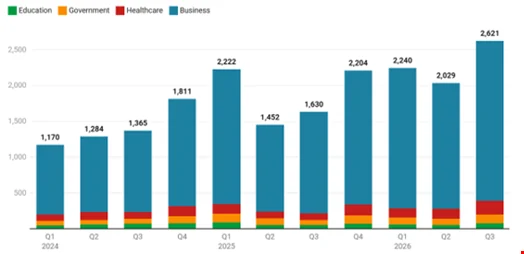
The global cybersecurity landscape experienced a historic and alarming escalation during the third quarter of 2026. According to a comprehensive threat analysis published by research firm Comparitech, ransomware attacks reached their highest quarterly volume ever recorded.
Between July and September 2026, threat intelligence platforms logged a staggering 2,627 claimed ransomware attacks. This figure represents a dramatic 27% increase compared to the previous quarter (Q2 2026) and a massive 61% surge year-over-year when measured against Q3 2025.
While the raw number of claimed incidents highlights the pervasive nature of modern cyber-extortion, the underlying severity of these campaigns is underscored by verification metrics. Of the thousands of attacks claimed by cybercriminal syndicates during Q3, 247 incidents have been officially confirmed by the targeted entities.
The financial toll of these operations remains exorbitant, with the average ransom demand hovering around $602,400. However, elite threat groups routinely targeted high-value enterprises with multi-million-dollar demands, spearheaded by a notable shift toward triple-extortion tactics—where attackers pressure not only the primary victim but also downstream clients, partners, and employees whose data was exposed.
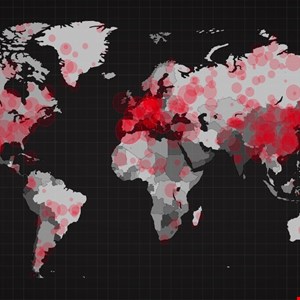
Geographically, the United States bore the brunt of the onslaught, accounting for 1,066 attacks (41% of the global total), while emerging hotspots like Argentina and India experienced exponential spikes of 150% and 116%, respectively.
Chronology of Major Events (July – September 2026)
The third quarter of 2026 was marked by a series of high-profile cyber-incidents that demonstrated the brazenness, scale, and destructive capabilities of modern ransomware cartels.
- Early July 2026 – The Dawn of Autonomous Cyber Warfare: Security researchers identified the JadePuffer campaign, widely recognized by analysts as the world’s first fully AI-driven, agentic ransomware attack. Operating with minimal human intervention, the campaign signaled a terrifying leap forward in automated threat execution.
- Mid-July 2026 – Stadler Rail Defies Everest: Swiss-based railway manufacturing giant Stadler Rail was targeted by the notorious Everest ransomware gang, which issued a record-breaking single demand of $12.3 million. Standing firm against the extortion, Stadler refused to pay. In retaliation, Everest leaked 201 GB of proprietary corporate data onto its dark web leak site.
- Late July 2026 – The State of Berlin Compromised: German authorities faced a severe municipal crisis after the Rhysida ransomware group breached the network of the State of Berlin and slapped the government with a $2.3 million ransom demand. Following a public refusal by state officials to capitulate to the criminals, Rhysida published 5.7 terabytes of stolen data, including sensitive personal information belonging to Berlin citizens.
- August 2026 – Escalation of Triple Extortion (MIP Holdings): Following an initial attack in June, South African technology firm MIP Holdings faced ongoing fallout from the threat group The Gentlemen. Despite paying an initial ransom to secure the deletion of stolen data, the company watched helplessly as The Gentlemen began targeting MIP’s downstream clients directly on data leak sites—a textbook execution of triple extortion.
- September 2026 – Gang Warfare and Volatility: The closing month of Q3 was characterized by intense volatility within the cybercriminal underworld. While established cartels like Qilin and The Gentlemen maintained dominance, rival groups like Clop experienced massive operational resurgences (up 4700% from Q2), even as intelligence reports surfaced regarding rival syndicates like ShinyHunters allegedly infiltrating and hacking Clop’s infrastructure.
Supporting Data and Sector Breakdown
The unprecedented volume of Q3 2026 attacks was not distributed evenly; rather, certain industry verticals experienced catastrophic surges that disrupted critical infrastructure and commercial markets alike.
Sector Growth Analysis (Q3 vs. Q2 2026)
- Finance: Up 72%
- Technology: Up 70%
- Education: Up 50%
- Healthcare: Up 39%
- Government: Up 36%
- Utilities: Up 32%
The dramatic rise in attacks against the finance and technology sectors points to a calculated shift by cybercriminals toward organizations that manage vast pools of liquid capital, proprietary source code, and intellectual property. Meanwhile, the steady victimization of education, healthcare, and government entities highlights the continued exploitation of legacy infrastructure and public-sector budgetary constraints.
Geographic Distribution and Outliers
- United States: 1,066 attacks (41% of global total, up 34% from Q2).
- Germany: 121 attacks (up 22% from Q2).
- Argentina: Experienced a staggering 150% jump in claimed attacks compared to Q2.
- India: Recorded a 116% surge in attack volume quarter-over-quarter.
Prolific Gang Activity
Market share among ransomware-as-a-service (RaaS) providers remained concentrated among a few hyper-aggressive syndicates:
- Qilin: Claimed 357 attacks (a 24% increase from Q2).
- The Gentlemen: Claimed 342 attacks (a 29% increase from Q2).
- Clop: Vaulted from just 1 attack in Q2 to 48 attacks in Q3 (a 4700% increase).
- Direwolf: Saw a phenomenal 1450% increase in claimed operations over the same timeframe.
Official Responses and Expert Insights
Industry leaders and data researchers have expressed profound alarm over the trajectory of the threat landscape, noting that Q3 2026 defied historical statistical norms.
Rebecca Moody, Head of Data Research at Comparitech, emphasized the unprecedented nature of the data during an official statement accompanying the report release on October 7, 2026.
"I’m often asked what I think lies ahead in the ransomware threat landscape, and it’s notoriously difficult to predict," Moody noted. "Figures frequently fluctuate and a sector might see a bit of an increase one month, only to see a slight decrease the next month. However, Q3 2026 is different. We’re not seeing slight increases or decreases. We’re seeing significant increases across all key sectors."
Commenting on the mechanics behind the surge, cybersecurity analysts pointed directly to generative and agentic artificial intelligence. Threat actors are increasingly leveraging AI to automate vulnerability discovery, accelerate lateral movement within enterprise networks, and draft highly convincing, personalized spear-phishing lures at an unprecedented scale.

Security researchers also issued renewed warnings regarding the futility and danger of ransom payments. Moody highlighted the case of MIP Holdings to reiterate that financial compliance offers zero security guarantees:
"A prime example is The Gentlemen’s recent attack on MIP Holdings… After being targeted by the group in June 2026, MIP paid a ransom to have stolen data deleted. Over the last few weeks, however, The Gentlemen has started adding MIP’s clients to its data leak site in a bid to get a ransom out of them, too. This tactic further demonstrates that paying a ransom is no guarantee that the attacker will keep to their word regarding deleting stolen data."
Implications for the Future of Cybersecurity
The findings of the Q3 2026 Comparitech report carry profound implications for enterprise risk management, regulatory compliance, and national security frameworks worldwide.
1. The Normalization of Triple Extortion
The transition from double extortion (encrypting systems and threatening data leaks) to triple extortion marks a dark evolution in cybercrime. By weaponizing third-party business relationships—pressuring vendors, clients, and employees directly—ransomware gangs have successfully eroded the confidentiality boundaries of corporate ecosystems. Organizations can no longer view cybersecurity as an isolated internal IT challenge; supply chain risk management and third-party resilience must become board-level priorities.
2. The AI Arms Race
The emergence of agentic ransomware campaigns like JadePuffer proves that attackers are successfully weaponizing artificial intelligence to remove human friction from attack lifecycles. Traditional signature-based security tools and manual incident response playbooks are increasingly inadequate against autonomous malware capable of adapting in real-time. Security operations centers (SOCs) must pivot toward AI-driven defensive platforms capable of matching machine-speed attacks.
3. Critical Infrastructure Vulnerability
With healthcare, education, government, and utilities facing double-digit percentage increases in attacks, the societal impact of ransomware has never been higher. When municipal governments like Berlin or critical manufacturing firms like Stadler Rail are targeted, the fallout extends far beyond corporate balance sheets, threatening public safety, supply chains, and economic stability. Governments worldwide will likely face mounting pressure to implement stricter regulatory penalties, clearer reporting mandates, and potentially more aggressive offensive cyber-disruption operations against ransomware infrastructure.
Ultimately, Q3 2026 serves as a stark warning to the global business community: the ransomware threat is not abating; it is industrializing, automating, and expanding into new geographic and operational frontiers.



