










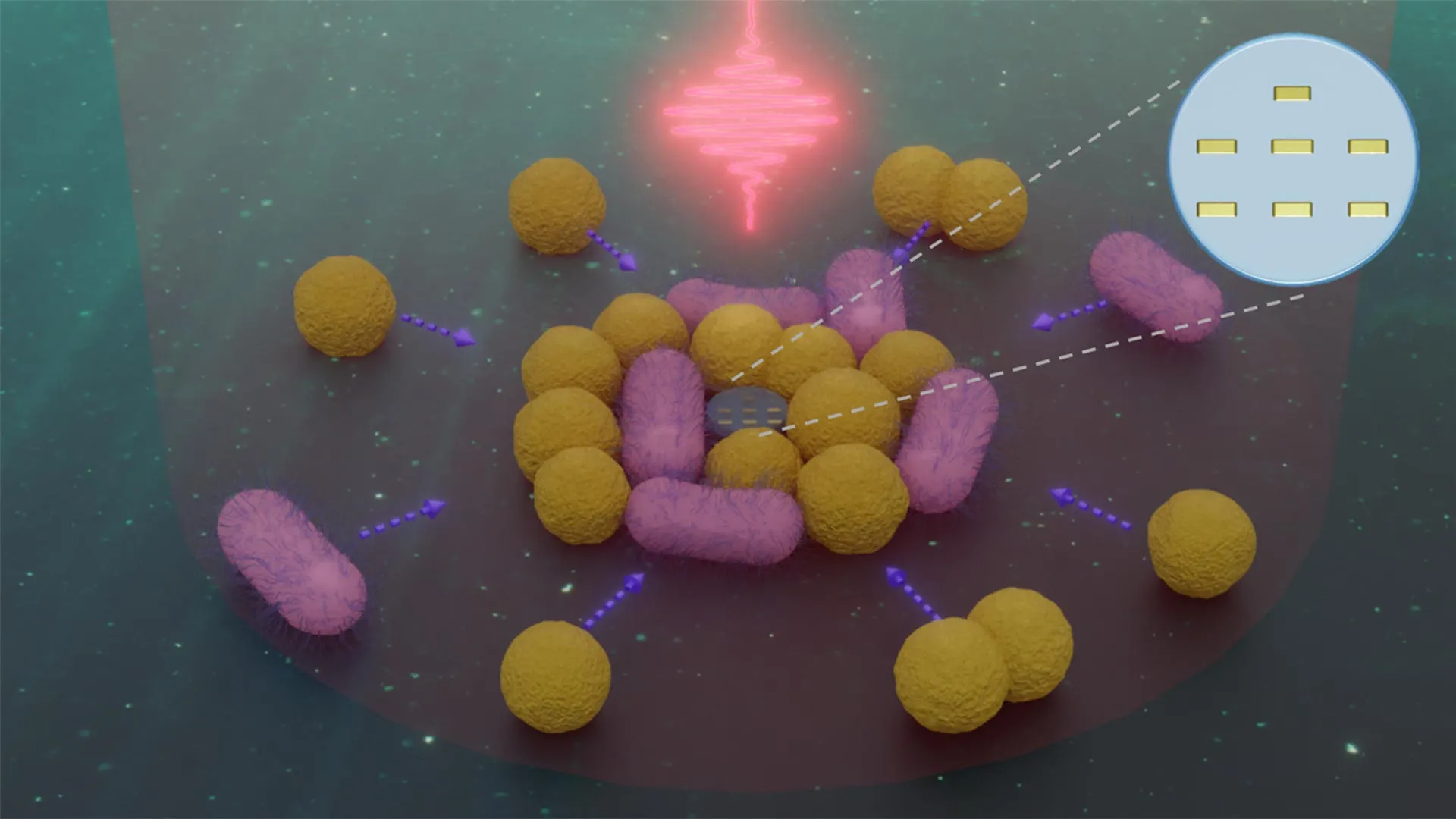
WÜRZBURG, GERMANY — For decades, the manipulation of individual biological entities has remained one of science’s most formidable frontiers. While researchers have long possessed the analytical tools to observe the microscopic universe through advanced optics, physically interacting with objects at the cellular and bacterial scale has been constrained by the limitations of macro-sized instruments. Water-borne biological materials, single cells, and floating bacteria have essentially existed behind an unbreachable barrier—too small to handle by hand, and too delicate for traditional mechanical probes.
Now, a team of physicists and materials scientists at Julius-Maximilians-Universität Würzburg (JMU) has shattered that barrier. Under the leadership of Professor Bert Hecht, researchers have developed light-powered nanorobots measuring roughly 50 times smaller than the diameter of a human hair. These sub-micron machines are capable of operating directly within the microbial realm, performing complex mechanical tasks such as collecting, transporting, and releasing individual bacteria with precision.
The breakthrough, which merges photonics, nanotechnology, and microbiology, transitions humanity from merely observing the microscopic world to actively shaping it. With applications spanning targeted biomedicine, environmental remediation, and cellular research, these "microscopic cleaners" represent a paradigm shift in how science interacts with the fundamental building blocks of life.
Main Facts
The core innovation centers on a class of sub-micron devices engineered to navigate and manipulate fluid environments at the cellular scale.
- Scale and Dimensions: The newly developed nanorobots measure less than one micrometer in size, making them approximately 50 times smaller than a human hair. This diminutive footprint allows them to operate unhindered in aqueous microscopic environments.
- Propulsion Mechanism: The devices are powered entirely by light, utilizing the minute recoil forces produced by individual photons.
- Design Architecture: Each microdrone incorporates up to four plasmonic nanoantennas alongside nanoscale antenna wires. These structures absorb specific wavelengths and polarizations of light and redirect them, generating thrust through photon momentum transfer.
- Steering and Maneuverability: By altering the polarization of the incoming laser light, operators can dictate the orientation and heading of the nanorobot. The machines exhibit exceptional agility, including the capacity to execute rapid 90-degree turns.
- Functional Capability: Demonstrating "microscopic cleaner" functionality, the robots can successfully hunt down, capture, transport, and release bacterial clusters in a controlled environment, maintaining operational integrity even under payload stress.
Chronology of the Breakthrough
The realization of light-driven microdrones did not happen overnight; it is the culmination of years of iterative engineering aimed at solving one of physics’ persistent challenges: propulsion at the nanoscale.
Early Theoretical Foundations
For years, the JMU research team led by Professor Bert Hecht investigated the physics of optical forces. Traditional micro-manipulation often relies on optical tweezers—focused laser beams that can trap and hold microscopic objects. However, optical tweezers are limited in their capacity for independent mobility and complex transport tasks. The JMU team envisioned active mobile agents: microscopic devices that could carry their own propulsion systems rather than relying entirely on external fields.
Harnessing Photon Recoil
The foundational breakthrough for the propulsion system came from exploiting radiation pressure at the microscopic scale. When light is absorbed and redirected by plasmonic structures, it transfers momentum to the material. Much like the recoil experienced when firing a firearm, redirecting photons creates a reactive force. Because the JMU microdrones possess near-negligible mass, these microscopic photon recoil forces translate into substantial acceleration and operational speeds.
Miniaturization and Simplification
Earlier iterations of light-powered devices were hindered by complex steering and control architectures, which limited how small they could be built. For their most recent study, Jin Qin and the experimental team focused heavily on design simplification. By stripping away redundant components and integrating nanoscale antenna wires, the researchers successfully reduced the robots’ footprint to under one micrometer. Crucially, this miniaturization was achieved without sacrificing propulsion efficiency or directional control.
Operational Demonstration
With the sub-micron scale achieved, the research team tested the devices in aqueous laboratory settings. The nanorobots successfully tracked, collected, and relocated living bacteria. Despite the added hydrodynamic drag and weight of carrying bacterial clusters, the robots retained full maneuverability, marking the transition of the technology from theoretical physics to functional microbiology.
Supporting Data and Technical Architecture
Operating machines at the sub-micron scale requires overcoming severe physical constraints, chief among them being the dominance of viscous forces over inertial forces (low Reynolds number regime). In water, things stop moving the instant propulsion ceases. Therefore, continuous and controllable thrust is mandatory.
[Incoming Polarized Light]
        │
        ▼
[Nanoscale Antenna Wires] ──(Aligns with Polarization)──> [Directional Control]
        │
        ▼
[Plasmonic Nanoantennas]   ──(Absorbs & Redirects Photons)──> [Photon Recoil Thrust]
        │
        ▼
[Sub-Micron Robot Body]    ──(Propels & Executes 90° Turns)──> [Bacterial Collection/Transport]
Plasmonic Nanoantennas and Momentum Transfer
The engine of the JMU nanorobot relies on plasmonics—the study of the interaction between electromagnetic field light and free electrons in metals. The microdrones are equipped with specialized plasmonic nanoantennas tuned to absorb light of a specific color and helicity (circular polarization).
When photons strike these nanoantennas, they are scattered in a preferential direction. According to the conservation of momentum, the directional emission of photons imparts a reactive recoil force onto the device. Because the mass of the nanorobot is measured in picograms, even the pico-Newtons of force generated by photon scattering are sufficient to propel the device at practical speeds through liquid media.
The Polarization Steering Mechanism
Steering a machine smaller than a bacterium presents immense engineering hurdles; mechanical rudders or onboard electrical motors are impossible at this scale. The JMU team solved this by utilizing built-in nanoscale antenna wires.
These microscopic wires naturally align themselves with the polarization vector of the illuminating laser light. By dynamically adjusting the polarization angle of the external light source, operators can rotate the robot instantly. Combined with continuous photon recoil propulsion, this creates an intuitive steering mechanism analogous to directional control in macro-scale vehicles.
Fluid Dynamics and Payload Performance
Laboratory trials revealed specific behavioral metrics regarding the robots’ performance:
- Turning Radius: The microdrones can execute sharp 90-degree turns almost instantaneously, allowing them to raster-scan broad areas of a microscopic slide efficiently.
- Load Handling: While transporting groups of bacteria, the robots experience a measurable decrease in top speed due to hydrodynamic drag and added mass. However, their steering fidelity and structural integrity remain uncompromised, proving their viability as functional cargo haulers in dense microbial suspensions.
Official Responses and Perspectives
The publication of the JMU findings has drawn significant attention from the international physics and biology communities, highlighting the collaborative and visionary nature of the work.
Jin Qin, the lead experimental scientist on the study, emphasized the practical transformation of the research into tangible utility:
"In essence, we have built a light-driven nanorobot that can track down and collect bacteria," Qin stated. "By simplifying the design, we reached a size at which these robots can operate directly in the microbial world—almost like microscopic cleaning devices."
Qin further highlighted the precision of the platform:
"They are exceptionally agile. Being able to make rapid 90-degree turns allows us to navigate complex biological landscapes in an organized, highly efficient manner without losing our cargo."
Professor Bert Hecht, who spearheaded the overarching research initiative at JMU, placed the achievement into a broader philosophical and technological context:
"This is a striking example of how light can be used not only to observe the microscopic world, but also to actively shape it," Hecht noted. "The idea of tiny robotic cleaners may sound futuristic, but we are already demonstrating the physical principles that make it possible."
Hecht underscored that while the current demonstrations have taken place under controlled laboratory conditions, the underlying physics are robust, paving the way for scalable real-world applications where precision and non-invasive control are paramount.
Implications for Science, Medicine, and Industry
The successful deployment of light-powered sub-micron robots opens up vast horizons across multiple scientific disciplines. While the technology is currently in its experimental phase, the long-term implications are profound.
1. Advanced Microbiology and Cellular Research
In standard microbiological research, sorting and isolating specific cells or bacteria often relies on bulk chemical methods, fluorescence-activated cell sorting (FACS), or clumsy microfluidic channels. Light-driven nanorobots offer an unprecedented degree of individual spatial control. Researchers can theoretically isolate a single mutated bacterium from a mixed colony in real-time, extract it, and transport it to an isolated observation chamber for genetic or metabolic sequencing.
2. Targeted Biomedical Interventions
The concept of "microscopic cleaners" hints at futuristic medical applications. While deploying light-driven nanorobots inside the human bloodstream presents immense biocompatibility and optical penetration challenges, localized treatments—such as clearing biofilms from medical implants, targeting localized infections in surface tissues, or assisting in micro-surgery—move closer to feasibility. Because light can be delivered via fiber optics, minimally invasive surgical probes could one day deploy and guide these microdrones within targeted bodily cavities.
3. Materials Science and Nanofabrication
Beyond biological applications, the ability to manipulate objects at the sub-micrometer scale using light fields has direct relevance to nanotechnology. Constructing nano-scale circuits, assembling quantum dots, or positioning carbon nanotubes requires mechanical precision that matches or exceeds current robotic pick-and-place systems. Light-driven microdrones could serve as autonomous assembly workers in cleanroom environments, building complex nanostructures atom-by-atom or molecule-by-molecule.
4. Environmental Monitoring and Remediation
Microbial ecosystems play a critical role in environmental health. Light-powered nanorobots could be deployed to analyze water purity by selectively capturing pollutant-absorbing bacteria, isolating harmful pathogens from water samples, or assisting in the remediation of micro-polluted aquatic environments.
Conclusion
The JMU research team’s achievement marks a definitive milestone in our mastery of the physical world. By cleverly harnessing the momentum of individual light particles and coupling it with ingenious nanoscale engineering, Professor Bert Hecht, Jin Qin, and their colleagues have transformed photonics from a passive window of observation into an active tool of manipulation.
As these light-powered microdrones transition from laboratory novelties to robust utility tools, the boundary between the macroscopic human experience and the microscopic domain continues to blur. Whether clearing bacterial pathways, sorting single cells, or laying the groundwork for advanced nanomanufacturing, these tiny robots prove that the future of technology is not just getting smaller—it is learning to work with the very light that illuminates it.



