










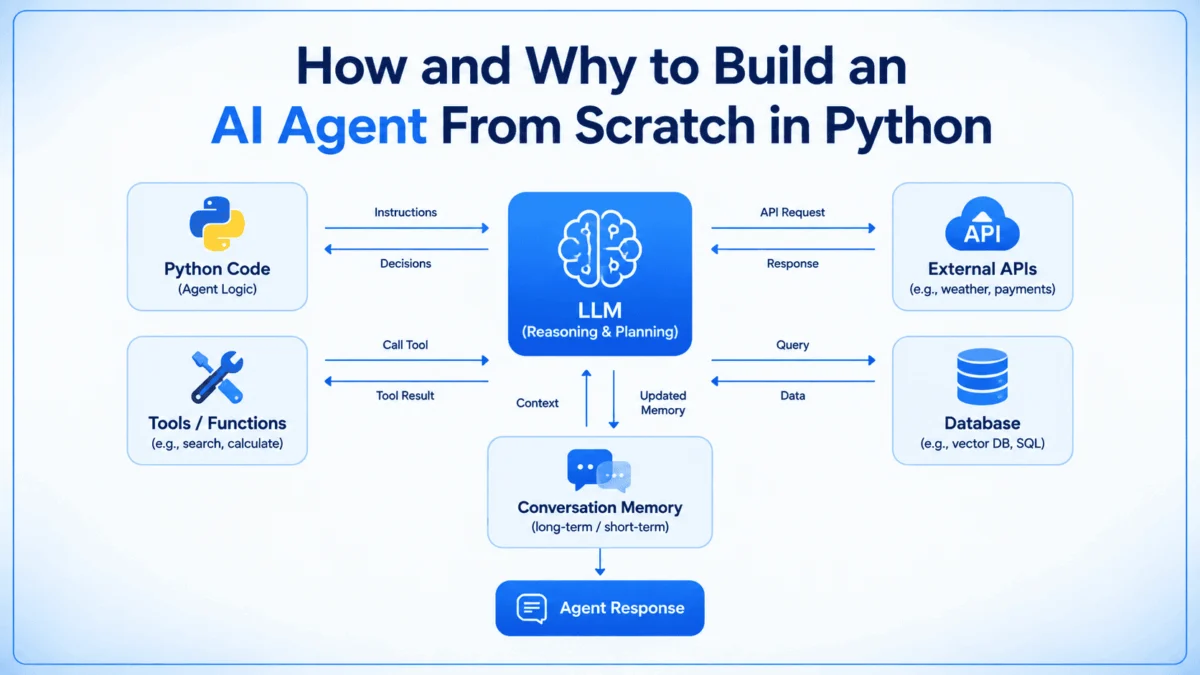
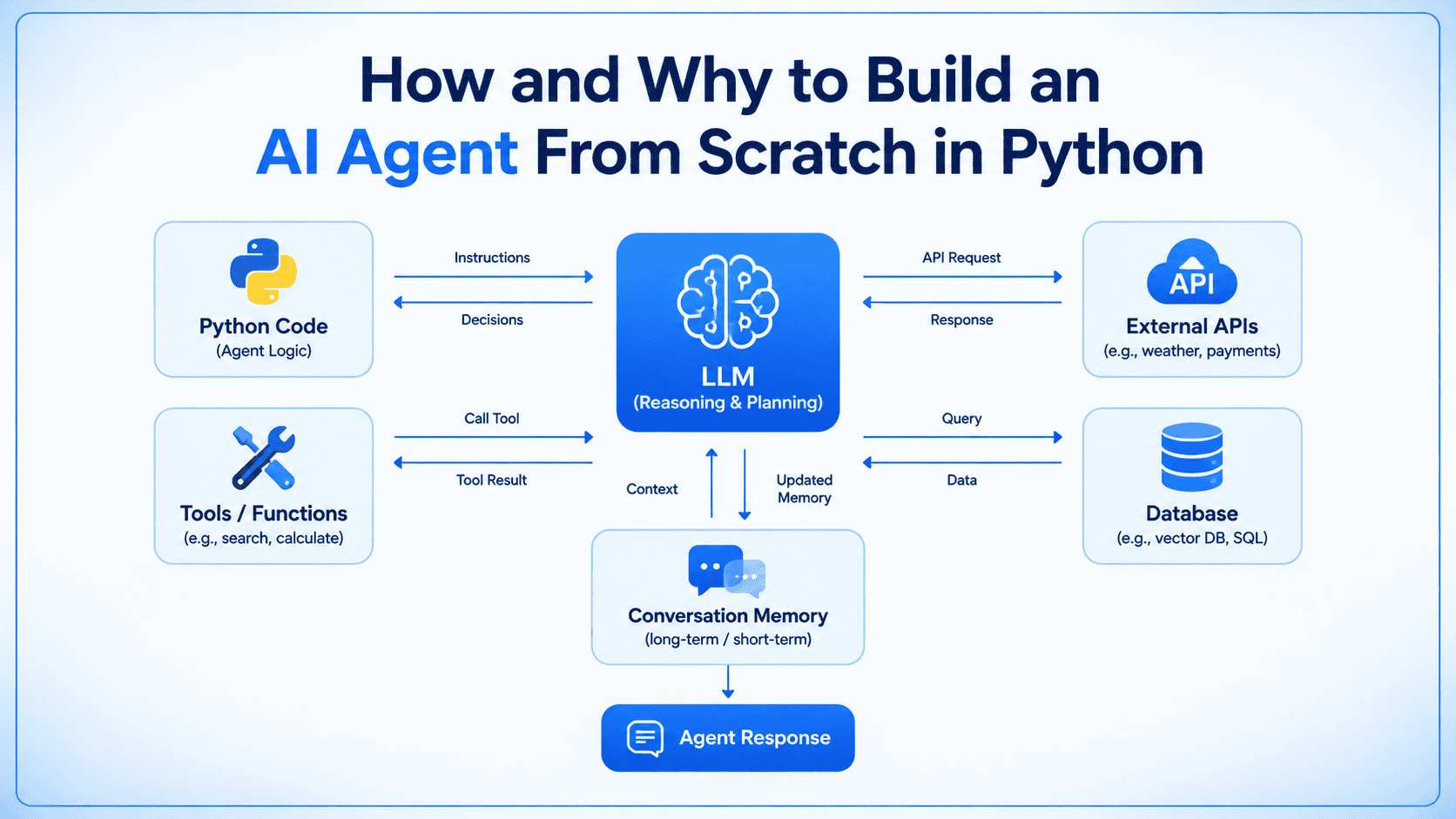
In the rapidly evolving landscape of artificial intelligence, the term "AI agent" is frequently tossed around as a buzzword, often tethered to complex orchestration frameworks that promise to simplify the development process. However, beneath the layers of abstraction lies a surprisingly elegant and understandable architecture. By stripping away these heavy frameworks and returning to the foundational mechanics of large language models (LLMs), developers can gain a profound understanding of how intelligent systems actually operate.
This article explores the core components of an AI agent—a model, a control loop, and a set of defined capabilities—and demonstrates how to construct one from scratch using plain Python and the Anthropic API.
The Core Concept: Moving Beyond Static Models
To understand why we need agents, we must first recognize the inherent limitations of standard LLMs. A typical interaction with a model—such as asking it to summarize a text or draft an email—is essentially a closed system. The model relies exclusively on its pre-trained knowledge. If the information is not within its training data, the model must either admit ignorance or, in some cases, "hallucinate" a plausible-sounding but incorrect answer.
An AI agent closes this "knowledge gap" by introducing the concept of tool calling. An agent is not merely a conversational partner; it is an autonomous actor capable of interacting with the world. It can query a SQL database, check a live API for shipping status, or perform complex calculations. When a user poses a question, the agent evaluates whether it has the necessary information. If it does not, it pauses its internal reasoning, requests the execution of a specific tool, processes the output, and only then provides a final, grounded response.
Why Avoid Orchestration Frameworks?
While libraries like LangChain or AutoGPT are powerful, they often hide the "plumbing" of the agent. By building from scratch, developers avoid the "black box" syndrome. You learn exactly how the conversation history is managed, how tool schemas are serialized, and how the model’s "stop reasons" dictate the flow of execution. This is not just an exercise in minimalism; it is an exercise in architectural transparency.
Chronology of Development: From Simple Calls to Autonomous Loops
Building an agent is an iterative process that moves from simple request-response cycles to stateful, autonomous loops.
Phase 1: The Basic Wrapper
The foundation is a standard API call. We utilize the Anthropic Python SDK to interface with a model like Claude. At this stage, the code is a simple function: you pass a prompt, and the model returns text.
Phase 2: Introducing Tool Definitions
The turning point in agent development is the definition of the input_schema. This schema is a JSON-like structure that informs the model about the functions available to it. It acts as a contract:
- Name: The identifier of the function.
- Description: The "instruction manual" for the model, explaining when and why it should use the function.
- Parameters: A strict definition of what arguments the function requires.
When the model is presented with this schema, it gains the ability to identify that a user’s question (e.g., "What is the status of order #4471?") requires an external data lookup.
Phase 3: The Execution Loop
The most critical advancement is the introduction of a loop. In a production-grade agent, we do not know how many tool calls are required to solve a problem. The agent might need to call a database, then pass that output to a weather service, then perform a calculation. The loop continues to run, appending the model’s requests and the subsequent tool results to the message history, until the model signals it has sufficient information to provide a final answer.
Supporting Data: Understanding the Tool Call Lifecycle
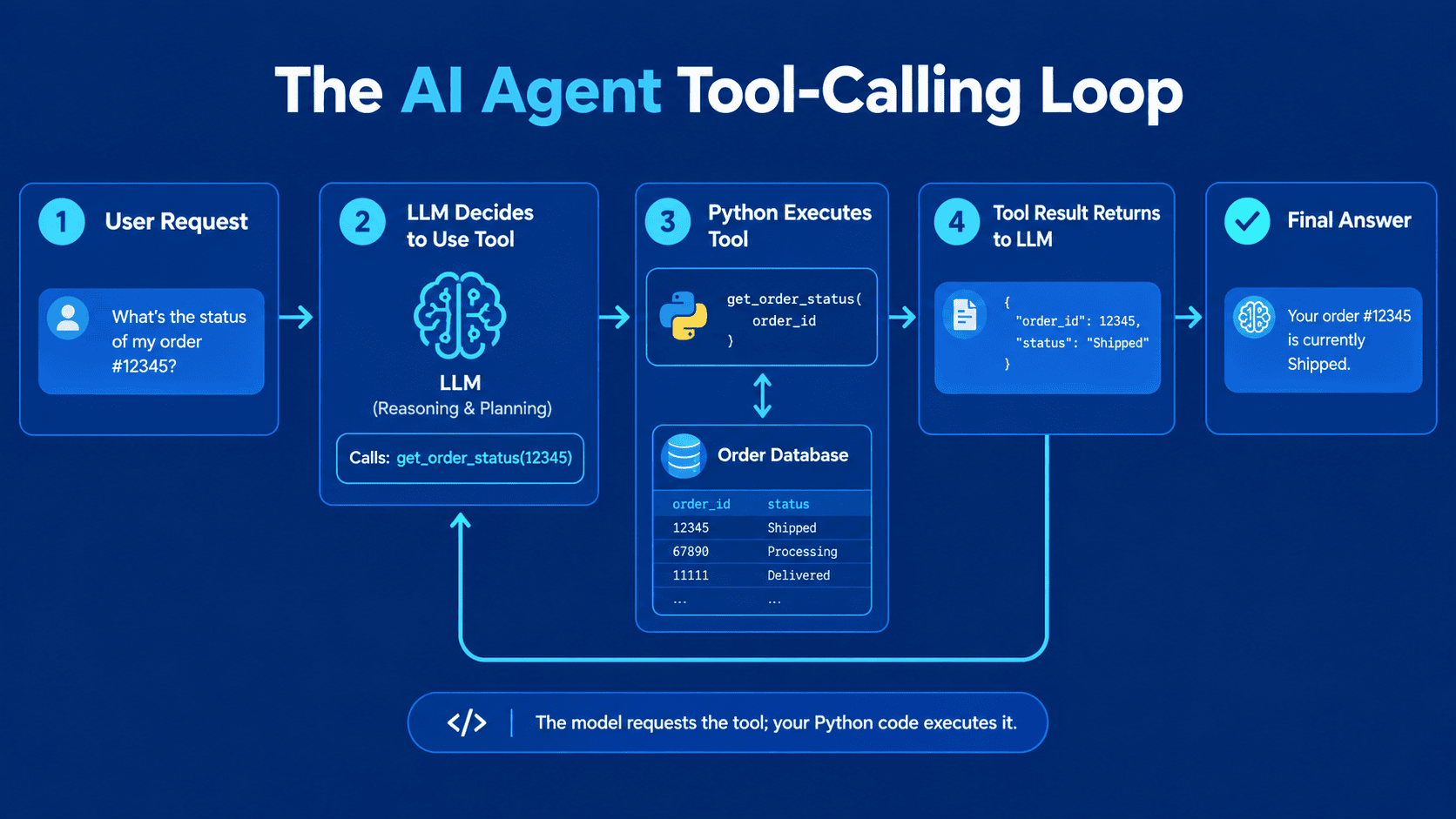
The interaction between the user, the model, and the tool can be visualized as a multi-stage data exchange.
- The User Prompt: The user asks a question that requires external data.
- The Model’s Request: The model returns a
stop_reasonoftool_use. It does not provide an answer; it provides a command. - The Execution: The Python script intercepts this command, executes the corresponding function (e.g.,
get_order_status(order_id="4471")), and captures the returned data. - The Injection: The script formats the result as a
tool_resultand appends it to the conversation history. - The Synthesis: The model processes the history (which now includes the context of the tool result) and generates the final, accurate response.
Note: As of September 2026, developers should be mindful of model lifecycle management. For example, Anthropic’s deprecation of specific models like Claude Sonnet 4.5 necessitates a modular approach to code, where model strings are easily swappable.
Official Guidelines and Best Practices
To build robust agents, developers must adhere to several best practices when implementing these systems:
- Error Handling: Always include a
max_iterationscap. Without it, a circular logic loop could cause an agent to exhaust its budget or stall indefinitely. - Schema Clarity: The "description" field in your tool schema is the most important part of the prompt engineering process. If the description is vague, the model will struggle to determine when to use the tool.
- State Management: Memory is the defining feature of a modern agent. By wrapping the logic in a class, you maintain the
messageslist as a persistent state. This allows the agent to recall context from previous turns—the difference between a "stateless" calculator and a "stateful" assistant.
Implications: The Future of Autonomous Systems
The transition from static LLMs to autonomous agents has significant implications for enterprise software.
The Rise of "Function-First" Design
As agents become more capable, software development will shift toward a "function-first" paradigm. Instead of building complex user interfaces for every internal database query, developers will expose high-quality, well-documented functions to an agent. The agent becomes the interface.
Scalability and Memory Constraints
While building a simple agent is straightforward, scaling it presents challenges. As the conversation history grows, it will eventually exceed the model’s context window. This necessitates the implementation of "memory management" techniques, such as:
- Summarization: Periodically condensing the conversation history.
- Persistence: Storing the session state in a database or cache, allowing the agent to resume long-running tasks after a process restart.
The Security Frontier
Giving an AI agent the ability to execute functions is inherently risky. If an agent can call an API to retrieve order status, can it also call an API to delete data? Robust agent design must include "guardrails" at the function level—ensuring that the agent only has the permissions required for the specific tasks it is intended to perform.
Summary and Next Steps
We have deconstructed the AI agent into its core components: a model, a message loop, and a tool-calling mechanism. By building this from scratch, we have bypassed the complexities of orchestration frameworks to reveal the elegant, functional reality of agentic AI.
The path forward for developers includes:
- Advanced Tool Orchestration: Experimenting with parallel tool calls, where the model decides to run multiple functions simultaneously.
- External Memory: Integrating vector databases to provide the agent with "long-term" memory that persists beyond a single conversation.
- Human-in-the-Loop: Implementing confirmation steps before an agent executes "write" or "delete" operations to ensure safety and control.
The era of the AI agent is not defined by the frameworks we use, but by the intelligence with which we define our tools and the constraints we place upon them. By understanding the underlying architecture, you are now equipped to build systems that are not just conversational, but genuinely capable.



