










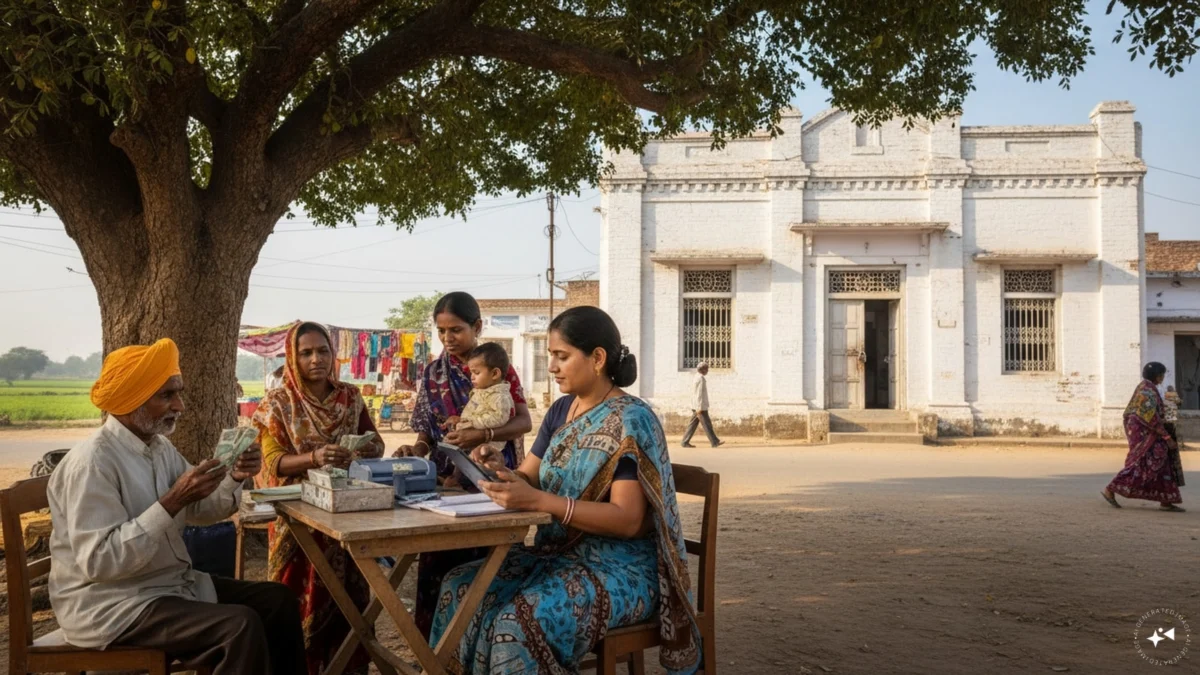
NEW DELHI — In the sprawling landscape of India’s modern economy, the traditional brick-and-mortar bank branch is no longer the sole anchor of financial services. Behind the grand facades of urban banking institutions lies a vast, decentralized army of grassroots financial intermediaries quietly transforming the country’s economic geography. Known as Business Correspondents (BCs), these authorized agents and service points have emerged as the beating heart of India’s last-mile banking infrastructure, penetrating deep into rural and semi-urban hinterlands where conventional banking has historically struggled to tread.
Recent data released by the Union Finance Ministry underscores the staggering scale of this transformation. As of July 17, 2026, India boasts an impressive network of more than 17.36 lakh (1.73 million) Business Correspondents. To put this monumental figure into perspective, it eclipses the country’s traditional bank branch network—standing at over 1.81 lakh branches—by a factor of more than nine. Furthermore, it dwarfs the roughly 1.65 lakh India Post Payments Bank (IPPPB) centers operating nationwide.
Driven by a combination of regulatory impetus, technological innovation, and aggressive government push for financial inclusion, this decentralized web of micro-outlets has brought nearly the entire nation into the formal banking fold. Government statistics reveal that an astonishing 6,008,68 out of India’s 601,328 inhabited villages—representing a near-universal 99.92%—now possess access to a banking outlet within a five-kilometer radius. This access is maintained through a synergistic blend of physical bank branches, post office payment centers, and, most prominently, the ubiquitous Business Correspondent network.
1. Main Facts: The Anatomy of India’s Last-Mile Banking Revolution
At its core, the Business Correspondent model is a regulatory framework designed to bridge the chasm between formal financial institutions and unbanked or underbanked populations. Authorized directly by banks under Reserve Bank of India (RBI) guidelines, a BC acts as an extended arm of the parent financial institution, authorized to deliver targeted banking services right to the doorstep of rural communities.
While traditional bank branches involve heavy capital expenditure, high operational costs, and immense infrastructural demands, the BC model thrives on agility. Operating out of local grocery stores, common service centers (CSCs), cooperative societies, or dedicated micro-kiosks, BCs eliminate the geographical frictions that have long plagued rural banking.
What Services Do Business Correspondents Provide?
The service palette of a Business Correspondent, while comprehensive for day-to-day needs, is tailored to routine transactions. Customers visiting a BC point can typically execute:
- Cash Deposits and Withdrawals: Allowing individuals to manage liquidity without undertaking expensive and time-consuming journeys to town centers.
- Balance Enquiries and Mini-Statements: Providing real-time visibility into account standings.
- Fund Transfers and Remittances: Facilitating domestic money transfers, which are vital for migrant workers sending money back to their families.
- Assisted Banking Services: Guiding digitally illiterate or first-time bank users through Aadhaar-enabled Payment Systems (AePS), Unified Payments Interface (UPI) micro-ATMs, and government direct benefit transfers (DBT).
However, the exact menu of services varies. Capabilities are dictated by the partner bank, technical connectivity at the outlet, hardware availability (such as biometric scanners and micro-ATM swiping machines), and local cash-holding limits.
2. Chronology: The Evolution of Financial Inclusion and the Rise of the BC Model
The journey toward universal financial inclusion in India did not happen overnight; it is the culmination of decades of policy shifts, technological leaps, and systemic reforms.
- Pre-2006 (The Era of Restricted Reach): For decades, India’s banking sector relied heavily on rural branch expansion mandates imposed on public sector banks. Despite these efforts, high setup costs restricted banks from opening viable branches in remote, sparsely populated villages, leaving millions dependent on informal moneylenders.
- 2006 (The Birth of the BC Guidelines): Recognizing the limitations of branch-led expansion, the Reserve Bank of India (RBI) formally permitted banks to utilize intermediaries—dubbed Business Correspondents and Business Facilitators—to provide banking and financial services. Initially restricted to non-governmental organizations (NGOs) and microfinance institutions, the framework was progressively liberalized to include retired bank employees, teachers, kirana (grocery) store owners, and corporate entities.
- 2014 (Pradhan Mantri Jan Dhan Yojana – PMJDY): The launch of PMJDY marked a monumental turning point. By opening hundreds of millions of zero-balance basic savings bank deposit accounts (BSBDA), the government created massive demand for last-mile cash-in/cash-out points. The BC network served as the logistical backbone required to service these accounts.
- 2018–2021 (The Fintech and Aadhaar Integration): Driven by the widespread adoption of the Aadhaar-enabled Payment System (AePS) and the proliferation of low-cost smartphones and affordable data, BC operations evolved. Manual ledger-keeping was replaced by instant biometric authentication, making transactions safer, faster, and more transparent.
- 2023–2026 (Consolidation and Universal Rural Coverage): By mid-2026, the BC count surged past 17.36 lakh. The focus shifted from merely opening bank accounts to driving active engagement, micro-credit, micro-insurance, and digital literacy through these last-mile agents, culminating in the milestone of 99.92% village banking coverage within a five-kilometer radius.
3. Supporting Data: The Numbers Behind the Network
To truly grasp the magnitude of India’s financial inclusion architecture, one must analyze the granular data released by the Union Finance Ministry:
| Indicator | Metric / Figure |
|---|---|
| Total Inhabited Villages in India | 601,328 |
| Villages with Banking Access (Within 5 km) | 600,868 (99.92%) |
| Total Business Correspondents (As of July 17, 2026) | 1,736,000+ (17.36 lakh) |
| Total Traditional Bank Branches | 181,000+ (1.81 lakh) |
| Total India Post Payments Bank Centres | ~165,000 |
| Ratio of BCs to Traditional Bank Branches | Greater than 9:1 |
The statistical divergence between traditional bank branches and BCs illustrates a profound structural shift. While bank branches remain critical hubs for large-scale corporate lending, complex regulatory compliance, and high-value transactions, the sheer density of the BC network—outnumbering branches by over nine times—ensures that the physical presence of the banking system is felt in virtually every corner of the country.
4. Official Responses and Industry Perspectives
The rapid expansion of the Business Correspondent ecosystem has drawn commentary from industry leaders, technology providers, and non-profit administrators, highlighting both the triumphs and operational realities of the model.
Addressing the structural challenges of rural banking, Ashish Misra, Deputy CEO of BLS E-Services, a prominent technology-enabled digital service provider, emphasized the psychological and physical distance the model seeks to eliminate.
"In rural areas, the real challenge is often not whether banking services exist, but how far customers must travel to reach them. A Business Correspondent operating in or near the village closes that gap," Misra noted.
By decentralizing points of service, tech-enabled BC networks reduce the opportunity cost for rural laborers, farmers, and artisans who previously had to forfeit a day’s wages and spend money on transport merely to update a passbook or withdraw government subsidies.
Meanwhile, institutional stakeholders are focusing heavily on quality control, standardization, and customer grievance redressal. D Tripathy, CEO and Director of BCRC, a New Delhi-headquartered non-profit organization dedicated to strengthening the BC ecosystem, underscored the ongoing collaborative efforts between networks and financial institutions.
"আমরা are engaging with our partner banks to ensure customers do not face any difficulties with banking services. Our BCs are also ensuring that necessary financial services are provided to the customers," Tripathy stated.
He reiterated that as transaction volumes through BC channels scale exponentially, maintaining rigorous oversight, ensuring adequate liquidity (cash availability) at remote kiosks, and preserving transactional security remain top priorities for network administrators.
5. Implications: What the BC Model Means for India’s Economic Future
The proliferation of over 17.36 lakh Business Correspondents carries profound implications for India’s macroeconomic trajectory, socio-economic fabric, and future financial architecture.
Redefining Financial Inclusion Beyond Account Opening
For years, financial inclusion was measured primarily by the number of bank accounts opened. However, an inactive account holds little economic value. The BC model has successfully transformed passive account holders into active participants in the formal economy. By facilitating regular deposits, withdrawals, and micro-remittances, BCs keep money circulating within formal financial channels rather than cash-under-the-mattress systems.
Empowering Assisted Digital Banking
While smartphone penetration in rural India is surging, a significant demographic—particularly the elderly, daily wage earners, and rural women—remains uncomfortable navigating complex mobile apps or internet banking portals. Business Correspondents provide a vital human bridge. Through assisted banking, BCs execute digital transactions on behalf of customers while explaining the mechanics, thereby fostering gradual digital and financial literacy at the grassroots level.
Limitations and the Myth of Branch Replacement
Despite their transformative impact, industry experts are quick to clarify that Business Correspondents are not—and cannot be—full replacements for traditional bank branches.
A BC outlet is an extension of a bank’s service network, designed for high-frequency, low-value retail transactions. Complex banking operations—such as comprehensive loan appraisal, specialized trade finance, high-value corporate banking, complex documentation, and legacy account interventions—still necessitate a physical visit to a conventional bank branch. Recognizing this distinction is crucial to managing customer expectations and designing realistic institutional policies.
Local Entrepreneurship and Employment Generation
Beyond banking services, the BC model acts as an engine for rural entrepreneurship. Many BCs are local shopkeepers or independent micro-entrepreneurs who earn commissions on every transaction processed. This supplementary revenue stream bolsters local retail businesses, incentivizes digital adoption at the merchant level, and generates localized employment opportunities for youth in semi-urban and rural areas.
Conclusion
India’s journey toward total financial inclusion is one of the most ambitious socio-economic experiments in modern history. The milestone of covering 99.92% of inhabited villages with banking access within a five-kilometer radius is a testament to the power of public-private synergy, regulatory foresight, and technological adaptability.
At the epicenter of this success story are the 17.36 lakh Business Correspondents. Operating out of remote villages, bustling weekly markets, and quiet rural outposts, these unsung financial foot soldiers have rewritten the rules of access. While challenges remain—ranging from connectivity dead zones and liquidity management to the need for continuous agent training—the BC network has fundamentally democratized banking in India, ensuring that no citizen is too remote to participate in the nation’s economic growth.



