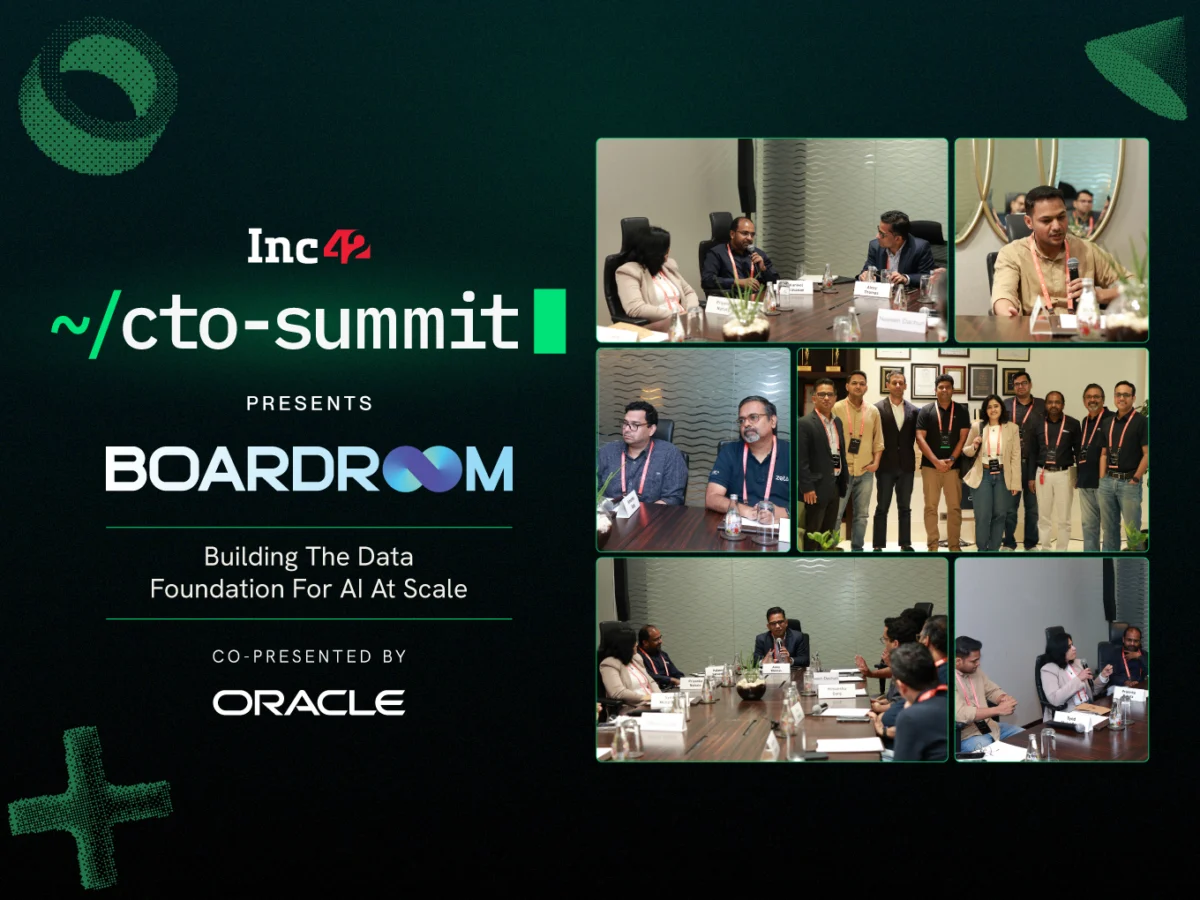
As the initial hype surrounding Generative AI begins to settle, Indian enterprises are hitting a sobering reality check: the "pilot purgatory." While early experiments with chatbots and productivity tools yielded quick wins, scaling AI to handle complex, mission-critical business processes requires far more than just plugging in a Large Language Model (LLM). It requires a fundamental overhaul of how data is stored, governed, and accessed.
At the recent CTO Summit 2026, hosted by Inc42 in partnership with Oracle, technology leaders gathered to address the central bottleneck of the AI era: the enterprise data foundation. The consensus was clear—fragmented data, a lack of semantic context, and porous access permissions are the primary barriers preventing businesses from moving AI from a "nice-to-have" novelty to a core engine of enterprise value.
The Core Challenge: Confronting Data Debt
For decades, enterprises have operated on a "silo-first" architecture. Departments like Finance, Sales, and Customer Support built their own specialized stacks, leading to a landscape where information is scattered across disparate SQL databases, legacy CRM systems, and unmanaged cloud storage.
When an AI agent is tasked with reasoning across these silos, it doesn’t just need access; it needs context. It needs to understand that a "customer ID" in the billing system refers to the same entity as "user profile" in the marketing platform. Without this, AI models suffer from hallucinations and superficial outputs.
The "4% Reality"
The scale of this challenge is underscored by recent data from Dun & Bradstreet. While 73% of Indian businesses report measurable returns from their early AI investments, a staggering 96% admit their data is not yet "fully ready" to support AI at scale. This "readiness gap" is essentially a result of accumulated data debt—decades of unstructured data, inconsistent naming conventions, and brittle integration layers that are ill-equipped for the real-time demands of autonomous AI agents.
Chronology of the Strategic Pivot
The roundtable discussion, moderated by Alexy Thomas, Partner, Technology Consulting at EY India, traced the evolution of how CTOs are now approaching AI infrastructure.
Phase 1: The "Outcome-First" Awakening
Historically, IT projects were driven by technology acquisition. Today, leaders like Gupta from Orchard Healthcare argue for a radical reversal: "The way we think about it is backwards. What is the problem to be solved?"
Gupta emphasized that his team’s recent customer data platform (CDP) project did not begin with a vendor selection, but with a six-month deep dive into how the tool would tangibly improve retention and customer understanding. This "Outcome-First" philosophy was echoed by Bilal from Perfios, who cautioned against the "tool-first" trap. "Start from an outcome focus and then figure out what to build," he advised, noting that the technology should be a consequence of the business requirement, not the driver.
Phase 2: The Platform-First vs. Use-Case-Led Debate
A recurring theme was the tension between building a bespoke solution for a single use case versus investing in a long-term, scalable platform. While use-case-led development offers faster time-to-market, it often creates "point-solution debt."
Murthy of Zeta provided a prescient counterpoint: "What AI gets in is that the use cases are no longer in your control." As AI agents proliferate, the number of use cases will grow faster than any centralized IT team can manage. Therefore, a platform-first approach—one that provides a unified, semantic-rich foundation—is becoming an insurance policy against future unpredictability.
Technical Implications: The Rise of the Semantic Layer
The roundtable highlighted that raw database connectivity is no longer sufficient. Agents need to understand the "what" and the "why" behind the data.
Palanivel from Oracle illustrated the complexity of connecting agents to polyglot environments containing Oracle, MySQL, PostgreSQL, and MongoDB. "The semantic layer is becoming mandatory to support the reasoning for the agent," he stated. By encoding business logic, relationships, and constraints directly into a semantic layer, enterprises can provide a "map" that allows agents to navigate complex data structures without constant human hand-holding.
Furthermore, this layer serves as a filter. By narrowing the scope of information an agent must search, the semantic layer improves the accuracy of retrieval and significantly reduces the computational overhead—a key factor in maintaining cost-efficiency.
Governance and Access: The "Bank A to Bank B" Dilemma
As AI moves into production, governance has shifted from a compliance checklist to a critical technical requirement. Saxena from InterviewBit & Scaler posed the quintessential ethical and legal question: "If a model learns from Bank A’s data, can that knowledge be used for Bank B?"
This is not just a regulatory concern but a fundamental architectural one. When building AI systems, enterprises must implement:
- Knowledge Isolation: Ensuring that models do not inadvertently train on proprietary data across different business units or clients.
- Agent Harnessing: As discussed by Garg of Kapture CX, organizations cannot stop employees from using frontier models. Therefore, the focus must shift to building "agent harnesses"—wrappers around AI tools that enforce guardrails, conduct automated testing, and monitor for unauthorized data access.
The Economics of AI: Balancing Value vs. Cost
Perhaps the most pragmatic portion of the discussion centered on the "Economics of AI." Dachuri from Yulu pointed out that internal AI tools allow for budget predictability, but customer-facing AI is a different beast entirely.
Strategies for Economic Viability:
- Right-Sizing the Model: Not every query requires a GPT-4 or Claude 3.5. Kapture CX reported success in using smaller, open-weight models for predictable, repetitive tasks like order-status queries, while reserving frontier models for high-level reasoning.
- Measurable ROI: Companies are now building models to calculate the ROI of AI by tracking "manual touchpoint reduction." If an AI agent saves a support agent 30 seconds per ticket, that time-saved value must exceed the API costs of the inference.
- Predictable Cost Structures: Organizations are increasingly pivoting toward open-weight models that provide greater cost transparency compared to the "black box" pricing of proprietary frontier models.
Looking Ahead: The Foundation for the Future
The path to "AI at Scale" is not a sprint; it is an architectural marathon. As the CTO Summit 2026 roundtable concluded, the successful enterprise of tomorrow will be the one that treats data not as a static asset, but as an active, governed, and semantic-rich foundation.
To move beyond the 4% readiness threshold, Indian enterprises must prioritize:
- Decoupling Strategy: Separating the "reasoning layer" (the AI models) from the "data layer" (the semantic foundation).
- Governance-by-Design: Embedding access controls and testing frameworks into the AI pipeline from day one.
- Economic Discipline: Treating every AI deployment as a profit-and-loss (P&L) unit, ensuring that the cost of inference never outpaces the value of the outcome.
The era of "AI experimentation" is coming to a close. We are now entering the era of "AI engineering," where the winners will be defined by their ability to harmonize messy, fragmented legacy data with the immense potential of autonomous agents. The technology is ready, but as the leaders at the CTO Summit proved, the infrastructure must be earned.